
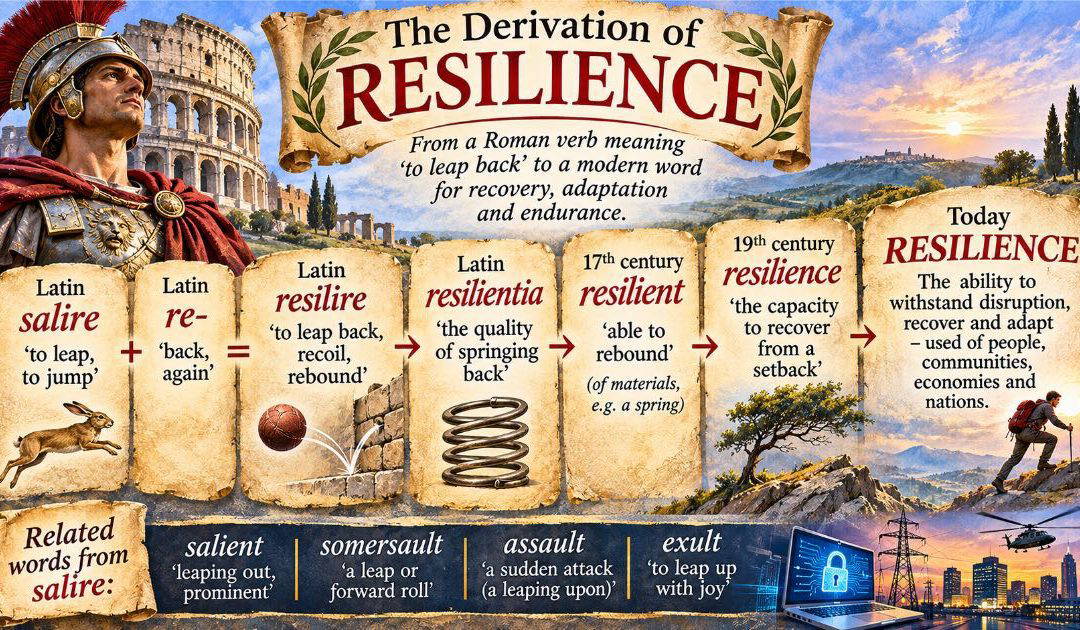
As we might expect, the word resilience has a history stretching back more than two thousand years to ancient Rome. Today, it describes the ability to recover from adversity, but its original meaning was much more physical: to leap or spring backwards.
The word derives from the Latin verb resilire, formed from the prefix re-, meaning ‘back’, and salire, meaning ‘to leap or jump’. Thus, resilire literally meant ‘to jump back’, ‘recoil’ or ‘rebound’. The related Latin noun resilientia expressed the quality of springing back.
The Romans used resilire to describe physical movements, such as something bouncing backwards after striking an obstacle. The underlying image was not of resisting a force, but of responding to it by returning or recoiling.
The word entered English during the seventeenth century. Its earliest recorded uses retained this physical sense of rebounding or springing back. The adjective resilient appeared in English before the noun resilience, which became established during the nineteenth century.
As scientific understanding developed, resilience acquired a more specialised meaning. Engineers and physicists used it to describe the capacity of a material to absorb energy when deformed and release that energy as it returned towards its original shape. A spring, for example, demonstrates resilience when compressed and subsequently released.
During the nineteenth century, the word increasingly acquired figurative meanings. People, communities and institutions could be described as resilient when they recovered from setbacks, disappointments or disasters.
In the twentieth century, psychologists adopted resilience to describe the capacity of individuals to adapt successfully to adversity, trauma or significant stress. Importantly, psychological resilience does not necessarily mean returning unchanged to an earlier condition. It can involve learning, adaptation and personal growth.
More recently, resilience has become prominent in politics, economics and national security. Governments discuss economic resilience, energy resilience, cyber resilience and the resilience of critical infrastructure. In these contexts, the word describes the ability of systems to withstand disruption, maintain essential functions and recover afterwards.
The Latin root salire has also contributed to several other English words, including salient, originally meaning ‘leaping’, and somersault, which ultimately derives from Latin expressions involving jumping.
There is something particularly evocative about the word’s evolution. What began as a description of an object bouncing backwards has become a defining quality of human endurance.
Resilience is not simply the ability to withstand a blow, but the capacity to recover, adapt and move forward again.