
I have posted about my career as a civil engineer. Thomas Telford was the first president of the Institution of Civil Engineers and he was born on the 8th of August 1757. He was one of the greatest civil engineers of the Industrial Revolution, a man whose roads, bridges, canals, and harbours transformed the landscape of Britain in the late eighteenth and early nineteenth centuries. Born into poverty in 1757 in the remote parish of Westerkirk in Dumfriesshire, Scotland, Telford rose through intelligence, determination, and practical skill to become one of the most respected engineers of his age. His achievements earned him the nickname “The Colossus of Roads,” and his influence on transport and infrastructure can still be seen throughout Britain today.
Telford’s father, a shepherd, died shortly after his birth, leaving the family in difficult circumstances. Raised by his mother, Telford received only a modest education at the local parish school. Like many boys of humble origins, he entered a trade at an early age and was apprenticed to a stonemason. This practical training proved invaluable. He learned not only the techniques of cutting and laying stone but also the discipline and precision required in construction work.
As a young man Telford travelled widely in search of employment, working first in Edinburgh and later in London. In the capital he helped with masonry work on important buildings, including additions to Somerset House. Yet Telford was unusually ambitious for a craftsman of his background. He educated himself by reading extensively in architecture, mathematics, and engineering. He also wrote poetry and took an interest in literature, unusual pursuits for a manual labourer of the period.
His career changed dramatically in the 1780s when he was appointed Surveyor of Public Works for Shropshire. This role gave him responsibility for roads, bridges, and public buildings in the county. It was here that he began to demonstrate the innovative thinking that would make his reputation. At a time when many roads in Britain were muddy, poorly drained tracks, Telford insisted on careful surveying, strong foundations, and proper drainage systems. His roads were smoother, stronger, and more durable than many of those built by his contemporaries.
One of Telford’s earliest major triumphs was the construction of the Pontcysyllte Aqueduct in north Wales, completed in 1805. Built to carry the Ellesmere Canal across the River Dee valley, the aqueduct was a masterpiece of engineering. It used cast iron troughs supported on tall stone piers, an innovative design that astonished contemporaries. Even today it remains one of the most remarkable canal structures in the world. The success of the aqueduct established Telford as a national figure.
Telford worked during a period when Britain’s rapidly expanding industries required better transport networks. Factories needed raw materials and efficient methods of distributing goods. The movement of people and information was also becoming increasingly important. Telford played a central role in creating the infrastructure that supported this economic transformation.
His road-building projects were especially significant. He designed and improved hundreds of miles of roads across Britain, including routes through the rugged Highlands of Scotland. Before Telford’s interventions, many Highland communities were isolated and difficult to reach. Under government commissions he supervised the construction of roads, bridges, and canals intended to stimulate trade and strengthen political control after the Jacobite rebellions. These works connected remote regions more closely to the rest of Britain and encouraged economic development.
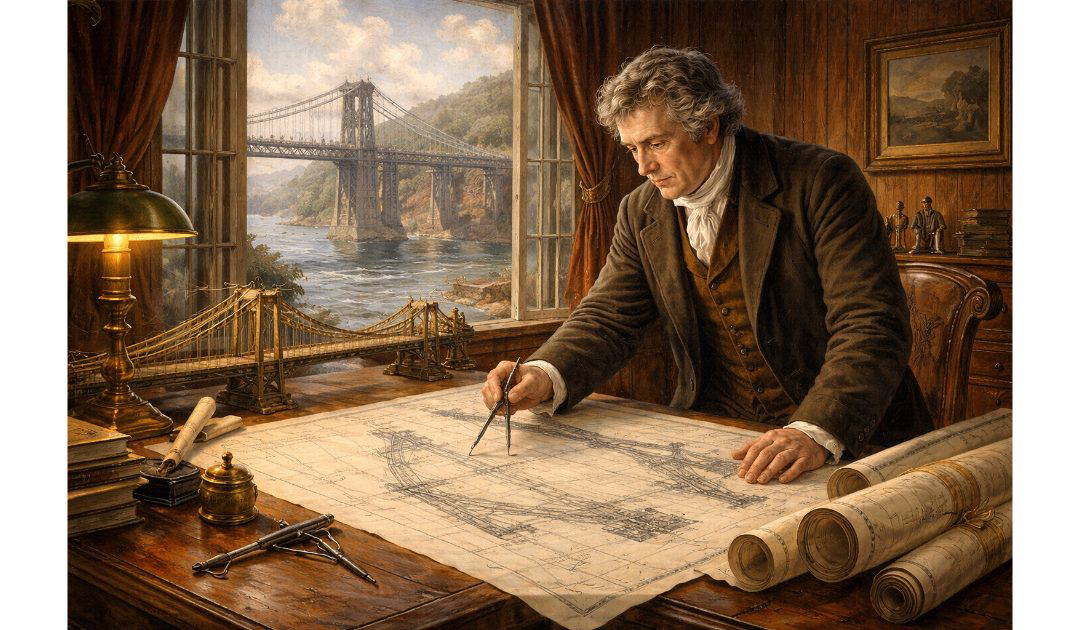
Among his most famous achievements was the Menai Suspension Bridge, completed in 1826. The bridge crossed the Menai Strait between mainland Wales and the island of Anglesey, carrying the vital road to the port of Holyhead, from which packets sailed to Ireland. Before the bridge, crossing the strait could be dangerous and unreliable. Telford designed an elegant suspension bridge with a central span of over 500 feet, then one of the longest in the world. The structure combined beauty with technical daring and became a symbol of modern engineering skill.
Telford also improved harbours and ports, recognising their importance to trade and communication. He worked on projects at Aberdeen, Dundee, and elsewhere, constructing piers and breakwaters to make navigation safer. His understanding of practical engineering problems was exceptional, and he paid close attention to the details of materials, weather, and local geography.
Although he is best remembered as an engineer, Telford was also an able administrator and organiser. Large engineering projects required the coordination of labourers, surveyors, financiers, and government officials. Telford’s reliability and calm judgement won him widespread trust. He became the first president of the Institution of Civil Engineers in 1820, helping establish engineering as a recognised profession rather than merely a skilled trade.
Personally, Telford was known for modesty, kindness, and tireless energy. Despite his fame, he never lost sympathy for ordinary working people, perhaps because of his own humble beginnings. He maintained friendships with writers and intellectuals, including the poet Robert Southey, and continued writing poetry throughout his life.
By the time of his death in 1834, Thomas Telford had transformed the physical landscape of Britain. His roads linked distant towns and regions, his bridges crossed rivers and straits once considered formidable obstacles, and his canals and harbours supported commerce during the Industrial Revolution. Many of his works remain in use today, testifying to the quality and durability of his engineering.
Telford’s legacy extends beyond the structures he built. He helped define civil engineering as a profession grounded in scientific knowledge, practical skill, and public service. In doing so, he became one of the key architects of modern Britain.