
I know, Remembrance Day was the 11th of November, and Remembrance Sunday was the eighth, but “lest we forget”.
The word remembrance has a rich and evocative history, stretching back through medieval French to the Latin. Its development reveals how the simple act of remembering became associated with affection, loyalty, mourning and the commemoration of those who have died.
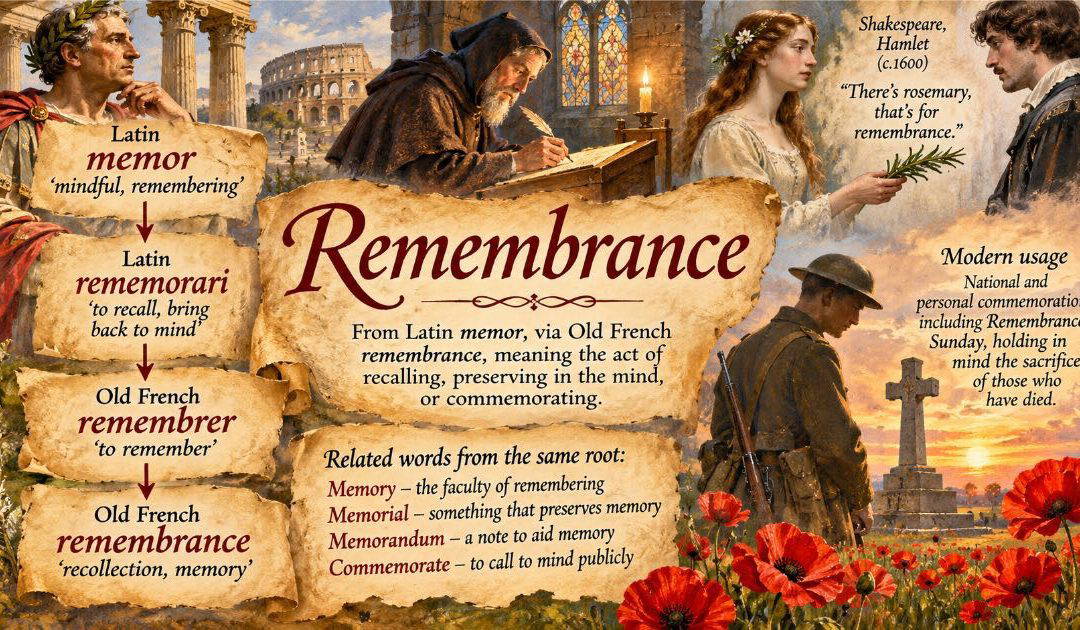
The English word remembrance entered the language during the Middle English period, around the fourteenth century. It was borrowed from Old French remembrance, meaning recollection, memory or the act of calling something to mind. The French noun derived from the verb remembrer, meaning to remember, which itself developed from the Latin rememorari, meaning to recall or bring back to memory.
At the heart of this linguistic family lies the Latin word memor, meaning mindful or remembering. From the same root come numerous familiar English words, including memory, memorial, memorandum and commemorate. The last derives from Latin commemorare, meaning to call to mind or make mention of.
Interestingly, the prefix re- in rememorari conveys the idea of repetition or returning. Thus, remembrance suggests bringing something back into the mind, rather than merely possessing knowledge of it.
In medieval England, remembrance carried several meanings. It could describe personal recollection, a reminder, or a keepsake intended to preserve someone’s memory. It also acquired religious significance, particularly in prayers for the dead and the Christian obligation to remember Christ’s sacrifice.
By the sixteenth and seventeenth centuries, remembrance had become closely associated with affection and fidelity. To hold someone in remembrance was to preserve their presence in one’s thoughts, even when separated by distance or death.
Shakespeare employed the word memorably in Hamlet, when Ophelia offers rosemary to Laertes, declaring, “There’s rosemary, that’s for remembrance.” Rosemary had long been associated with memory and fidelity, particularly at weddings and funerals.
The word acquired an especially solemn national significance following the First World War. The unprecedented scale of death transformed remembrance into a collective act of mourning and gratitude. Armistice Day, first observed in 1919, and the subsequent traditions of Remembrance Sunday established the word firmly within British public life.
Today, remembrance embraces both private memory and public commemoration. Unlike the more neutral word recollection, it frequently implies emotional attachment and a conscious determination not to forget.
Its linguistic journey, from Latin memor through medieval French into modern English, illustrates a profound human impulse: to preserve the past within the present, ensuring that people, experiences and sacrifices are not lost to time.