
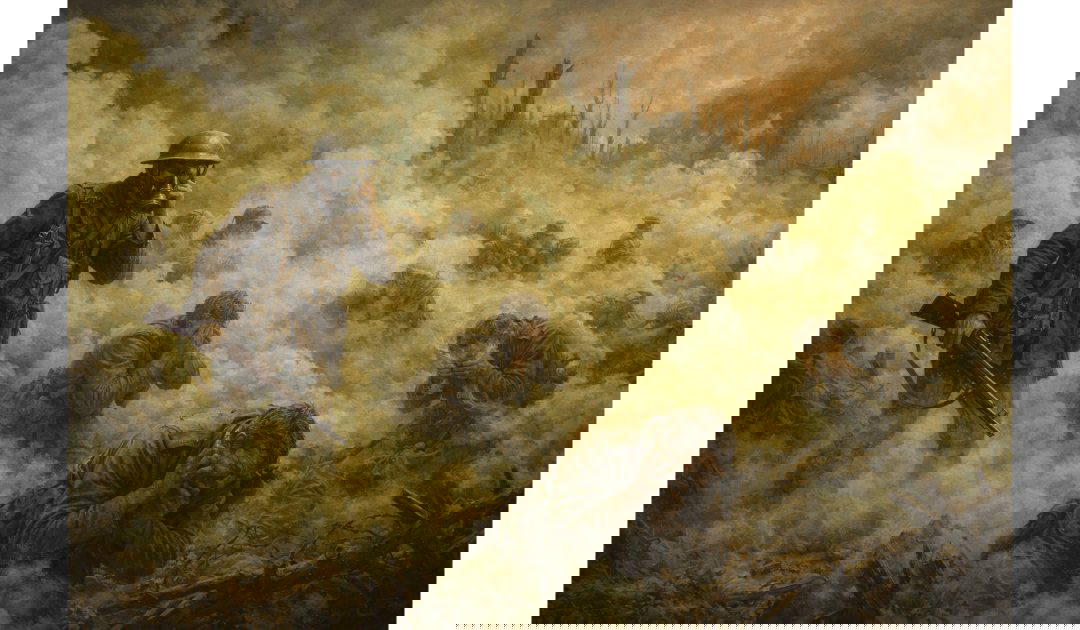
On the 22nd of April, 1915, chlorine gas was first used as a chemical weapon in the Second Battle of Ypres. I have written about The third Battle of Ypres, also known as Passchendaele.
In ancient times, armies occasionally sought to poison wells, contaminate food supplies, or use smoke and fumes in sieges. The Greeks and Romans knew of sulphur fumes as a choking agent, and there are accounts of burning pitch and resin to produce noxious smoke in confined spaces. During medieval sieges, defenders and attackers alike sometimes used toxic smoke from burning materials to drive enemies from tunnels or fortifications. These early efforts were crude and unreliable, but they reveal a longstanding awareness that air itself could be turned into a weapon.
The true transformation came with the rise of modern chemistry in the nineteenth century. Industrial processes allowed the large-scale production of chemicals, and scientific understanding of gases and their physiological effects grew rapidly. By the early twentieth century, European powers possessed both the knowledge and the means to weaponise toxic chemicals. Although international agreements such as the Hague Conventions of 1899 and 1907 attempted to prohibit the use of poison and poisoned weapons, the pressures of total war soon overrode these restraints.
The First World War marked the birth of modern chemical warfare. The stalemate of trench warfare on the Western Front led commanders to search for new methods to break enemy lines. Germany was the first to deploy chemical gas on a large scale. On the 22nd of April, 1915, during the Second Battle of Ypres in Belgium, German forces released approximately 168 tons of chlorine gas from thousands of cylinders along their front line. A favourable wind carried the greenish-yellow cloud toward French and Algerian troops. The results were devastating. Soldiers, unprepared and unprotected, experienced burning lungs, choking, blindness, and panic. Thousands fled; many died where they stood.
Chlorine was chosen not because it was the most lethal gas available, but because it was abundant, cheap, and easy to produce as a by-product of the chemical industry. Chlorine attacks the respiratory system, forming hydrochloric acid when it contacts the moisture in the lungs. Victims feel as though they are drowning, their lungs filling with fluid. Though not always immediately fatal, it inflicted terror and severe injury, which was itself a strategic objective.
The shock of Ypres did not end chemical warfare; it escalated it. Within months, both sides developed their own gas capabilities. Gas masks were issued, and scientists worked feverishly to create more effective agents. Phosgene, introduced later in 1915, was far deadlier than chlorine and responsible for many more deaths. Mustard gas, first used in 1917, caused severe blistering of the skin and lungs and could linger in the environment for days. Chemical warfare became a grim arms race, with each side seeking more potent and insidious agents.
By the end of the war, an estimated 90,000 soldiers had died from gas exposure, and over a million had been injured. Although gas rarely achieved decisive military breakthroughs, its psychological impact was enormous. The fear of an invisible, suffocating death haunted soldiers and civilians alike and left a deep moral scar on public consciousness.
After the war, there was widespread revulsion at the use of chemical weapons. This led to the Geneva Protocol of 1925, which prohibited the use of chemical and biological weapons in war. However, the protocol did not forbid their production or stockpiling, and many countries continued to research and store such weapons.
Chemical weapons did not disappear between the wars. Italy used mustard gas against Ethiopian forces in the 1930s. Japan employed chemical agents in China. During the Second World War, all major powers possessed large stockpiles, including new nerve agents developed by Germany, such as tabun and sarin. Yet, in Europe at least, they were not used on the battlefield, largely due to fear of retaliation in kind.
The post-war period saw further development of nerve agents, which were far more lethal than chlorine or mustard gas. During the Cold War, vast chemical arsenals were maintained by both NATO and Warsaw Pact nations. Meanwhile, chemical weapons were used in regional conflicts, most notoriously by Iraq during the Iran–Iraq War in the 1980s and against Kurdish civilians at Halabja.
International efforts to eliminate chemical weapons gained momentum in the late twentieth century. The Chemical Weapons Convention (CWC), which came into force in 1997, went beyond earlier agreements by banning the development, production, acquisition, stockpiling, and use of chemical weapons. It also established a verification regime and required the destruction of existing stockpiles under international supervision.
Despite these efforts, chemical weapons have not entirely vanished. Their use in the Syrian civil war and in isolated terrorist incidents has demonstrated that the threat remains.
Chlorine gas, though relatively simple compared to later agents, remains emblematic of chemical warfare. It was the first gas to be used on a massive scale and symbolises the moment when industrial science was turned toward poisoning the air itself. Its legacy is not only historical but moral, a reminder of how technological progress can be harnessed for profound cruelty.