
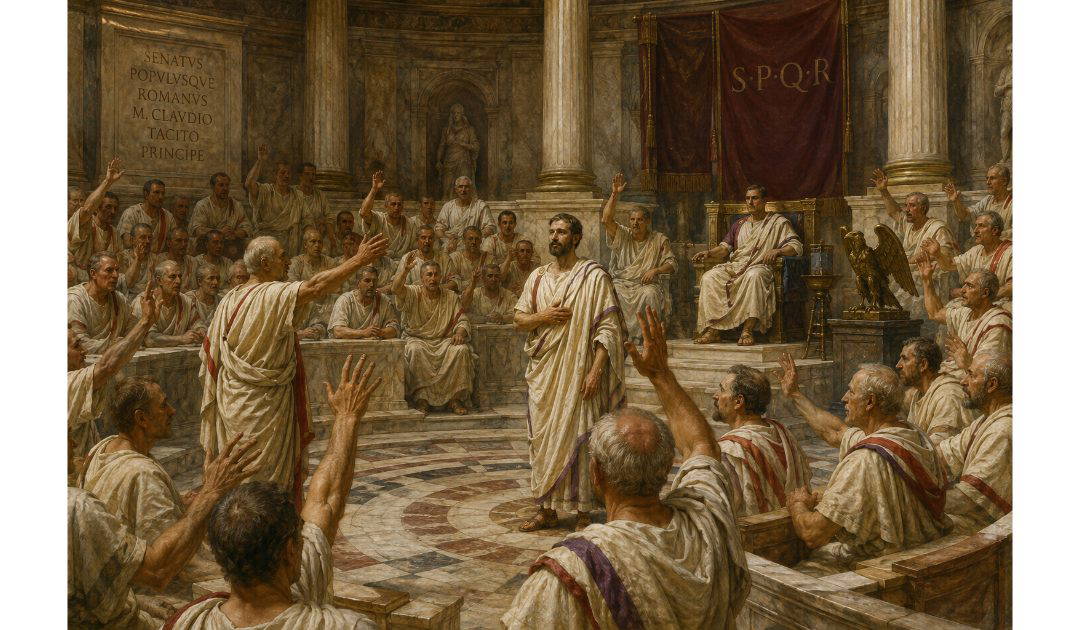
On the 25th of September, 275CE, the Roman Senate chose, for the last time, Marcus Claudius Tacitus as emperor. I have written about several Roman Emperors, of whom Octavian was the first. We seem to be approaching the end now.
Marcus Claudius Tacitus was Roman emperor for only a few months, yet his reign marked an important moment in the recovery of the Roman Empire after decades of instability. Although he ruled from late AD 275 until the middle of AD 276, Tacitus was remembered by later historians as an elderly senator who attempted to restore dignity to imperial government after the assassination of Emperor Aurelian. His brief reign came during the turbulent period known as the Crisis of the Third Century, when the empire was threatened by foreign invasions, civil wars, economic disruption, and rapid changes of emperor.
Very little is known with certainty about Tacitus’s early life. He was probably born around AD 200, making him one of the oldest men ever to become Roman emperor. His family was probably of senatorial rank, and he had enjoyed a long career in public service before ascending the throne. Later writers claimed that he was descended from the famous Roman historian Publius Cornelius Tacitus, but modern historians generally regard this as an invention intended to enhance his prestige. Whether or not there was any connection, Tacitus himself reportedly admired the historian’s works and encouraged their preservation by ordering copies to be made for public libraries.
The circumstances of his accession were highly unusual. Emperor Aurelian, one of Rome’s greatest soldier-emperors, was murdered by his own officers in AD 275 while preparing for a campaign against Persia. His death left the empire temporarily leaderless. Rather than immediately proclaiming another military commander, the army appears to have consulted the Roman Senate. After several months of uncertainty, the Senate selected Tacitus as emperor, perhaps because of his advanced age, respectable reputation, and lack of obvious political enemies.
Tacitus accepted the purple reluctantly, according to later accounts, although such stories were common literary devices used to portray emperors as modest. Once in office, he sought to demonstrate respect for traditional Roman institutions. He restored certain honours to the Senate and attempted to emphasise that the emperor ruled in cooperation with Rome’s ancient governing body rather than solely through military power. This policy reflected the hopes of many senators that the empire might return to a more constitutional style of government after decades dominated by the army.
Despite these intentions, Tacitus could not avoid the military realities of the third century. The Roman Empire remained under constant pressure from barbarian peoples along its frontiers. Soon after his accession, reports arrived that Gothic tribes, together with allied Heruli and other groups from around the Black Sea, had invaded Asia Minor. These raiders had crossed the Black Sea and devastated parts of Pontus, Cappadocia, Galatia, and Cilicia, looting cities and carrying away captives.
Although already elderly, Tacitus personally led an army eastwards to confront the invaders. His forces achieved several victories, defeating bands of the raiders and recovering prisoners and plunder. These successes earned him the honorary title Gothicus Maximus, indicating victory over the Goths. Much of the remaining fighting was conducted by his capable half-brother, Florianus, who held high military command and played a significant role in restoring order in the eastern provinces.
Tacitus also continued many of Aurelian’s administrative and monetary policies. The empire’s finances remained fragile after years of warfare and inflation, and there was little opportunity for sweeping reforms during his short reign. Coins issued in his name survive in considerable numbers and depict him wearing military dress, emphasising that, despite his senatorial background, he remained commander of the Roman armed forces. These coins were struck across several imperial mints, demonstrating that his authority was recognised throughout the empire.
His reign ended abruptly in AD 276 after only about six months. Ancient sources disagree about the cause of his death. Some claim he died of illness or fever while campaigning in Asia Minor, perhaps exhausted by the hardships of military life at an advanced age. Others allege that he was assassinated by mutinous soldiers or officers. Modern historians generally consider death from natural causes slightly more likely, although the evidence is too limited to be certain.
After Tacitus’s death, Florianus immediately proclaimed himself emperor, hoping to secure the succession. However, his rule lasted only a few months before he was challenged by the experienced general Marcus Aurelius Probus. Florianus was abandoned by his troops and killed, allowing Probus to become emperor and continue the restoration of imperial stability.
Marcus Claudius Tacitus is not ranked among Rome’s greatest rulers, largely because his reign was too brief to leave a lasting institutional legacy. Nevertheless, his accession demonstrated that the Senate still retained symbolic importance, even during an age when military power usually determined the succession. His willingness to lead troops personally, despite his advanced age, also reflected the expectations placed upon every Roman emperor. Though overshadowed by Aurelian before him and Probus after him, Tacitus occupies an important place in Roman history as a transitional figure whose short reign helped maintain continuity during one of the empire’s most uncertain periods.