
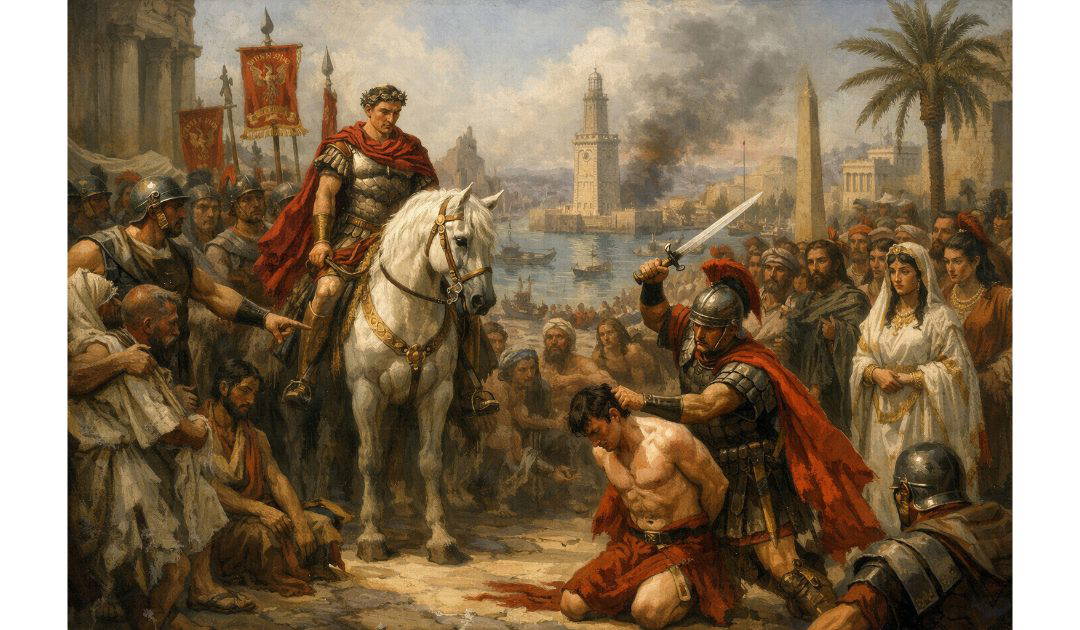
On the 1st of August 30 BCE Octavian, the first Roman emperor, entered Alexandria and executed Marcus Antonius Antyllus, the son of Mark Antony by his third wife, Fulvia, who had travelled with his father to Alexandria and lived there with him and Cleopatra.
Augustus—born Gaius Octavius in 63 BCE—was the founder of the Roman Empire and its first emperor, ruling from 27 BCE until his death in 14 CE. His life marks the decisive turning point between the chaotic final years of the Roman Republic and the long stability of imperial rule.
Octavius was born into a relatively modest but well-connected equestrian family. His great-uncle was Julius Caesar, one of the most powerful figures in Roman history. Although not initially destined for greatness, Octavius came to prominence through this connection. When Caesar was assassinated in 44 BCE, his will revealed that he had adopted Octavius as his son and principal heir. At just 18 years old, Octavius suddenly found himself thrust into a dangerous political world.
Rome at this time was unstable, riven by factional violence and civil war. Octavius moved quickly and shrewdly. He formed an alliance with Mark Antony and Marcus Aemilius Lepidus, creating the Second Triumvirate in 43 BCE. This three-man dictatorship allowed them to defeat Caesar’s assassins, notably at the Battle of Philippi in 42 BCE. However, the alliance was always uneasy, and tensions eventually led to further conflict.
Octavius proved himself not just a political survivor but a master strategist. He gradually outmaneuvered Lepidus and forced him into retirement, leaving the Roman world divided between himself in the West and Antony in the East. Antony’s alliance and romantic involvement with Cleopatra VII, Queen of Egypt, alarmed many Romans, who saw it as a betrayal of Roman values. Octavius exploited this fear brilliantly, presenting himself as the defender of Rome against eastern decadence.
The rivalry culminated in the Battle of Actium in 31 BCE, a decisive naval engagement off the coast of Greece. Octavius’s forces, commanded by his able general Marcus Agrippa, defeated Antony and Cleopatra. The following year, both Antony and Cleopatra died, and Egypt fell under Roman control. With this victory, Octavius became the unchallenged ruler of the Roman world.
Despite his absolute power, Octavius understood that Romans deeply distrusted kingship. In 27 BCE, he carried out a careful political settlement often called the First Settlement. He ostensibly “restored” the Republic to the Senate and people, while in reality retaining ultimate authority. In recognition, the Senate granted him the honorific title “Augustus,” meaning “the revered one.” From this point, he is generally known as Augustus.
Augustus’s genius lay not only in winning power but in maintaining it. He established a system later called the Principate, in which he ruled as “first citizen” rather than overt monarch. This allowed him to preserve republican forms while exercising imperial control. He reorganized the army, creating a standing professional force loyal to the state, and established the Praetorian Guard as his personal bodyguard.
His reign ushered in a long period of relative peace and stability known as the Pax Romana. Augustus undertook extensive building projects, famously claiming that he found Rome a city of brick and left it a city of marble. He reformed taxation, improved infrastructure, and promoted economic growth across the empire. His administration brought efficiency and order to a vast and diverse territory.
Augustus was also deeply concerned with Roman morals and traditions. He enacted laws encouraging marriage and childbirth among the upper classes, and sought to revive traditional religious practices. At the same time, he was a master of propaganda. Through literature, art, and monuments, he cultivated an image of himself as a benevolent and divinely favored ruler. Poets like Virgil and Horace celebrated his achievements, helping to shape his legacy.
Personally, Augustus was known for his careful, sometimes cautious temperament. He suffered from poor health throughout his life, yet demonstrated remarkable endurance and discipline. He was not a flamboyant battlefield commander like Caesar, but he excelled in political calculation and long-term planning. His reliance on capable allies, especially Agrippa, was another key to his success.
Succession was one of Augustus’s greatest challenges. Lacking a direct male heir, he maneuvered through a series of adoptions and marriages within his family. Ultimately, he designated his stepson Tiberius as his successor. When Augustus died in 14 CE, he was deified by the Senate.
Augustus’s legacy is immense. He transformed Rome from a fractured republic into a stable empire that would endure for centuries. His political system, though imperfect, provided a framework for governance that balanced tradition with innovation. Later emperors would struggle to match his skill and restraint, but his model remained influential.