
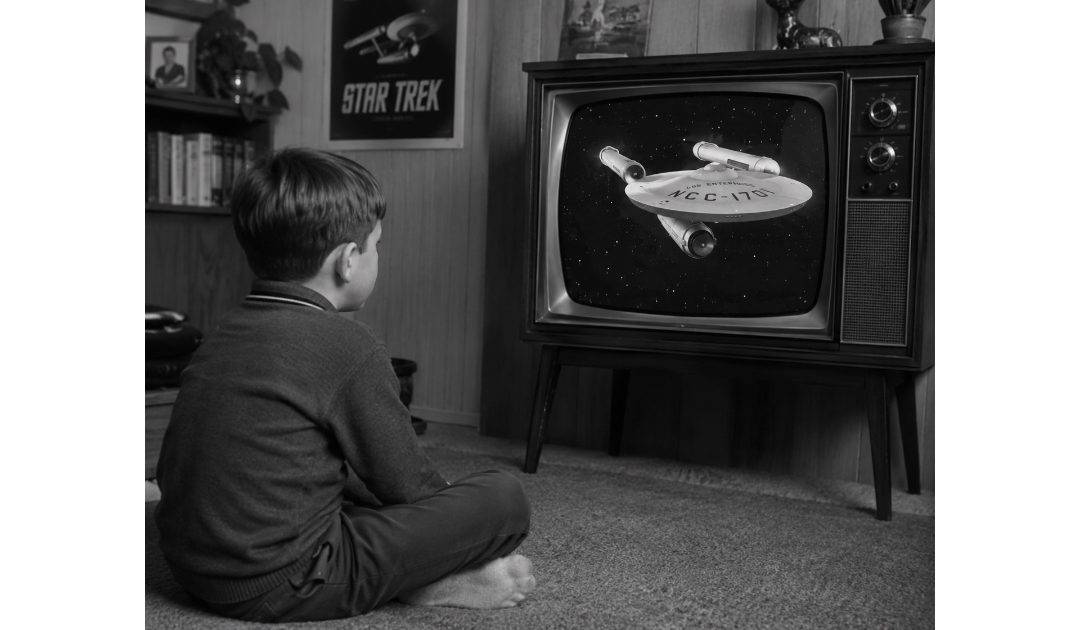
On the 8th of September,1966, the first episode of Star Trek was shown It was titled The Man Trap. I have always been a great fan of Star Trek. I quite enjoyed Doctor Who, but if I had to make a choice, it would be Star Trek every time.
Conceived by Gene Roddenberry, the original television series first aired in 1966. Although it initially lasted only three seasons, its imaginative vision of the future, memorable characters and optimistic philosophy won a devoted following. Over the decades, Star Trek has grown into a cultural phenomenon that has inspired generations of scientists, engineers, astronauts and writers.
The original series follows the voyages of the starship USS Enterprise under the command of James T. Kirk. Accompanied by his loyal first officer Spock, a half-human and half-Vulcan science officer, the ship’s chief medical officer Leonard ‘Bones’ McCoy, and Scotty “she canna take anymore cap’n the engineer Kirk explores strange new worlds, encounters alien civilisations and confronts moral dilemmas. The series’ famous opening declaration—to explore “strange new worlds, to seek out new life and new civilisations, to boldly go where no man has gone before”—perfectly captures its spirit of exploration.
Unlike much science fiction of the Cold War era, Star Trek presented a hopeful future. Humanity had overcome poverty, racism and many of the divisions that had plagued earlier centuries. Earth was united within the United Federation of Planets, an interstellar alliance devoted to peace, diplomacy and scientific progress. While conflict still existed, especially with rival powers such as the Klingon and Romulan Empires, the Federation generally sought cooperation rather than conquest.
One of Star Trek’s defining principles is the Prime Directive, a rule preventing Starfleet officers from interfering in the natural development of less advanced civilisations. Many episodes revolve around the ethical challenges posed by this principle, forcing characters to weigh compassion against respect for another society’s independence.
Following the success of the original series in syndication, Star Trek expanded dramatically. A series of feature films beginning in 1979 reunited the original cast and introduced spectacular visual effects. Several of these films, particularly Star Trek II: The Wrath of Khan, are regarded as classics of the science-fiction genre.
Television returned in 1987 with Star Trek: The Next Generation, set roughly a century after Kirk’s adventures. The new USS Enterprise, commanded by Jean-Luc Picard, became equally beloved. Picard’s thoughtful, diplomatic leadership contrasted with Kirk’s more instinctive style, while characters such as Data, an android striving to become more human, explored questions about consciousness, identity and artificial intelligence.
The success of The Next Generation led to further television series including Star Trek: Deep Space Nine, which focused on politics, religion and war aboard a space station; Star Trek: Voyager, following a stranded starship attempting to return home across the galaxy; and Star Trek: Enterprise, depicting humanity’s earliest ventures into deep space before the founding of the Federation.
In recent years, the franchise has expanded again with series such as Star Trek: Discovery, Star Trek: Picard, Star Trek: Strange New Worlds and several animated productions. These newer programmes have introduced Star Trek to new audiences while continuing to develop its rich fictional universe.
The technology imagined in Star Trek has often anticipated real-world inventions. Handheld communicators resemble modern mobile phones, tablet computers echo the show’s portable data devices, and voice-activated computers foreshadow today’s digital assistants. Although technologies such as warp drive and transporters remain fictional, the franchise has inspired many engineers and researchers to pursue careers in science and technology.
Star Trek is also celebrated for its progressive social outlook. The original series featured one of the first multicultural casts on American television, including a Russian officer during the Cold War, an Asian helmsman and a Black female communications officer. The famous interracial kiss between Captain Kirk and Lieutenant Uhura was groundbreaking for American television and reflected the show’s commitment to challenging social barriers.
The franchise has developed an enormous and dedicated fan community. Enthusiasts attend conventions around the world, build detailed model starships, learn the Klingon language and discuss every aspect of the fictional universe. The longevity of Star Trek owes much to this passionate fan base, which has sustained interest across six decades.
Ultimately, Star Trek endures because it combines exciting adventure with thoughtful ideas. It asks profound questions about humanity’s future, ethics, exploration and cooperation while remaining entertaining and accessible.