
As I choose my word for the day, riots are taking place in France against hardship in schools and the cost of living. I like to be a few days ahead of myself for when I may not have the time to write a post. So whilst I sincerely hope the disorder in France will have been been resolved, I fear the word will still be news somewhere.
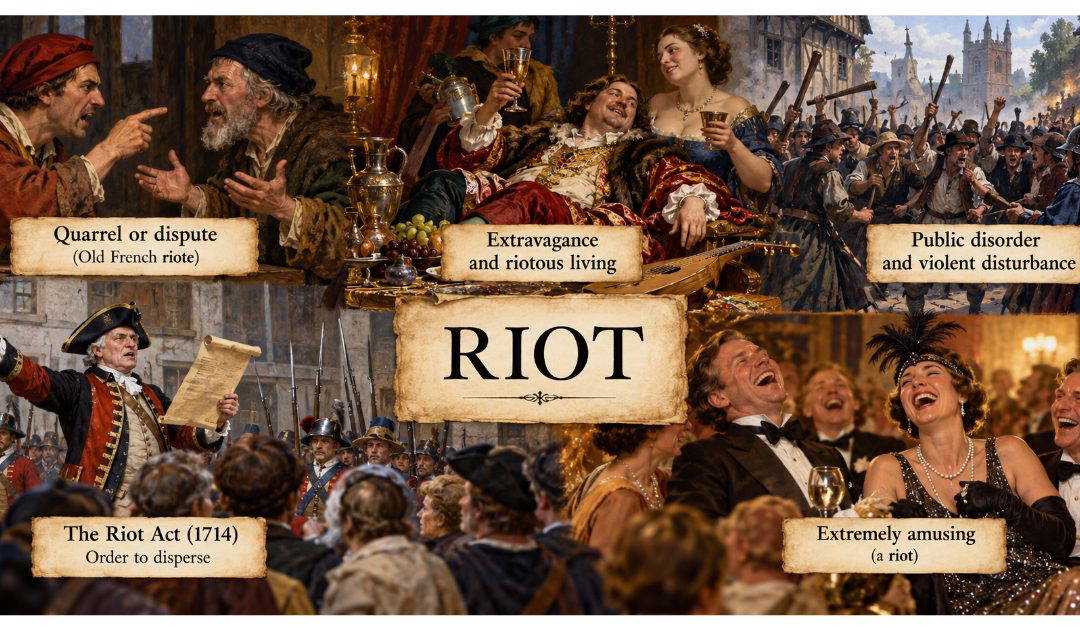
The word riot has a surprisingly colourful history, beginning not with violence or civil disorder, but with quarrelling, extravagance and unruly behaviour. Its journey into English reflects changing attitudes towards public disorder, social excess and political protest.
Riot entered Middle English during the thirteenth century, from the Old French riote, meaning a dispute, quarrel, argument or disturbance. The precise origin of the French word remains uncertain. Some etymologists have suggested connections with words expressing contention or commotion, but no convincing Latin or Germanic ancestor has been established.
In medieval English, riot initially described noisy disputes, disorderly conduct and excessive behaviour. A person who indulged in extravagant living, drunkenness or reckless spending might be accused of riotous behaviour, even without participating in anything resembling a modern riot.
This meaning survives in the biblical expression riotous living. In the King James Bible of 1611, the Prodigal Son is described as having “wasted his substance with riotous living” (Luke 15:13). The emphasis is on extravagance and moral irresponsibility rather than violence.
By the fourteenth and fifteenth centuries, however, riot was increasingly associated with collective disorder. Groups of people assembling noisily, challenging authority or engaging in violence could be described as rioters.
English common law gradually developed a more precise definition. A riot came to mean an unlawful disturbance involving three or more people acting together. This distinguished it from an affray, involving public fighting, and an unlawful assembly, which did not necessarily involve actual violence.
The Riot Act of 1714, which came into force in 1715, gave the word particular significance in Britain. Magistrates could order gatherings of twelve or more people to disperse. Remaining assembled for an hour after the prescribed proclamation constituted a serious offence. From this legislation arose the familiar expression to read the Riot Act, meaning to issue a stern warning.
Interestingly, riot subsequently acquired a more cheerful meaning. By the nineteenth century, describing something as a riot could mean that it was extraordinarily amusing or entertaining.
Thus, a word originally associated with quarrelling and extravagance developed meanings encompassing public violence, political unrest and even uproarious laughter. The common thread throughout its history is behaviour that breaks the bounds of ordinary restraint.