
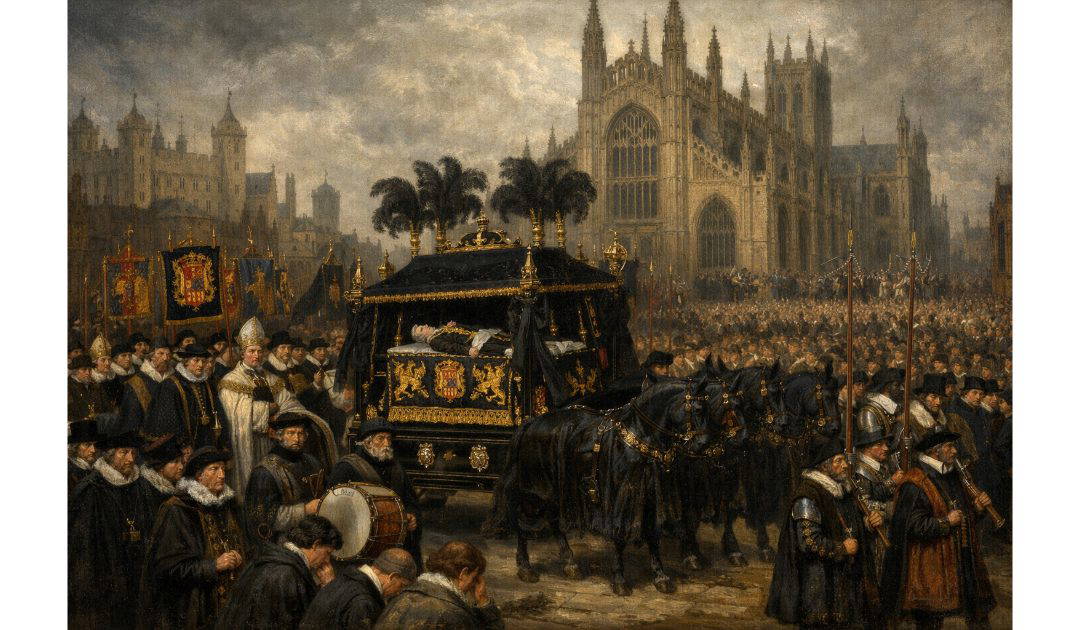
The state funeral of King James I took place on the 7th of May, 1625. Yes, I hear the Scottish outcry. He was King James VI of Scotland before he was King James I of England. May I continue? It was, of course, held in Westminster Abbey. James wasn’t my favourite king. He sent my ancestor, Sir Anthony Standen, to the Tower of London charged with treason. I have read, in the British Library, the reports of Venetian ambassadors that Standen would never be seen at large again. Actually he was released after a few months and travelled to Rome. Standen is the hero of my Sir Anthony Standen Adventures series. But we should get back to James.
James VI of Scotland, who became James I of England in 1603, was the first monarch to rule over both kingdoms, inaugurating what he styled the “Union of the Crowns.” His reign marked a turning point in the history of the British Isles, laying intellectual and political foundations for the later creation of Great Britain, while also sowing tensions that would erupt in the next generation.
Born on the 19th of June, 1566, at Edinburgh Castle, James was the only son of Mary, Queen of Scots and her second husband, Henry Stuart, Lord Darnley. His infancy was turbulent. Darnley was murdered in 1567 under mysterious circumstances, and Mary was soon forced to abdicate amid rebellion by the Scottish nobility. The infant James, not yet thirteen months old, was crowned King of Scots at Stirling.
Raised apart from his mother—who fled to England and was later executed in 1587 by Elizabeth I—James received a rigorous Protestant education. His tutor, the formidable scholar George Buchanan, instilled in him a deep love of learning but also exposed him to stern humanist discipline. James grew into an intellectually curious ruler, fluent in theology, fascinated by kingship, and keenly aware of his precarious political inheritance.
As King of Scots, James faced factional struggles among powerful nobles and threats from Catholic plots. Yet by the 1580s he had begun to assert greater personal control. His marriage in 1589 to Anne of Denmark strengthened ties with Protestant Denmark and produced several children, including the future Charles I of England.
When Elizabeth I died childless in March 1603, James—her closest Protestant relative—was proclaimed King of England. He travelled south in a carefully choreographed progress, seeking to present himself as a unifying monarch. Though England and Scotland remained legally separate kingdoms, James now ruled both, calling himself “King of Great Britain.”
He envisioned a fuller political union, but English resistance thwarted immediate integration. Even so, the dynastic union altered the balance of power in the British Isles and ended centuries of Anglo-Scottish warfare.
Religion dominated James’s reign. A committed Protestant, he nevertheless sought a moderate path between extremes. Shortly after his accession, the 1604 Hampton Court Conference addressed Puritan demands for reform. Although James rejected many of their proposals, he authorised a new translation of the Bible. The resulting 1611 “King James Version” became one of the most influential works in the English language.
James also faced Catholic discontent. In November 1605, conspirators led by Robert Catesby plotted to blow up Parliament in the Gunpowder Plot, killing the king and political elite. The discovery of Guy Fawkes guarding barrels of gunpowder in the cellar beneath the House of Lords shocked the realm. The failure of the plot strengthened Protestant identity and hardened official suspicion toward Catholics.
James was not merely a ruler but a theorist of monarchy. In works such as Basilikon Doron and The True Law of Free Monarchies, he articulated the doctrine of the divine right of kings—the belief that monarchs derived authority directly from God and were accountable only to Him. While this view resonated with many contemporaries, it alarmed members of Parliament who guarded traditional liberties and fiscal oversight.
Financial difficulties plagued his English reign. Elizabeth had left debts, and James’s generosity toward favourites—most notably George Villiers, 1st Duke of Buckingham—strained royal finances further. Repeated clashes with Parliament over taxation and prerogative foreshadowed the constitutional crises of his son’s reign.
Unlike Elizabeth, James preferred diplomacy to war. In 1604 he concluded the Treaty of London with Spain, ending the long Anglo-Spanish War. His foreign policy sought to position England as a mediator in European conflicts, though events on the continent—especially the outbreak of the Thirty Years’ War in 1618—complicated his balancing act.
When his daughter Elizabeth married Frederick V, Elector Palatine, and later became embroiled in the Bohemian phase of the war, English Protestants clamoured for intervention. James hesitated, wary of costly continental entanglements.
James’s court was intellectually vibrant but politically contentious. He patronised writers and scholars, including William Shakespeare, whose acting company became the “King’s Men.” The Jacobean era saw significant literary and architectural achievements, as well as heightened intrigue at court.
James died on the 27th of March, 1625, and was succeeded by Charles I. His reign is often judged ambivalently: he successfully united the crowns and preserved relative peace, yet his financial mismanagement and strong assertions of royal authority strained relations with Parliament.