
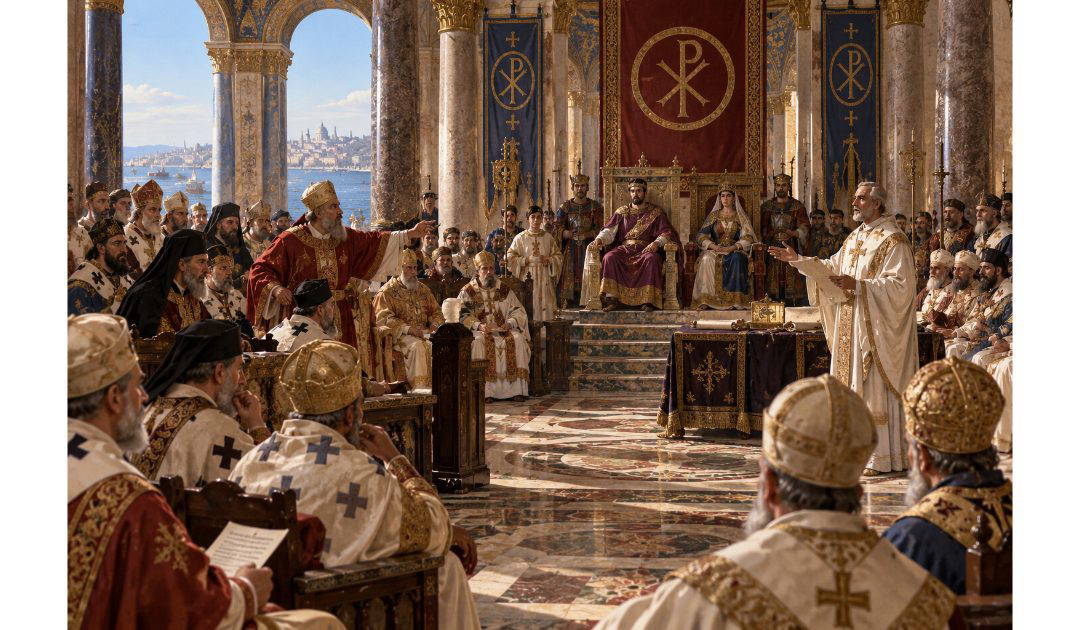
From the 8th of October, to the 1st of November, 451CE, hundreds of bishops gathered at Chalcedon, across the Bosporus from Constantinople, for one of the most consequential meetings in the history of Christianity. The Council of Chalcedon attempted to settle a theological dispute that had divided the Church and become entangled with the politics of the Roman Empire. Its conclusions helped define mainstream Christian belief about the nature of Jesus Christ, but they also produced divisions that have lasted for more than fifteen centuries.
The central question was deceptively simple: how could Jesus Christ be both God and man?
Christians had believed in Christ’s divinity from the earliest centuries of the Church, but explaining the relationship between his divine and human natures proved extraordinarily difficult. The controversy intensified after the Council of Nicaea in 325 had declared that Christ was truly divine and “of one substance” with God the Father.
During the fifth century, competing theological traditions emerged particularly strongly in Alexandria and Antioch. The Alexandrian tradition emphasised the unity of Christ, while theologians associated with Antioch were anxious to preserve the reality of both his humanity and divinity.
The immediate controversy concerned a monk in Constantinople named Eutyches. In defending Christ’s unity, Eutyches appeared to argue that after the Incarnation Christ effectively possessed only one nature. His opponents feared this compromised Christ’s genuine humanity.
Behind these theological arguments lay personalities and politics. Dioscorus, the powerful Patriarch of Alexandria, defended Eutyches, while Flavian, Patriarch of Constantinople, opposed him. Pope Leo I in Rome also intervened, setting out his understanding of Christ in his famous Tome of Leo.
A council held at Ephesus in 449 restored Eutyches and condemned Flavian, who died shortly afterwards. Leo denounced the proceedings as the Latrocinium—the “Robber Council”. When Emperor Theodosius II died in 450, the political situation changed. His successor Marcian and Marcian’s wife Pulcheria supported another council to resolve the dispute.
The Council of Chalcedon consequently assembled in 451. Somewhere around 500 bishops and their representatives attended at various stages, overwhelmingly from the eastern half of the Roman Empire. Representatives of Pope Leo were also present.
The council condemned Eutyches and removed Dioscorus from office. More importantly, it produced what became known as the Definition of Chalcedon.
It declared that Jesus Christ was one and the same Son, “perfect in Godhead and perfect in humanity”, truly God and truly man. Christ existed in two natures, divine and human, which were united “without confusion, without change, without division, without separation”.
Those four qualifications became enormously important.
The first two guarded against the idea that Christ’s divinity and humanity had somehow blended together to create something new. The latter two rejected the opposite possibility—that Jesus could effectively be divided into two separate persons.
Chalcedon was therefore attempting to establish a theological middle course. Christ was neither half-human and half-divine nor a divine being merely disguised as a man. Nor were there two separate Christs. He was one person possessing complete divinity and complete humanity.
The council also generated a major political controversy. Its Canon 28 elevated Constantinople’s ecclesiastical status, arguing that because it was “New Rome”, its bishop should enjoy privileges second only to those of Rome. Pope Leo rejected this canon, demonstrating that disputes over theology were increasingly intertwined with arguments about authority within the Church.
Nor did Chalcedon produce universal agreement.
Many Christians in Egypt, Syria and Armenia rejected its definition. Their descendants formed churches now generally described as the Oriental Orthodox Churches, including the Coptic Orthodox, Armenian Apostolic and Syriac Orthodox traditions.
For centuries their theology was frequently labelled “Monophysite”, implying belief that Christ possessed only a divine nature. Modern scholarship and ecumenical dialogue have demonstrated that this description can be misleading. The disagreement involved subtle differences of theological terminology as well as genuine disputes over authority and doctrine.
The consequences were enormous. Religious divisions weakened the unity of the eastern Roman provinces, particularly Egypt and Syria. When Muslim armies conquered much of the region in the seventh century, they encountered Christian communities that had spent generations in conflict with the imperial Church of Constantinople.
Yet Chalcedon’s greatest legacy remains theological. Its formula became fundamental to the Christianity of the Roman Catholic Church, Eastern Orthodox Church and, eventually, most Protestant traditions.
The Council of Chalcedon demonstrates just how seriously early Christians took questions that can appear extraordinarily abstract today. The bishops gathered there believed that the identity of Christ lay at the heart of Christianity itself. If Christ were not genuinely human, humanity could not truly be represented by him; if he were not genuinely divine, he could not provide the salvation Christians believed came through God.
Their solution—one person, two natures, fully God and fully human—became one of the defining statements of Christian orthodoxy and remains influential nearly sixteen centuries later.