
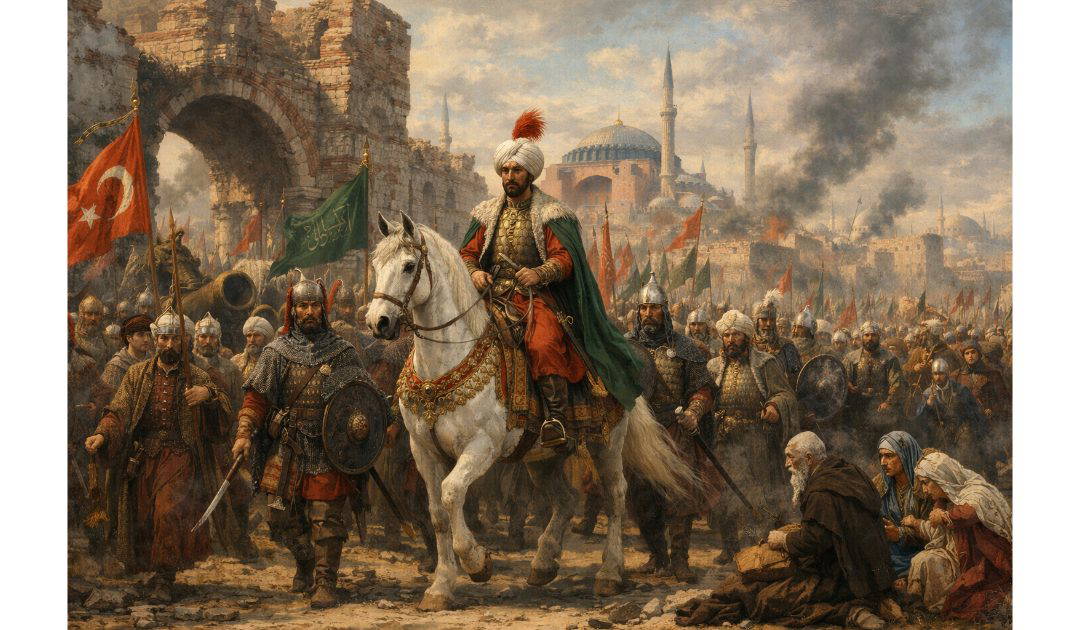
On the 29th of May, 1453, Constantinople fell to the Ottoman army under Sultan Mehmed II after a 53 day siege. It was the end of over 2000 years of the Roman Empire. The history of Constantinople is one of the most remarkable urban stories in the world: a city founded as a Greek colony, transformed into the capital of a Christian empire, conquered by a Muslim sultan, and ultimately reshaped into modern Istanbul. For over sixteen centuries it stood at the crossroads of Europe and Asia, commanding trade, culture, religion, and war.
Byzantium: The Greek Foundation
The city began as Byzantium, founded around 657 BC by Greek settlers from Megara. Its position on the Bosporus Strait was strategically brilliant. It controlled access between the Black Sea and the Mediterranean, making it a hub of maritime trade. Over centuries, Byzantium passed through Persian and Athenian influence before becoming part of the Roman Empire.
Despite its modest size, its location ensured survival and prosperity. The city was protected by water on three sides and by defensible land approaches on the fourth. This geography would later prove decisive.
Constantine and the New Rome
The turning point came in AD 330 when the Roman emperor Constantine the Great refounded Byzantium as his new imperial capital. Officially named Nova Roma (New Rome), it soon became known as Constantinople — “City of Constantine.”
Constantine sought a capital closer to the empire’s wealthy eastern provinces and away from the political intrigues of Rome. He adorned the city with forums, palaces, churches, and a hippodrome. Most importantly, Constantinople became the centre of a Christian empire after Constantine’s conversion to Christianity.
Following the formal division of the Roman Empire in 395, Constantinople became the capital of the Eastern Roman Empire — what modern historians call the Byzantine Empire. While the Western Roman Empire collapsed in 476, Constantinople endured.
The Byzantine Golden Age
Under Emperor Justinian I (r. 527–565), the city reached new heights. Justinian attempted to reconquer lost western territories and rebuilt the city magnificently after the Nika Riots of 532. His greatest architectural legacy was Hagia Sophia, completed in 537. Its vast dome symbolized both imperial power and divine authority, and it remained the largest cathedral in the world for nearly a thousand years.
The Theodosian Walls, constructed in the 5th century, made Constantinople nearly impregnable. For centuries, these fortifications protected the city from Persians, Arabs, Bulgars, and Rus. The city developed a unique blend of Roman law, Greek culture, and Christian theology. It became the heart of Eastern Orthodox Christianity and a centre of scholarship, preserving much of classical Greek literature.
Latin Conquest and Decline
Despite its strength, Constantinople was not invincible. In 1204, during the Fourth Crusade, Western European crusaders diverted from their mission and sacked the city. This catastrophic event shattered Byzantine power. A Latin Empire briefly ruled Constantinople until Byzantine forces recaptured it in 1261.
However, the empire never fully recovered. Trade increasingly fell under the control of Italian maritime powers like Venice and Genoa. Territory shrank under pressure from emerging Turkish states in Anatolia and the Balkans.
By the 15th century, Constantinople was largely isolated — a once-great capital surrounded by Ottoman lands.
The Ottoman Conquest
In 1453, Sultan Mehmed II, later known as “Mehmed the Conqueror,” besieged Constantinople with a massive army and powerful artillery, including enormous cannons capable of battering the Theodosian Walls. After 53 days, on the 29th of May, 1453, the city fell.
The last Byzantine emperor, Constantine XI Palaiologos, died defending the city. The conquest marked the end of the Byzantine Empire and is often seen as the end of the Middle Ages.
Mehmed II entered the city and declared it the new capital of the Ottoman Empire. Rather than destroy it, he restored and repopulated it. Hagia Sophia was converted into a mosque, symbolizing the new Islamic order.
Ottoman Capital
Under Ottoman rule, Constantinople flourished again. It became the political and cultural heart of a vast empire stretching across Southeast Europe, the Middle East, and North Africa. Sultans built grand mosques, palaces, and markets, including the Topkapı Palace and the Grand Bazaar.
The city became cosmopolitan: Muslims, Christians, and Jews lived in distinct communities under the Ottoman millet system. Trade thrived, linking East and West.
For nearly five centuries, Constantinople remained one of the world’s great imperial capitals.
From Empire to Republic
In the 19th century, the Ottoman Empire declined under internal weakness and external pressures. Following defeat in World War I, Allied forces occupied Constantinople. The Turkish War of Independence, led by Mustafa Kemal Atatürk, resulted in the establishment of the Republic of Turkey in 1923.
The capital was moved to Ankara, and in 1930 the city was officially renamed Istanbul. Though no longer a capital, it remained Turkey’s largest city and economic powerhouse.
Legacy
Constantinople’s legacy is immense. It preserved Greco-Roman learning, shaped Orthodox Christianity, influenced Islamic architecture, and acted as a bridge between continents. Its walls withstood centuries of assault; its churches and mosques reflect successive civilizations.
Few cities have been Roman, Byzantine, and Ottoman capitals in turn. Fewer still have shaped world history so profoundly. From Byzantium to Constantinople to Istanbul, the city remains a living monument to the layers of human civilization.