
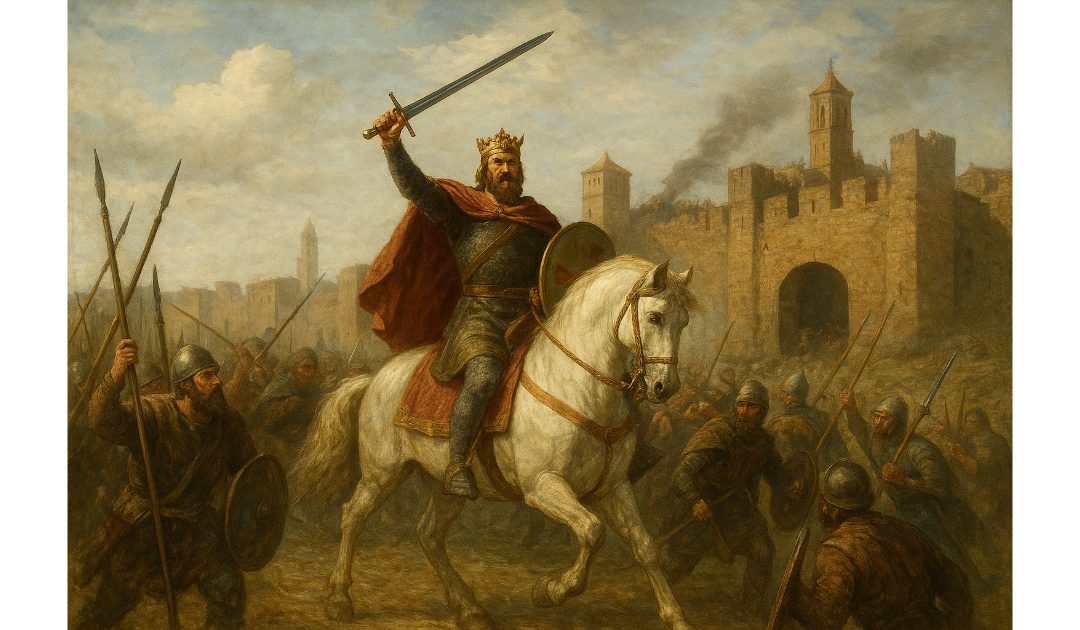
On the 18th of December, 1118, King Alsonso I of Aragon seized the city of Zaragoza from the Almoravid. King Alfonso I of Aragon and Zaragoza, often styled Alfonso I of Aragon and Navarre, and popularly known as Alfonso the Battler (c. 1073 – 1134), was one of the most notable monarchs of medieval Spain. His reign left a profound impact on the political and military landscape of the Iberian Peninsula during a crucial phase of the Reconquista. He earned his epithet through relentless campaigns and his dedication to expanding and defending the Christian kingdoms against the Muslim taifas.
Alfonso was the second son of Sancho Ramírez, King of Aragon and Navarre, and was not initially expected to inherit the throne, as it was his elder brother, Peter I, who succeeded their father in 1094. Alfonso received extensive military training in his youth, which prepared him for the rigorous life of a frontier king. He became king in 1104 upon the death of Peter I, inheriting the kingdoms of Aragon and Navarre. From the outset, Alfonso’s reign was defined by continuous military action and an unyielding commitment to territorial expansion.
One of his earliest and most significant achievements was his conquest of Zaragoza in 1118. Zaragoza had been the capital of a powerful taifa kingdom and was a strategic and prestigious prize during the Reconquista. Its capture not only provided a crucial foothold in the Ebro River valley but also symbolised a major triumph for the Christian cause. Alfonso’s campaign to seize Zaragoza was carefully orchestrated, involving alliances with other Christian rulers and the support of crusading forces from across the Pyrenees. The city’s fall reflected both his military skill and his ability to mobilise resources and men for extended campaigns.
Alfonso I’s wider military efforts were marked by both bold strategy and relentless activity. He frequently conducted raids deep into Muslim-held territories, aiming to weaken their capacity to retaliate and to secure booty and captives. His campaigns extended into the lands of Valencia, Andalusia, and even the approaches to Córdoba, though such expeditions were often more about asserting dominance and maintaining pressure than establishing permanent control. Alfonso also demonstrated organisational acumen by encouraging the settlement of frontier lands with loyal subjects and by supporting the establishment of military orders, such as the Knights Templar, in his dominions.
Politically, Alfonso’s reign was also complex. He married Urraca, the widowed queen of León and Castile, in 1109, a union intended to create a powerful Christian bloc against the Muslim states. However, the marriage was troubled and ultimately unsuccessful, leading to open conflict between the spouses and the annulment of the marriage. The discord with Urraca prevented the full unification of their realms and led to a series of internal disputes and wars, which consumed considerable energy and resources. Nonetheless, Alfonso remained an independent and assertive ruler, determined to pursue his own policies.
Alfonso I’s governance was heavily influenced by his martial character. He relied on the support of his nobility and his urban militias, particularly from newly conquered cities such as Zaragoza. He took an active interest in the defence and fortification of his territories, understanding that the survival of his kingdom depended on secure strongholds and the loyalty of his subjects along the volatile frontier. He showed pragmatism in allowing a degree of autonomy to Muslim and Jewish communities within his realms, as their economic contributions and local knowledge were valuable to the stability of his territories.
His final years were dominated by continued military activity and an enduring sense of purpose in the Reconquista. In 1134, Alfonso launched a bold campaign into the heart of Muslim-controlled territory, besieging the fortress of Fraga. This expedition, however, ended disastrously. The Christian forces were decisively defeated, and Alfonso himself died shortly afterwards, either from wounds sustained in battle or from illness, at the age of around sixty.
Alfonso I left no direct heirs, and his unusual will caused controversy. He attempted to bequeath his kingdoms to the military orders, including the Templars and the Hospitallers, a reflection of his crusading spirit and his desire to see his lands continue the struggle against Islam. His nobles, unwilling to honour such an unprecedented testament, instead invited his brother Ramiro II, a former monk, to take the throne of Aragon, while Navarre chose its own separate ruler, thus ending the personal union between the two kingdoms.