
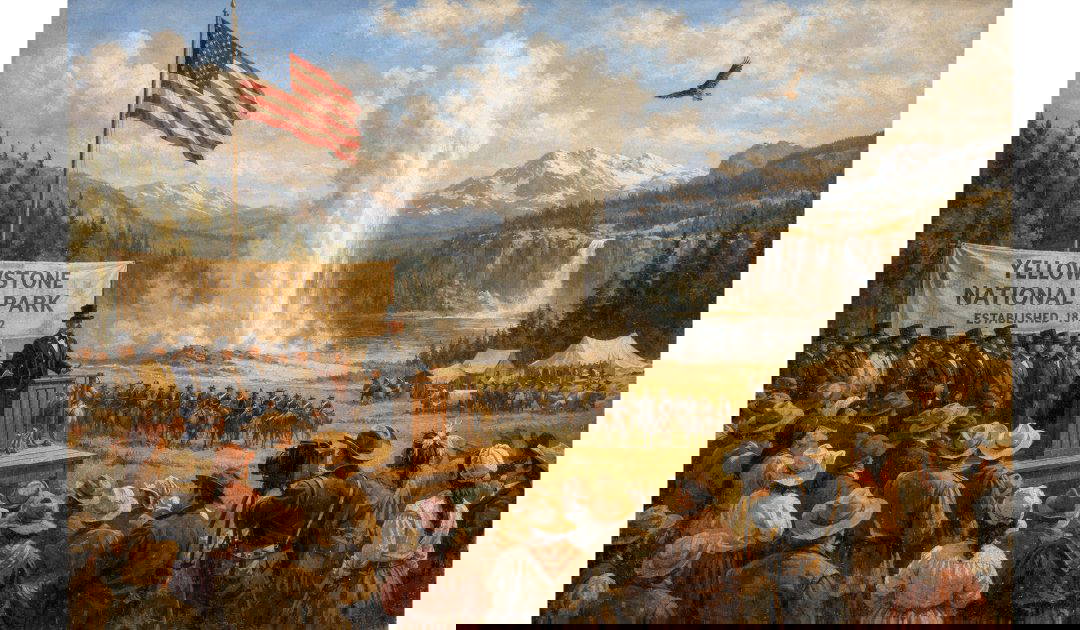
On the 1st of March, 1872, Yellowstone National Park was established as the world’s first national park. Yellowstone National Park is one of the world’s most celebrated natural landscapes and holds a unique place in environmental history as the first national park ever established. Set primarily in the northwestern United States—mostly in Wyoming, with portions extending into Montana and Idaho—Yellowstone covers nearly 2.2 million acres of wilderness. Renowned for its geothermal wonders, dramatic scenery, and abundant wildlife, the park represents both the raw power of nature and the origins of the global conservation movement.
Yellowstone was designated a national park in 1872, during the presidency of Ulysses S. Grant. At a time when westward expansion and resource exploitation were central to American life, the idea of preserving such a vast tract of land “for the benefit and enjoyment of the people” was revolutionary. Explorations in the late 1860s and early 1870s—particularly the Hayden Geological Survey—brought back vivid reports and images of geysers, boiling pools, and towering waterfalls that captured the public imagination. These accounts helped convince Congress that Yellowstone’s wonders were too extraordinary to be left to private development.
Long before European-American exploration, however, the region had been inhabited by Indigenous peoples for at least 11,000 years. Tribes such as the Shoshone, Bannock, Crow, and Blackfeet used the land seasonally for hunting, travel, and spiritual purposes. Their presence and deep connection to the landscape are increasingly recognised as an essential part of Yellowstone’s history.
Yellowstone sits atop one of the largest volcanic systems on Earth, known as the Yellowstone Caldera. This immense volcanic hotspot is responsible for the park’s unparalleled geothermal activity. Yellowstone contains more than half of the world’s geysers, including the famous Old Faithful, which erupts with remarkable regularity. Other geothermal features—such as hot springs, mud pots, and fumaroles—create a landscape that feels almost otherworldly.
Among the most striking sights is the Grand Prismatic Spring, whose vivid rings of blue, green, yellow, and orange are caused by heat-loving microorganisms called thermophiles. These colours shift with temperature and mineral content, turning the spring into a living work of natural art. Elsewhere, the earth bubbles, hisses, and steams, offering a visible reminder that Yellowstone is geologically alive.
Beyond its geothermal fame, Yellowstone boasts extraordinary scenic diversity. The Yellowstone River cuts through the park to form the Grand Canyon of the Yellowstone, where powerful waterfalls plunge into a vast gorge of yellow, red, and pink rock. Dense forests, alpine meadows, broad valleys, and rugged mountain ranges support a wide range of ecosystems shaped by elevation, climate, and fire.
Fire itself plays a vital ecological role. The 1988 Yellowstone fires, which burned roughly a third of the park, were initially viewed as catastrophic. Over time, however, they came to be understood as a natural and necessary process that renews forests, recycles nutrients, and creates varied habitats. Yellowstone has since become a leading example of fire ecology and adaptive land management.
Yellowstone is one of the last remaining large, nearly intact ecosystems in the temperate northern hemisphere. It is home to an iconic array of wildlife, including bison, elk, wolves, grizzly bears, black bears, moose, and pronghorn. The park’s bison herd, the largest free-roaming population in the United States, is a powerful symbol of both survival and conservation success.
The reintroduction of gray wolves in 1995 marked a major ecological milestone. Their return helped restore balance to the ecosystem by controlling elk populations, which in turn allowed vegetation to recover along rivers and valleys. This “trophic cascade” demonstrated how the presence or absence of a single species can reshape an entire landscape.
Yellowstone’s influence extends far beyond its boundaries. As the world’s first national park, it inspired the creation of protected areas across the globe and laid the groundwork for modern conservation philosophy. Today, it is a UNESCO World Heritage Site, recognised for its natural value and scientific importance.
Yet Yellowstone also faces challenges. Climate change, increasing tourism, invasive species, and pressure on wildlife migration corridors all threaten the delicate balance of the park’s ecosystems. Managing Yellowstone requires constant scientific research, careful stewardship, and public awareness to ensure its preservation for future generations.
Yellowstone National Park stands as a testament to nature’s creativity and power. From erupting geysers and thundering waterfalls to roaming bison and howling wolves, it offers a rare glimpse of Earth functioning largely on its own terms. More than a scenic destination, Yellowstone is a living symbol of humanity’s responsibility to protect and respect the natural world—a legacy that continues to shape conservation efforts worldwide.