
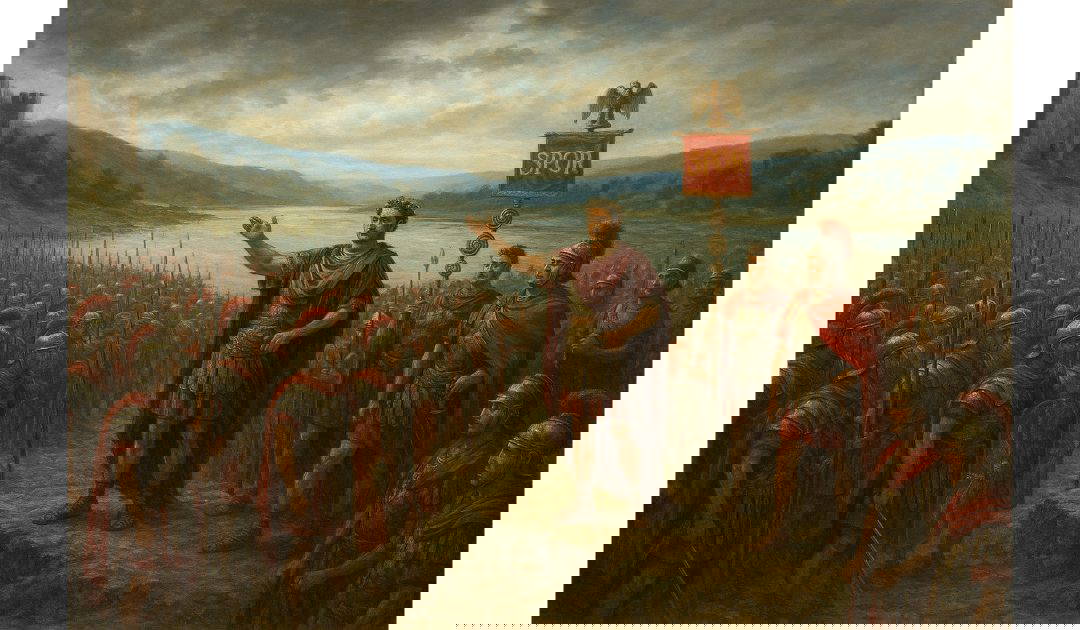
Wikipedia tells me that on the 3rd of January, 69CE, the Roman legions on the Rhine refused to swear their allegiance to Galba. Instead they proclaimed their legate, Aulus Vitellius, as emperor. The year 69CE is known as the year of the four emperors, so what was going on?
The crisis began with the fall of Nero, the last of the Julio-Claudian dynasty. His reign had become increasingly despotic and unpopular, culminating in open revolt by several provincial governors and the loss of support from the Senate and the Praetorian Guard. Facing certain execution, Nero committed suicide in June 68 CE, leaving no clear heir. The Senate declared Servius Sulpicius Galba, the governor of Hispania Tarraconensis, as the new emperor. Galba marched on Rome with the support of the legions in Spain and parts of Gaul, constituting the first of the four emperors.
Galba’s reign was marked by extreme austerity and a fatal lack of political tact. He alienated both the Senate and the army by cutting back on donatives—financial rewards traditionally given to soldiers upon a new emperor’s accession—and by punishing those who had supported Nero. Even the Praetorian Guard, whose support was essential, felt betrayed when Galba reneged on promises of payment. Moreover, Galba’s adoption of Lucius Calpurnius Piso Licinianus as his heir in January 69 CE further offended Marcus Salvius Otho, a former ally and ambitious senator who felt he had been denied the succession. Otho’s discontent would soon prove deadly for Galba.
By January 15, 69 CE, Otho had orchestrated a coup with the backing of the discontented Praetorians. Galba and Piso were murdered in the Forum, and Otho was hailed as emperor. His rule began with promises of generosity and reform, seeking to stabilise the capital and win over the soldiers. Yet Otho’s position was immediately threatened by the legions in Germania, who had already proclaimed their own candidate: Aulus Vitellius, the governor of Lower Germany. The German legions were powerful and battle-hardened, and they refused to accept Otho, whom they viewed as weak and illegitimate.
Vitellius’ forces began their march on Italy, and Otho, despite some initial manoeuvres to avoid open conflict, eventually chose to confront them in a series of battles. The decisive engagement took place at Bedriacum (modern-day Cremona) in April 69 CE. Otho’s forces were defeated, and rather than prolong the civil war, Otho committed suicide, reportedly to spare Rome further bloodshed. He had reigned for just three months.
Vitellius now became the third emperor of the year. His accession was celebrated with feasting and indulgence, but his character and leadership were ill-suited to the demands of ruling an empire in crisis. Vitellius alienated many in the Senate with his gluttony and perceived laziness, while also losing favour with some military factions as his regime became increasingly disorganised. His harsh treatment of those loyal to Otho and his neglect of the eastern legions would soon prove fatal.
In the eastern provinces, the legions in Judaea, Egypt, and Syria had already declared their support for Titus Flavius Vespasianus—better known as Vespasian—who was leading the Roman campaign to suppress the Jewish Revolt. Vespasian enjoyed the loyalty of experienced legions and the strategic advantage of controlling the grain supply from Egypt. By mid-69 CE, his forces, under the command of his ally Antonius Primus, marched into Italy and challenged Vitellius’ rule. Another battle at Bedriacum in October 69 CE resulted in Vitellius’ defeat. As Vespasian’s forces entered Rome in December, Vitellius attempted to abdicate but was captured and gruesomely killed. The year of the four emperors reminds me of that month when Liz Truss was Prime Minister, but bloodier.