
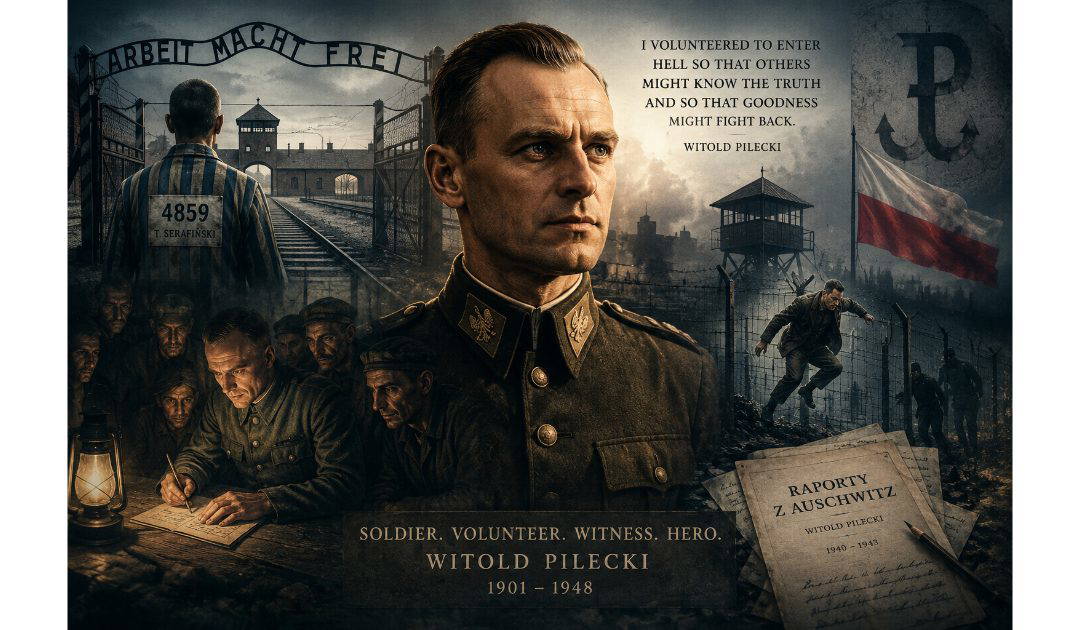
On the 19th of September, 1940, Witold Pilecki was voluntarily captured by by the German army and sent to Auschwitz concentration camp in order to gather information and smuggle it out to the resistance group. I’m struggling to get my head around this. The man voluntarily got himself sent to Auschwitz. Why haven’t I heard about this hero before? I have been fascinated by WWII because my father fought through it. I have researched intelligence gathering since discovering my spy ancestor Sir Anthony Standen.
Pilecki was born on the 13th of May, 1901, in Olonets, then part of the Russian Empire, where his family had been exiled after the failed Polish uprisings against Russian rule. Raised in a strongly patriotic household, he grew up believing that Poland would one day regain its independence. As a young man he joined the Polish Scout movement, which combined outdoor activities with patriotic education, and he later fought in the conflicts that accompanied the rebirth of Poland after the First World War.
During the Polish-Soviet War of 1919–1921, Pilecki served with distinction in the Polish Army, helping to defend the newly independent nation against the advancing Red Army. After the war he returned to civilian life, marrying Maria Ostrowska in 1931. The couple had two children and managed a family estate in eastern Poland. Pilecki became known as a progressive farmer who introduced modern agricultural techniques while remaining active in local community affairs and the military reserve.
Everything changed when Nazi Germany invaded Poland on the 1st of September 1939. Pilecki was mobilised as a cavalry officer and fought in the desperate defence of his country. After Poland was defeated and divided between Germany and the Soviet Union, he joined the underground resistance in German-occupied Warsaw. The resistance soon learned disturbing rumours about a new concentration camp at Auschwitz, where political prisoners and members of the Polish intelligentsia were being sent. Little reliable information emerged from the camp, and the underground desperately needed someone to investigate.
In one of the most remarkable acts of self-sacrifice in modern history, Pilecki volunteered for the mission. On the 19th of September, 1940, during a German round-up in Warsaw, he deliberately allowed himself to be arrested. Transported to Auschwitz under the false identity of Tomasz Serafiński, he entered the camp as prisoner number 4859.
Life inside Auschwitz was unimaginably brutal. Prisoners endured starvation, disease, forced labour, arbitrary executions and savage beatings. Despite these conditions, Pilecki secretly established an underground organisation known as the Union of Military Organisation (ZOW). The network helped prisoners survive by sharing food and information, boosting morale and secretly recording German atrocities. It also transmitted intelligence beyond the camp using prisoners released from Auschwitz or those who escaped.
Pilecki’s reports were among the first detailed eyewitness accounts reaching the Polish resistance and, through them, the Western Allies. They described mass executions, appalling living conditions and the rapidly expanding system of terror. As Auschwitz evolved into the principal centre for the murder of Europe’s Jews, his intelligence became even more significant. Although the reports confirmed the horrific nature of the camp, the Allies were unable to mount any operation capable of liberating Auschwitz, and proposals to attack the camp or support an uprising were judged impractical or too costly.
By 1943 Pilecki concluded that remaining in Auschwitz no longer served a useful purpose. He believed an armed attack by the resistance might be possible if he could escape and report directly to underground commanders. On the night of 26th–27th of April, 1943, he and two fellow prisoners successfully escaped after overpowering a bakery guard. After several days avoiding German patrols, they reached safety and resumed contact with the resistance.
Pilecki wrote a comprehensive report describing everything he had witnessed inside Auschwitz. Today, these documents are regarded as some of the most important contemporary records of the Holocaust and of Nazi crimes in occupied Poland.
He continued fighting until the end of the war, taking part in the Warsaw Uprising of 1944 against German occupation. Captured after the uprising, he spent the remainder of the war as a prisoner of war in Germany before being liberated by American forces in 1945.
After the war, Poland fell under Soviet-backed Communist control. Despite opportunities to remain safely in the West, Pilecki returned to Poland on orders to gather intelligence on the new regime. In 1947 he was arrested by the Communist secret police. During months of imprisonment he was brutally tortured but refused to betray his comrades.
Following a show trial, Pilecki was convicted on fabricated charges of espionage and executed on the 25th of May, 1948, in Warsaw. His burial place remains uncertain, although historians believe his remains were probably hidden in an unmarked grave alongside many other victims of Communist repression.
For decades, the Communist government suppressed his story. Only after the collapse of Communist rule in 1989 was Pilecki publicly honoured. Today he is recognised as one of Poland’s greatest national heroes. Schools, streets and memorials bear his name, and his reports from Auschwitz are studied around the world as powerful testimony to courage, moral conviction and resistance against tyranny. His decision to enter one of history’s most infamous death camps voluntarily remains almost without parallel, making Witold Pilecki an enduring symbol of extraordinary bravery in the face of overwhelming evil.