
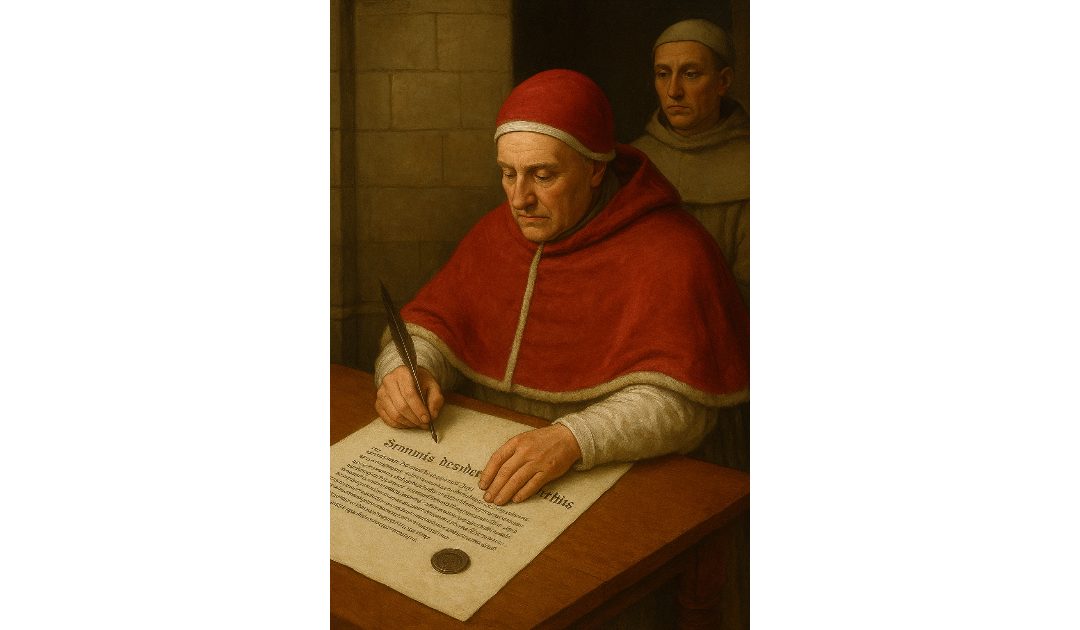
On the 5th of December, 1484, Pope Innocent VIII issued the Summis desiderantes affectibus, a papal bull appointing Heinrich Kramer and Jacob Sprenger as inquisitors to root out alleged witchcraft in Germany. I have chosen witchcraft today as, together with anti-semitism, it is a theme of Called to Account, the fourth book in my Sir Anthony Standen Adventures.
The bull arose out of a context of anxiety over heresy, social unrest, and perceived diabolic activity in late medieval Europe. During this period, beliefs about witchcraft were evolving from localised notions of folk magic into a coherent demonological system in which witches were understood as heretics in league with the Devil. Kramer had encountered resistance from certain local authorities in his attempts to prosecute suspected witches, especially in parts of Germany such as the dioceses of Mainz, Cologne, Trier, Salzburg, and Bremen. These regions were experiencing incidents that Kramer interpreted as evidence of witchcraft: crop failures, storms, livestock deaths, and social discord. He argued that without papal support, he could not effectively pursue the accused.
The title Summis desiderantes affectibus translates roughly as “Desiring with the greatest ardour” and reflects the pope’s stated concern for the salvation of souls and the eradication of heretical evil. The document declares that many people, both male and female, had abandoned the Catholic faith, entered into pacts with demons, and committed acts that included infanticide, the destruction of crops, and the ruin of livestock. It laments that such diabolic activities were allegedly spreading across several regions of Germany, causing spiritual and material harm. Pope Innocent VIII, by issuing the bull, formally empowered Kramer and Sprenger to proceed with inquisitorial authority, even in areas where local ecclesiastical leaders had initially obstructed them.
Importantly, the bull did not in itself introduce new doctrines about witchcraft; belief in maleficium (harmful magic) and diabolic pacts was already embedded in ecclesiastical thought. However, the document’s significance lies in the way it lent papal legitimacy to the witch-hunting activities of Kramer and Sprenger. It effectively endorsed their interpretation of witchcraft as a pressing spiritual and social threat, and it provided a legal and moral foundation for expanded inquisitorial campaigns.
The immediate and long-term consequences of Summis desiderantes affectibus were considerable. Following the bull, Kramer and Sprenger composed the Malleus Maleficarum (The Hammer of Witches), first published in 1487, which became the most infamous treatise on witchcraft in early modern Europe. Although the bull itself is sometimes printed as a preface to the Malleus, it is a separate document. Nonetheless, the pairing of the papal endorsement with the manual offered inquisitors and secular judges a powerful justification to pursue witch trials with greater zeal.
The bull also reflects the tension between local and central church authorities in the late fifteenth century. Many bishops were cautious or sceptical about widespread witch persecutions, preferring to maintain local control and to focus on more conventional heresies. By bypassing these local reservations, Pope Innocent VIII signalled the papacy’s willingness to intervene directly in matters of witchcraft, framing the issue as part of the broader battle against heresy and the Devil.
Historians today view Summis desiderantes affectibus as a pivotal moment in the escalation of witch hunts. It illustrates how religious anxiety, social dislocation, and institutional politics converged to produce a climate in which accusations of witchcraft could lead to systematic persecution. Although the bull did not singlehandedly create the witch craze, it legitimised a narrative in which witchcraft was a diabolical conspiracy requiring urgent and often violent response. Its legacy is thus entwined with one of the darkest chapters in European religious and legal history, highlighting the power of official sanction in shaping popular fear and judicial practice.