
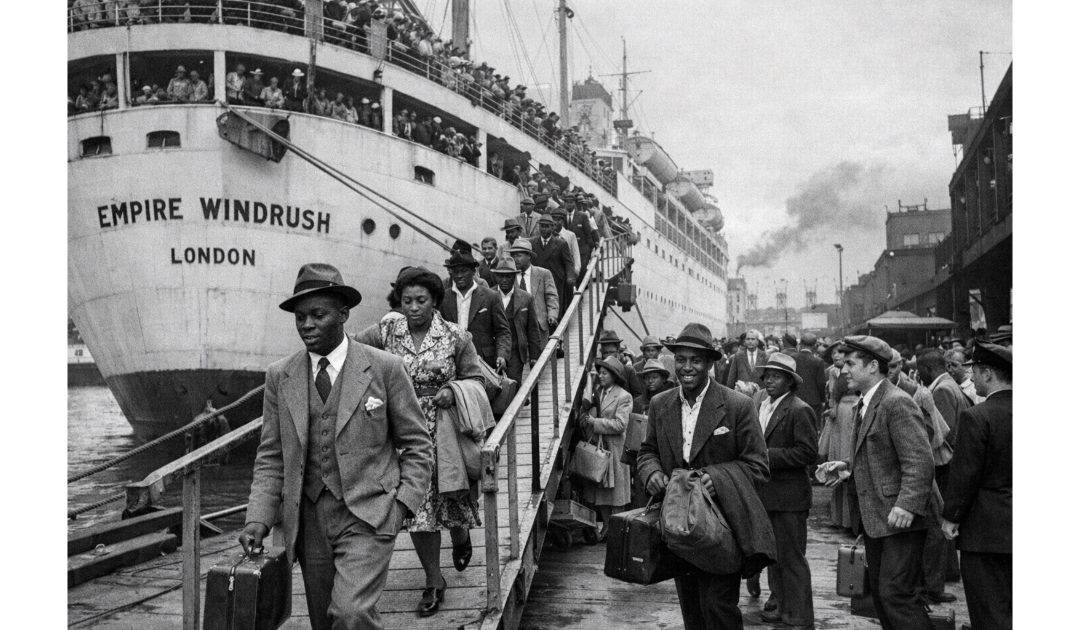
The Empire Windrush occupies a central place in modern British history. Although it was originally just one passenger vessel among many travelling between the Caribbean and Britain, its arrival in 1948 came to symbolise the beginning of large-scale post-war migration from the Caribbean to the United Kingdom. The people who arrived on the ship later became known collectively as the “Windrush generation,” and their presence profoundly shaped British society.
The ship itself had an unusual history even before its famous voyage. It had been built in Germany in 1930 as the passenger liner Monte Rosa, operated by the Hamburg Süd shipping company. During the 1930s it carried European holidaymakers on cruises and emigrants to South America. When the Second World War began, the vessel was requisitioned by the German government and used as a troopship. At the end of the war it was captured by the British and transferred to the Ministry of Transport, which renamed it Empire Windrush. Under British control it served mainly as a troop transport, carrying soldiers and supplies between different parts of the empire.
In 1948 the ship was scheduled to travel from Australia to Britain. After leaving Australia it sailed to the Caribbean to pick up servicemen and civilians wishing to travel to the United Kingdom. At the time, Britain was still adjusting to the devastation of the Second World War. Large parts of the country had been bombed, the economy was struggling, and there were serious labour shortages in many industries such as transport, construction, and the newly created National Health Service. The British government encouraged people from across the empire and Commonwealth to come and help rebuild the country.
The legal basis for this migration was the British Nationality Act of 1948. This act created the status of “Citizen of the United Kingdom and Colonies” and confirmed that people from British colonies had the right to live and work in Britain. Many Caribbean citizens therefore saw migration as both a legal right and an opportunity for economic advancement.
The Empire Windrush left the Caribbean island of Jamaica in May 1948, stopping at other islands including Trinidad before crossing the Atlantic. On board were around 1,027 passengers. Of these, roughly 492 were Caribbean migrants travelling to Britain to start new lives. Many were young men, though women and children were also among the passengers. Some had served in the British armed forces during the war and felt a strong connection to Britain.
After a voyage of several weeks, the ship arrived at Tilbury Docks in Essex on the 22nd of June 1948. News reporters and photographers were present to document the arrival. Images of the passengers disembarking the gangway, dressed in suits, hats, and summer clothing, quickly spread through newspapers across the country. Although the arrival was not initially viewed as a major historical moment, it later became recognised as highly significant.
Many of the migrants initially stayed in temporary accommodation, including an air-raid shelter in south London at Clapham South Deep Level Shelter. From there they searched for work and housing. Jobs were found in industries that urgently needed workers, particularly London Transport, the railways, hospitals, and factories.
Despite the opportunities, the newcomers also faced considerable challenges. Britain in the late 1940s was not accustomed to large-scale non-European immigration, and many migrants experienced discrimination and prejudice. Some landlords refused to rent rooms to Black tenants, while racist hostility sometimes appeared in workplaces and public spaces. Nevertheless, Caribbean migrants gradually built communities, churches, social clubs, and cultural organisations.
Over time the Windrush generation made enormous contributions to British life. They played a vital role in rebuilding the economy after the war, especially in public services such as the NHS and public transport. Their influence can also be seen in music, literature, sport, food, and popular culture. Caribbean traditions helped shape modern British identity, contributing to events such as the Notting Hill Carnival and influencing genres like reggae, ska, and later forms of British music.
The ship itself did not remain in service for long after its famous voyage. In 1954 the Empire Windrush suffered a catastrophic engine-room fire while sailing in the Mediterranean. The blaze forced the crew and passengers to abandon ship, and the vessel eventually sank off the coast of Algeria.
In recent decades the story of the Windrush generation has received renewed attention. In 2018 the so-called Windrush scandal revealed that some long-term Caribbean residents had been wrongly detained, denied services, or threatened with deportation because they lacked formal documentation proving their right to live in Britain. The controversy led to public apologies from the government and greater recognition of the historical significance of the Windrush migrants.
Today the arrival of the Empire Windrush is widely regarded as a defining moment in the history of modern multicultural Britain. Each year on the 22nd of June, the United Kingdom celebrates Windrush Day to honour the contributions of those who travelled from the Caribbean and helped shape the nation in the decades that followed.