
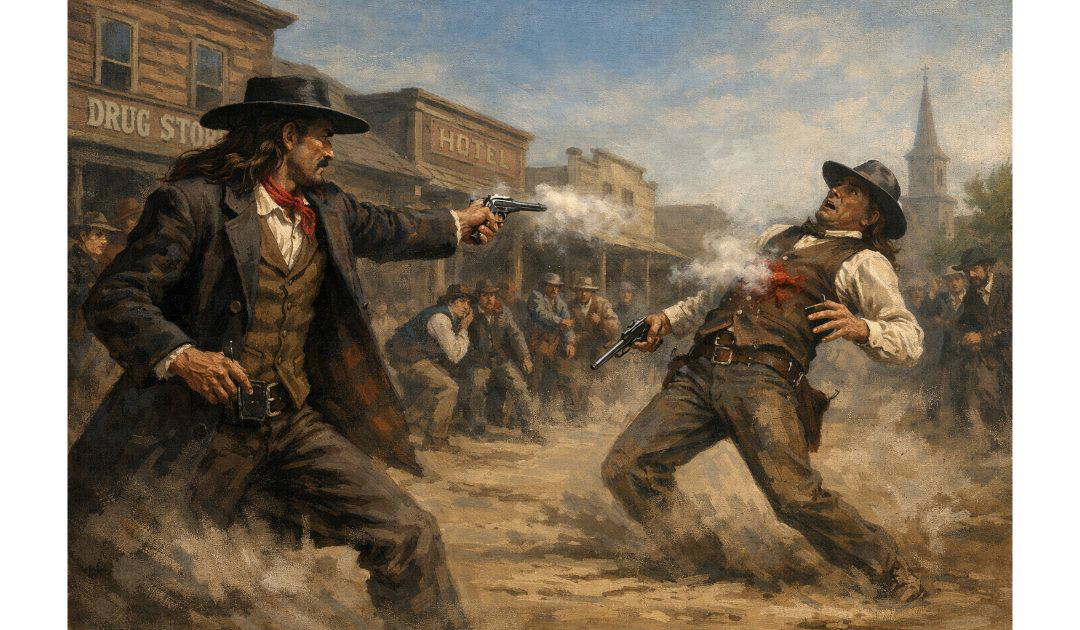
On the 21st of July, 1865, Wild Bill Hickok shot and killed David Tutt in a shootout in Springfield, Missouri. I have written a post on the gunfight at the OK Corral so let’s look into this other Western legend.
Wild Bill Hickok, born James Butler Hickok, was one of the most famous and controversial figures of the American frontier. Soldier, scout, lawman, gambler and gunfighter, he became a legend during his own lifetime and remains one of the enduring symbols of the Wild West.
Hickok was born on 27 May 1837 in Troy Grove. His family farm was strongly opposed to slavery and served as a stop on the Underground Railroad, helping escaped slaves travel north to freedom. As a young man Hickok grew up in a rough frontier environment and became an excellent horseman and marksman.
In 1855 he left Illinois and travelled west to the troubled territory of Kansas. At that time Kansas was torn by violent disputes over whether slavery should be allowed there, a period later known as the Bleeding Kansas. Hickok joined the anti-slavery “Free State” forces led by James H. Lane and worked as a scout and bodyguard. During these years he gained a reputation for courage, coolness under pressure and great skill with firearms.
By 1858 Hickok had become a constable in Kansas and later worked for Russell, Majors and Waddell, the great freight company that also created the Pony Express. He was too large to be one of the famous riders, but he worked as a wagon-master and station employee.
His first great claim to fame came in 1861 at Rock Creek Station. A local man named David McCanles came to the station during a dispute over money. Hickok and others shot McCanles and two of his companions. Newspapers and magazines later exaggerated the affair enormously, claiming that Hickok had single-handedly killed a whole gang of outlaws. Although historians now believe the real event was far less dramatic, the story made Hickok famous across the United States.
During the American Civil War Hickok served the Union army as a scout, spy and sharpshooter. It may have been during this period that he acquired the nickname “Wild Bill”. He travelled widely on the frontier and became known for his long hair, large moustache, elegant clothes and pair of ivory-handled revolvers. According to one description, he was over six feet tall, handsome, calm and extremely dangerous in a fight.
The event that most firmly established Hickok’s reputation as a gunfighter took place in Springfield on the 21st of July 1865. Hickok quarrelled with another gambler and gunman, David Tutt, over money and a watch that Tutt had taken from him after a card game. Tutt publicly displayed the watch in the town square, humiliating Hickok. The two men faced each other from about 75 yards apart in what is often described as the first classic “quick-draw” duel of the Old West. Tutt fired first and missed. Hickok calmly took aim and shot him dead with a single bullet. Hickok was tried for murder but acquitted, and his fame spread across America.
In the late 1860s and early 1870s Hickok worked as a lawman in some of the roughest towns in the West. He served as sheriff of Hays and later as marshal of Abilene. Both towns were filled with cowboys, gamblers, drunks and gunmen. Hickok kept order through a mixture of fear, reputation and deadly force. Several men died in shootouts with him.
However, his career as a lawman was not entirely successful. In 1871, while exchanging shots with a group of troublemakers in Abilene, Hickok accidentally killed his own deputy, Mike Williams. The tragedy deeply upset him and contributed to the end of his law-enforcement career.
After leaving Abilene, Hickok briefly became a performer in Wild West shows. He appeared alongside his old friend Buffalo Bill Cody in the stage production The Scouts of the Prairie. Hickok disliked acting and drank heavily, and the venture was not a success.
In 1876 he married Agnes Lake Thatcher, but shortly afterwards he travelled to the gold-mining town of Deadwood in search of fortune. By then he was only thirty-nine, but years of hardship, drinking and failing eyesight had weakened him.
On the 2nd of August, 1876, Hickok was playing poker in a saloon in Deadwood when a drifter named Jack McCall walked up behind him and shot him in the back of the head. Hickok had unusually been forced to sit with his back to the door, something he normally avoided. McCall was eventually captured, convicted and hanged. At the moment of his death Hickok was said to be holding two black aces and two black eights. Ever since, this poker combination has been known as the “Dead Man’s Hand”.
Wild Bill Hickok’s life has often been exaggerated, both by himself and by others. Modern historians believe he killed perhaps six or seven men rather than the hundred he once claimed. Yet his combination of courage, violence, style and mystery made him one of the great legends of the American frontier.