
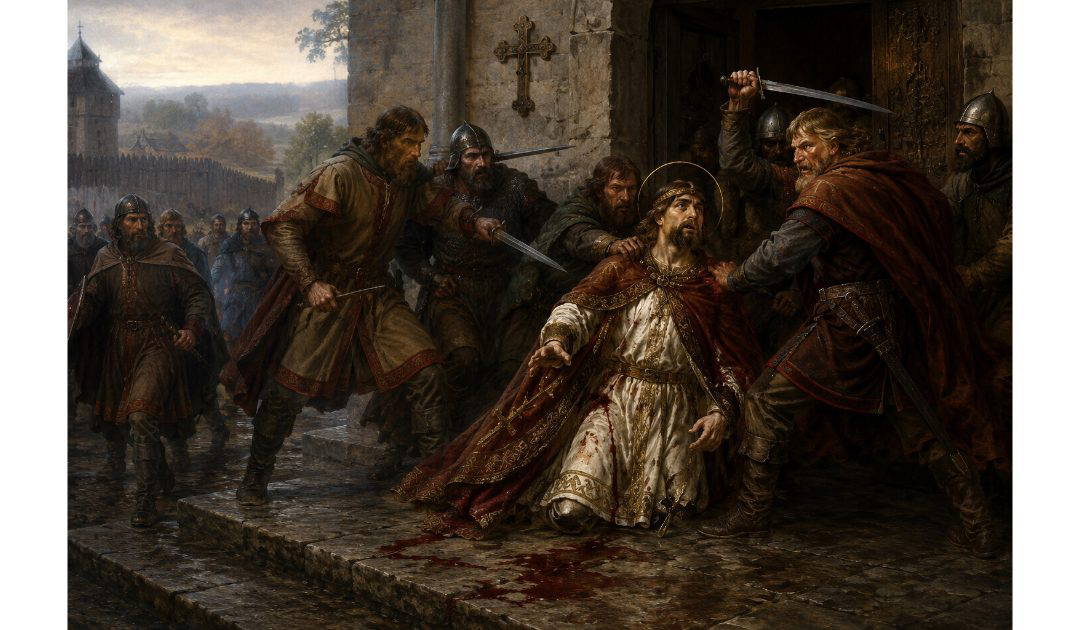
On the 28th of September, 935 CE, Duke Wenceslaus I of Bohemia was murdered by a group of nobles led by his brother, Boleslaus I.
Wenceslaus I, Duke of Bohemia, is one of the most celebrated figures of early medieval Central Europe. Known in Czech as Václav, he was born around 907, probably at Stará Boleslav or Prague, into the ruling Přemyslid dynasty. He became Duke of Bohemia while still a young man and ruled for roughly fourteen years before being murdered by his younger brother, Boleslaus, in 935. His death transformed him from a controversial medieval ruler into a Christian martyr and eventually into the patron saint of the Czech lands.
Wenceslaus was the son of Duke Vratislaus I and his wife, Drahomíra. His grandmother, Ludmila, was a deeply Christian woman who played an important role in Wenceslaus’s upbringing. Ludmila supported the spread of Christianity in Bohemia and is herself venerated as a saint.
When Vratislaus died in 921, Wenceslaus was still a child. The government was therefore initially controlled by his mother, Drahomíra, although his grandmother Ludmila also exercised considerable influence. The rivalry between the two women was partly political and partly religious. Ludmila favoured the Christian clergy and the continuation of her son’s policies, while Drahomíra represented elements of the older Bohemian aristocracy.
The conflict ended tragically. In 921, Ludmila was murdered, traditionally said to have been strangled by assassins acting on Drahomíra’s orders. Wenceslaus subsequently came under the influence of Christian clergy and was educated in the faith. Later tradition portrays him as an exceptionally devout young prince, although the surviving evidence was written largely by Christian authors who wished to emphasise his holiness.
Around 922, Wenceslaus assumed effective control of the duchy. Bohemia at this time was very different from the later medieval kingdom. Prague was becoming an important political and commercial centre, but the Přemyslid rulers did not yet possess the highly centralised state that their descendants would eventually establish. Wenceslaus had to maintain his authority over powerful local nobles while simultaneously dealing with neighbouring rulers.
One of his most important political challenges came from Henry the Fowler, King of East Francia. Henry was building a powerful kingdom in the German lands and sought to bring neighbouring territories under his influence. Wenceslaus eventually acknowledged Henry’s overlordship and is traditionally said to have agreed to pay an annual tribute of silver and cattle. Although later Czech tradition sometimes portrayed this as humiliating submission, it was probably a pragmatic arrangement that helped preserve Bohemian independence while avoiding a destructive war.
Wenceslaus was also an enthusiastic supporter of Christianity. He encouraged the construction and development of churches and supported the Christian clergy. One of his most important religious foundations was associated with the church of St Vitus at Prague Castle. The cathedral that now dominates Prague belongs to a much later period, but Wenceslaus’s church established the religious tradition upon which the later cathedral was built.
Christianity was still relatively new in Bohemia. The old pagan religion remained influential, and the process of Christianisation was gradual. Wenceslaus therefore occupied an important position in the transition between the pagan and Christian cultures of early medieval Bohemia.
His growing authority, however, created enemies. His younger brother Boleslaus became the focus of opposition to Wenceslaus’s rule. The precise reasons for their conflict remain uncertain. Later accounts depict Boleslaus as ambitious and hostile to his brother’s Christianity, but political rivalry and disagreements among the aristocracy were almost certainly involved.
In September 935, Wenceslaus travelled to Stará Boleslav, where he was received by his brother. According to the traditional account, Boleslaus and his supporters attacked him as he was going to church. Wenceslaus attempted to defend himself but was killed outside the church door. His last words are traditionally reported as a prayer.
His murder had extraordinary consequences. Rather than destroying Wenceslaus’s reputation, it created a powerful cult around him. His body was eventually transferred to Prague and buried in St Vitus’s Church. Miracles were attributed to him, and stories of his piety and charity multiplied.
Wenceslaus became known as a model Christian prince: just, merciful, charitable to the poor and willing to die for his faith. Medieval rulers of Bohemia regarded him as an important predecessor and spiritual protector. His image eventually became inseparable from Czech identity.
His fame spread far beyond Bohemia. In England he became particularly well known through the nineteenth-century Christmas carol “Good King Wenceslas”, although the song’s portrayal of him is based more upon the later legend of the charitable Christian ruler than upon the historical duke.
The historical Wenceslaus was undoubtedly more complicated than the saintly figure of later tradition. He was a ninth- and tenth-century prince operating in a violent political world, attempting to consolidate the Přemyslid dynasty while navigating the growing power of the German kingdom. Nevertheless, his short reign was important in the development of Bohemia.
Saint Wenceslaus remains one of the central figures of Czech history. His feast day, the 28th of September, commemorates his martyrdom, and the tradition surrounding him has survived for more than a thousand years. The duke murdered at Stará Boleslav became, in death, the enduring symbol of Christian Bohemian statehood.