
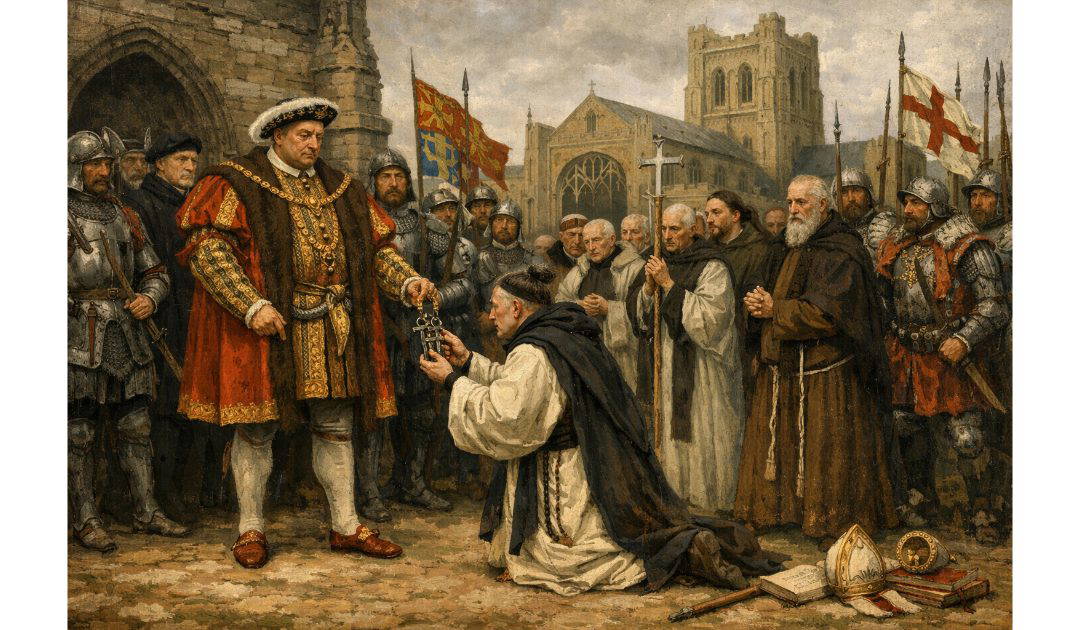
On the 23rd of March, 1540, Waltham Abbey was surrendered to King Henry VIII. It was the last religious community to be closed during the Dissolution of the Monasteries.
The origins of Waltham Abbey lie in the early Anglo-Saxon period. Tradition holds that in the 7th century a wooden church stood on the site, founded by the East Saxons. By the 11th century, however, Waltham had become a place of great religious significance due to the arrival of a revered relic: the Holy Cross of Waltham. According to legend, a miraculous black marble cross was discovered on Montacute Hill in Somerset and, after several divine signs, was brought to Waltham. The cross quickly became the focus of pilgrimage and devotion, giving the church a national reputation.
The man most closely associated with Waltham’s rise to prominence was Harold Godwinson, later King Harold II of England. Around 1060, Harold rebuilt the church in stone and established a college of secular canons there. He endowed it richly, making Waltham one of the wealthiest and most important churches in England. Harold’s association with Waltham was so strong that after his death at the Battle of Hastings in 1066, tradition states that his body was brought back and buried at Waltham, making it one of the most evocative sites connected to the last Anglo-Saxon king.
After the Norman Conquest, Waltham retained its importance. William the Conqueror and his successors respected its wealth and status. In 1177, under Henry II, the secular canons were replaced by Augustinian canons, and Waltham was formally refounded as an abbey. This marked a new phase in its history. The abbey church was rebuilt on a grand scale in the Norman and Early English styles, and monastic buildings rose around it. The abbey controlled vast estates across several counties, generating significant income and influence.
Throughout the medieval period, Waltham Abbey was a thriving religious, economic, and cultural centre. Pilgrims continued to visit the Holy Cross, believing it possessed healing powers. The abbey’s lands were farmed, mills operated, and trade flourished in the surrounding settlement, which grew into a prosperous town. The canons maintained a scriptorium, educated novices, and provided charity and hospitality to travellers. Its proximity to London—only about 15 miles away—made it particularly accessible and important.
Architecturally, Waltham Abbey became one of the most impressive churches in England. Much of what survives today dates from the Norman rebuilding begun in Harold’s time and expanded in the 12th century. The massive Norman nave, with its heavy pillars and distinctive zigzag carvings, still stands as one of the finest examples of Romanesque architecture in the country. Later Gothic additions enhanced its grandeur, including an extended choir, chapels, cloisters, and monastic ranges, most of which were destroyed after the Dissolution.
Royal connections continued throughout the Middle Ages. Several monarchs visited Waltham, and it enjoyed royal protection. Edward I is known to have worshipped there, and the abbey often served as a stopping point for royal journeys between London and East Anglia. Its prestige was reinforced by its relic, its royal associations, and its wealth.
By the early 16th century, however, the abbey—like many others—faced an uncertain future. When Henry VIII broke with Rome and began the Dissolution of the Monasteries in the 1530s, Waltham was an obvious target due to its wealth. Smaller monasteries were dissolved first, but larger and more prestigious houses, including Waltham, were suppressed later. On the 23rd of March, 1540, Waltham Abbey became the last monastery in England to surrender to the king’s commissioners. The abbot, Robert Fuller, handed over the keys and the abbey’s vast properties to the Crown.
The consequences were dramatic. The monastic buildings were largely demolished, their stone reused elsewhere. The shrine of the Holy Cross disappeared, likely destroyed. The cloisters, chapter house, dormitories, and refectory vanished. However, unlike many abbey churches, the nave of Waltham was spared because it served as the parish church for the local population. This act of practicality ensured the survival of the most ancient part of the structure.
In the centuries that followed, Waltham Abbey adapted to its new role as a parish church. It underwent repairs, modifications, and Victorian restorations, but its Norman core remained intact. Antiquarians and historians became increasingly interested in its past, especially the tradition of Harold’s burial. In the 18th and 19th centuries, excavations and investigations sought to locate his grave, though no conclusive proof has ever been found.
Today, visitors to Waltham Abbey can still see the great Norman arches, the massive pillars built in Harold’s time, and later medieval features. The churchyard contains a reputed grave of Harold II, marked in modern times. Nearby, the outlines of the vanished monastic buildings can be traced in the landscape, and archaeological work has revealed much about the abbey’s former extent.
Waltham Abbey’s story encapsulates much of English religious history: Anglo-Saxon devotion, Norman consolidation, medieval monastic prosperity, and Tudor destruction. Its survival is remarkable not because it escaped history, but because it absorbed it. From legendary relics and royal burials to dissolution and reinvention, Waltham Abbey remains a living monument to over a thousand years of English faith, power, and continuity.