
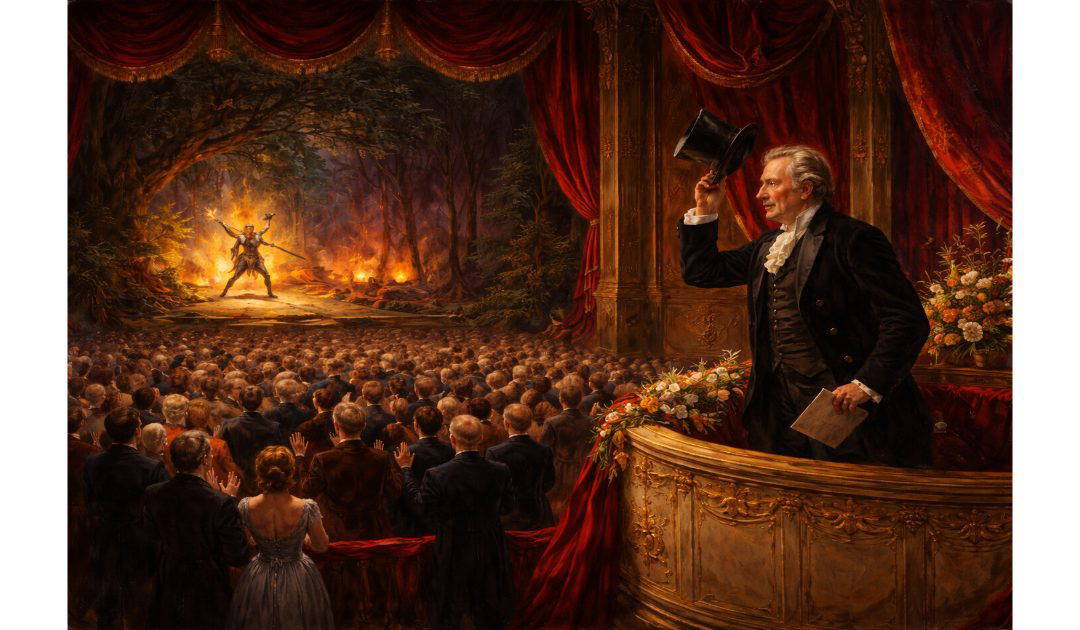
On the 16th of August, 1876, Richard Wagner’s Siegfried premiered at the Bayreuth Festspielhaus. It was the penultimate opera of his Ring cycle. I have written about a few composers including Mozart and Beethoven, so let’s have a look at Wagner.
Richard Wagner was one of the most influential, innovative, and controversial figures in the history of Western music. Born in Leipzig on the 22nd of May, 1813, Wagner transformed opera from a sequence of arias and choruses into a seamless fusion of music, poetry, drama, and stagecraft. His works continue to inspire admiration and provoke debate because of both their artistic power and his deeply antisemitic writings.
Wagner showed literary and musical talent from an early age. He was inspired by the plays of William Shakespeare and the symphonies of Ludwig van Beethoven. Unlike many composers, Wagner wrote his own librettos, giving him complete control over both words and music. His early operas, including The Flying Dutchman, Tannhäuser, and Lohengrin, established his reputation and introduced themes of redemption, sacrifice, and spiritual longing.
Wagner was also a political radical. He supported the revolutionary movements of 1848–49 and took part in the uprising in Dresden. When the revolt failed, he fled Germany and spent years in exile, mainly in Zurich. During this period he wrote essays outlining his theory of the Gesamtkunstwerk, or “total work of art,” in which music, poetry, drama, and visual design were united into a single artistic experience.
His greatest achievement was Der Ring des Nibelungen, commonly called the Ring Cycle. This vast sequence of four operas—Das Rheingold, Die Walküre, Siegfried, and Götterdämmerung—takes around fifteen hours to perform. Drawing on Norse and Germanic mythology, it explores power, greed, love, and the downfall of the gods. Wagner used recurring musical themes known as leitmotifs to represent characters, objects, and ideas, a technique that later influenced film music.
Another landmark work was Tristan und Isolde, premiered in 1865. Its daring chromatic harmonies, especially the famous Tristan chord, stretched traditional tonality to its limits and opened the way for modern music. Composers such as Gustav Mahler, Claude Debussy, and Arnold Schoenberg were profoundly affected by his innovations.
Wagner’s personal life was turbulent. He was frequently in debt and relied on wealthy patrons. His fortunes changed when he gained the support of Ludwig II of Bavaria, who admired his music and provided essential financial backing. Wagner later married Cosima Wagner, daughter of Franz Liszt.
With Ludwig’s help, Wagner built the Bayreuth Festspielhaus, a theatre specifically designed for his operas. Its hidden orchestra pit and darkened auditorium were revolutionary innovations. The first Bayreuth Festival opened in 1876 with the complete Ring Cycle and remains one of the world’s leading opera festivals.
Wagner’s final opera, Parsifal, premiered at Bayreuth in 1882. A deeply spiritual work dealing with compassion and redemption, it was described by Wagner as a “festival play for the consecration of the stage.”
He died on the 13th of February, 1883, in Venice and was buried at Wahnfried in Bayreuth.
Wagner’s legacy is immense. His operas transformed music drama, and his harmonic innovations reshaped the course of classical music. At the same time, his antisemitic writings and the later appropriation of his work by the Nazi regime have cast a lasting shadow over his reputation. Few composers have altered the history of music as profoundly as Richard Wagner.