
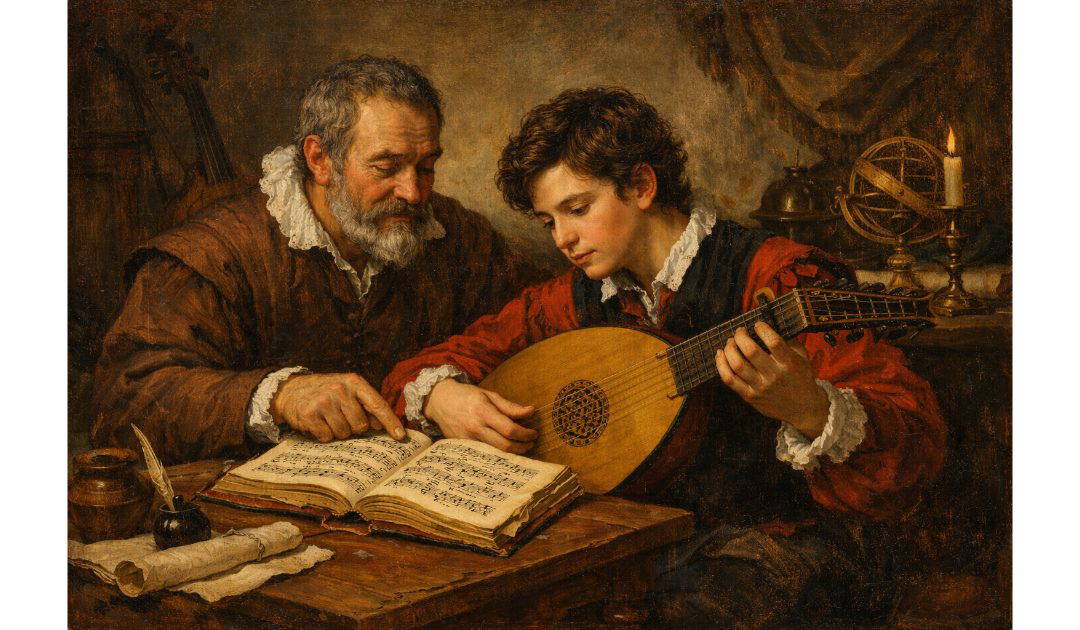
Fire and Earth, the second book in the Sir Anthony Standen Adventures, features Galileo Galilei. Today I shall write about his father. Vincenzo Galilei was an Italian composer, lutenist, and music theorist of the late Renaissance. Vincenzo’s contributions to music and intellectual life were significant, particularly in shaping the transition from Renaissance polyphony to the early Baroque style.
Born around 1520 in Florence, Vincenzo grew up in a cultural environment that was at the heart of the Italian Renaissance. Florence was a hub of artistic, scientific, and philosophical innovation, and this atmosphere deeply influenced his career. Although relatively little is known about his early life, he eventually became an accomplished performer on the lute, one of the most popular instruments of the period.
Vincenzo’s musical training was further refined under the guidance of Gioseffo Zarlino, a leading music theorist of the time. Zarlino was a master of the traditional contrapuntal style that dominated Renaissance music, characterized by complex interweaving vocal lines. However, Vincenzo would later challenge many of his teacher’s ideas, demonstrating a bold and independent intellectual spirit.
A key turning point in Vincenzo’s life came when he became associated with the Florentine Camerata, a group of humanists, musicians, poets, and scholars who gathered in Florence during the late 16th century. This circle included figures such as Giovanni de’ Bardi, who hosted discussions on art and culture. The Camerata sought to revive what they believed to be the expressive power of ancient Greek music and drama, which they felt had been lost in the dense polyphony of Renaissance compositions.
Vincenzo played an important role in these discussions, contributing both practical musicianship and theoretical insight. He became a strong critic of overly complex polyphonic music, arguing that it obscured the clarity of text and emotional expression. Instead, he advocated for a simpler style in which a single melodic line, supported by harmonic accompaniment, would allow the words to be clearly understood and emotionally conveyed. This approach laid the groundwork for the development of monody and, ultimately, opera.
His most influential written work, Dialogo della musica antica et della moderna (Dialogue on Ancient and Modern Music), published in 1581, reflects these ideas. In this treatise, Vincenzo used a conversational format to compare ancient Greek musical practices with those of his own time. He criticized contemporary composers for prioritizing technical complexity over expressive clarity and argued for reforms that would restore music’s emotional impact. The book became an important statement of the Camerata’s ideals and influenced future generations of composers.
In addition to his theoretical work, Vincenzo was also an innovator in the scientific study of music. He conducted experiments on strings and pitch, investigating how tension, length, and thickness affected sound. These experiments were among the earliest systematic studies of acoustics and demonstrate a proto-scientific approach that would later be reflected in the work of his son Galileo. Indeed, Vincenzo’s willingness to question established authority and rely on observation and experiment probably had a profound influence on Galileo’s development as a scientist.
As a composer, Vincenzo wrote primarily for the lute and for voice, often favouring simpler textures that aligned with his theoretical views. While his music is not as widely performed today as that of some of his contemporaries, it represents an important step in the evolution of musical style during a period of transition. His compositions reflect a move away from the intricate polyphony of the Renaissance toward a more direct and expressive musical language.
Vincenzo also played a central role in his family’s intellectual life. He ensured that his children, including Galileo, received a solid education. Galileo himself initially pursued music and was a skilled lutenist, a testament to his father’s influence. However, Vincenzo encouraged him to study mathematics and science, fields that offered more stable career prospects.
Despite his achievements, Vincenzo did not enjoy great financial success. Like many musicians of his time, he relied on patronage and struggled to secure consistent income. Nevertheless, his intellectual legacy proved far more enduring than his material circumstances might suggest.
Vincenzo Galilei died on the 2nd of July, 1591, leaving behind a body of work that bridged the worlds of music, science, and humanist thought. His contributions to musical theory helped inspire the changes that led to the birth of opera and the Baroque style. At the same time, his experimental approach to understanding sound foreshadowed the scientific revolution that his son would help to lead.
Today, Vincenzo Galilei is remembered not only as the father of Galileo but as an important figure in his own right—a musician and thinker whose ideas helped reshape the course of Western music and contributed to a broader shift toward observation, experimentation, and expressive clarity.