
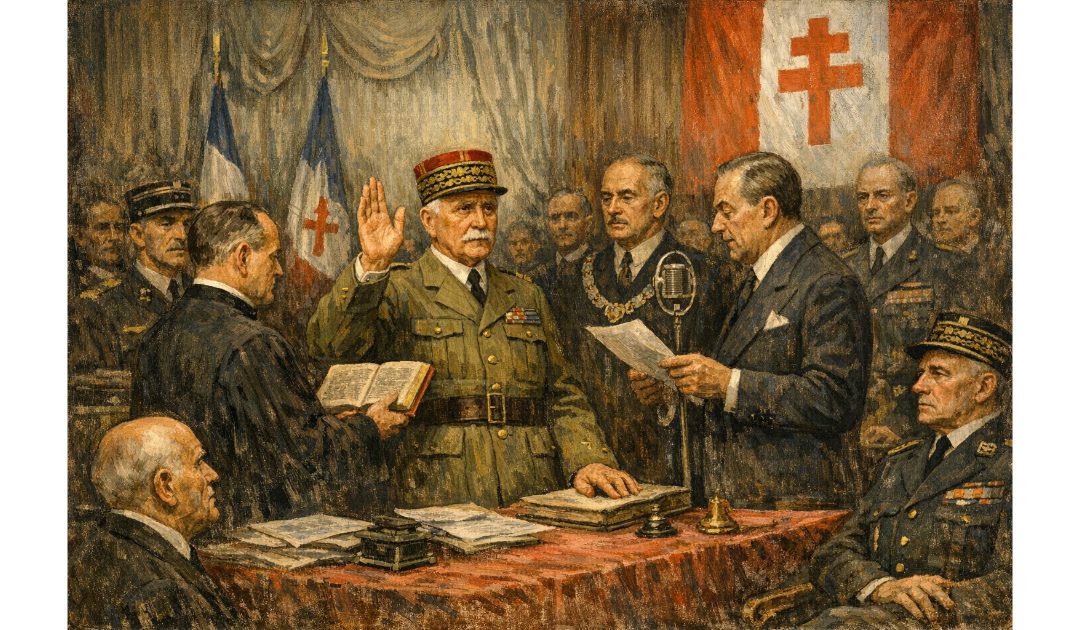
On the 16th of June, 1940, Henri Philippe Pétain became chief of state of Vichy France. Henri Philippe Pétain was one of the most controversial figures in modern French history. Revered as a national hero after the First World War, he later became the leader of the authoritarian regime that governed unoccupied France during much of the Second World War. His career therefore spans both national glory and national disgrace.
Pétain was born on the 24th of April, 1856, in the village of Cauchy-à-la-Tour in northern France. He joined the French army as a young man and rose slowly through the ranks. Unlike many officers of his time, he believed that defensive tactics and careful use of artillery were more effective than reckless offensives. His ideas were not widely appreciated before the First World War, but the terrible realities of modern warfare soon proved his views correct.
His reputation was made during the Battle of Verdun in 1916, one of the longest and most brutal engagements of the First World War. When the German army launched a massive offensive against the fortress city of Verdun, Pétain was given command of the French forces defending it. Through careful organisation, constant reinforcement, and a determination to maintain morale, he managed to prevent the Germans from breaking through. His famous phrase “Ils ne passeront pas” (“They shall not pass”) became a symbol of French resistance. The successful defence of Verdun turned him into a national hero.
After the war, Pétain became one of France’s most respected military leaders. He served as a marshal of France and later held several senior positions, including minister of war and ambassador to Spain. By the late 1930s he was an elderly but highly respected figure, widely regarded as a symbol of stability and patriotism.
This reputation played a crucial role in the crisis of 1940. When Nazi Germany launched its invasion of France during the Battle of France, the French army collapsed with alarming speed. German forces bypassed the Maginot Line and swept through the Low Countries before driving deep into France. As defeat became inevitable, the French government faced a critical decision: continue fighting from overseas territories or seek an armistice with Germany.
Pétain, who had been appointed prime minister in June 1940, argued strongly that France should stop fighting to prevent further destruction and loss of life. On the 22nd of June, 1940, France signed an armistice with Germany. The country was divided into two main zones: the northern and western regions were occupied by German forces, while the southern part remained nominally independent under a new government based in the spa town of Vichy.
This regime became known as Vichy France. In July 1940 the French parliament voted to grant Pétain extraordinary powers, effectively ending the democratic Third Republic. Pétain assumed the title “Chief of the French State” and established an authoritarian government that rejected many republican principles. His regime promoted a conservative ideology known as the “National Revolution,” emphasising traditional values such as family, religion, and rural life. The regime’s motto replaced the republican slogan “Liberty, Equality, Fraternity” with “Work, Family, Fatherland.”
Although Vichy France retained limited autonomy, it collaborated extensively with Nazi Germany. The government cooperated with German authorities in political, economic, and military matters. It also implemented harsh policies against political opponents, communists, and especially Jews. Vichy authorities introduced anti-Jewish legislation and assisted in the deportation of thousands of Jews to Nazi concentration camps.
This collaboration deeply divided French society. Some officials believed cooperation would protect France from harsher German control, while others saw it as a betrayal of national honour. Opposition to the regime developed both inside and outside the country. The most famous resistance leader was Charles de Gaulle, who fled to Britain and called on French citizens to continue fighting alongside the Allies.
As the war progressed, Vichy’s independence diminished further. In 1942, after Allied forces landed in North Africa, Germany occupied the previously unoccupied southern zone of France. From that point onward the Vichy government had even less real power and functioned largely under German supervision.
The regime came to an end in 1944 after the Allied invasion of Normandy and the liberation of France. Pétain was taken to Germany by the retreating Germans but later returned to France to face trial. In 1945 he was tried for treason. The court found him guilty and sentenced him to death, though the sentence was commuted to life imprisonment because of his advanced age and his earlier service during the First World War.
Pétain spent the final years of his life imprisoned on the island of Île d’Yeu, where he died in 1951 at the age of ninety-five.
Today, the legacy of Pétain remains highly controversial in France. To some he was the hero of Verdun who tried to shield his country from total destruction; to many others he was the leader of a regime that collaborated with Nazi Germany and participated in persecution and repression. His life therefore represents one of the most dramatic and troubling transformations of any figure in modern European history.