
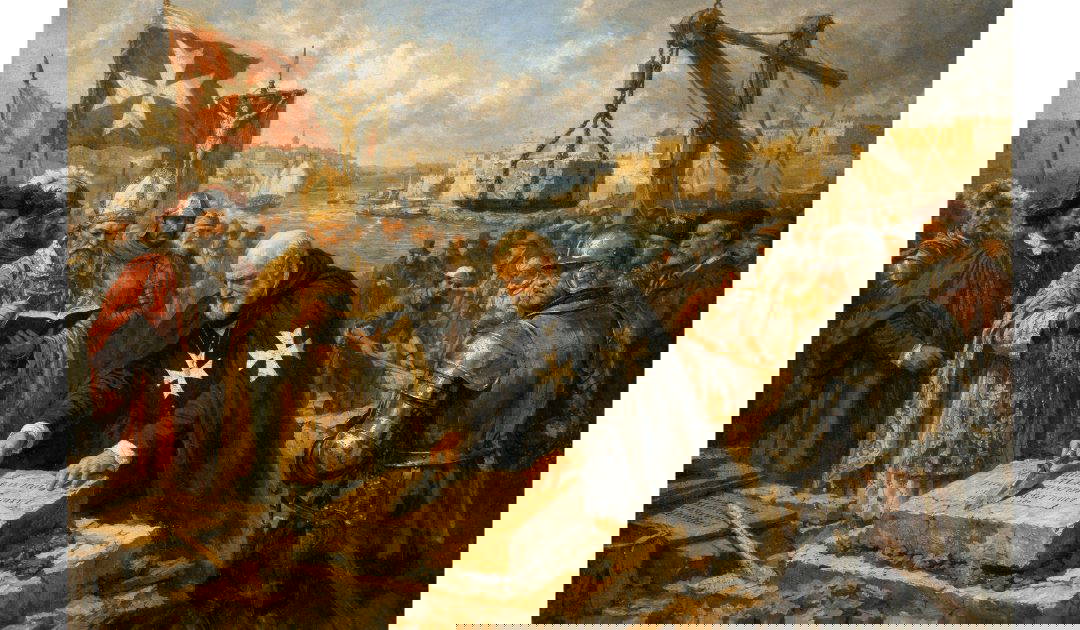
- On the 28th of March, 1566, the foundation stone of Valletta was laid by Jean Parisot de Valette. I have only been to Malta once, and that was to learn to scuba dive in 1988.
Jean Parisot de Valette (1494–1568) stands as one of the most formidable figures in the long history of the Order of Saint John of Jerusalem. Remembered above all as the Grand Master who led the Knights Hospitaller through the Great Siege of Malta in 1565 and then laid the foundations of the fortified city that would bear his name, Valletta, he embodied the austere, martial, and religious ideals of the Order at a moment when the Mediterranean world was locked in a titanic struggle between Christian Europe and the expanding Ottoman Empire.
Born in 1494 into a noble but not especially wealthy family in Quercy, in southern France, de Valette entered the Order of St John at a young age. The Order, originally founded during the Crusades as a hospitaller brotherhood caring for pilgrims in Jerusalem, had by the sixteenth century become a powerful military and naval institution. After the loss of Rhodes to the Ottomans in 1522, the Knights had wandered for several years before receiving Malta from Emperor Charles V in 1530. This small, rocky island, lying between Sicily and North Africa, became their new bastion against Ottoman expansion.
De Valette’s early career in the Order was marked by long years of naval warfare against Muslim corsairs and Ottoman fleets. He served in the galleys of the Knights, taking part in raids, sea battles, and the brutal life of Mediterranean naval campaigning. At one point he was captured by Ottoman forces and spent a year as a galley slave before being ransomed. This experience left a profound mark on him. He came to know the enemy not in theory but in chains, rowing under the lash. It hardened his resolve and gave him a lifelong hatred of Ottoman power, as well as an intimate understanding of its methods.
Rising steadily through the ranks, de Valette became known for his discipline, piety, and uncompromising sense of duty. In 1557 he was elected Grand Master of the Order. By then he was already in his sixties, but age had not diminished his energy or authority. As Grand Master, he focused on strengthening Malta’s defences and improving the Order’s naval capacity. He understood clearly that the Ottoman Empire, under Sultan Suleiman the Magnificent, would not tolerate the Knights’ presence for long. Malta’s position made it a constant threat to Ottoman shipping and North African corsair bases. A confrontation was inevitable.
That confrontation came in 1565, when a vast Ottoman armada arrived off Malta carrying perhaps 30,000 to 40,000 men, including elite Janissaries, under the command of Lala Mustafa Pasha and the famed admiral Piyale Pasha. The Ottoman objective was simple: crush the Knights, seize Malta, and use it as a base for further operations into the western Mediterranean, possibly even against Sicily and southern Italy.
De Valette, then seventy-one years old, commanded a defending force of perhaps 6,000 to 8,000 men, including around 500 Knights, Maltese militia, Spanish and Italian soldiers, and mercenaries. The odds were daunting. Yet from the outset de Valette displayed extraordinary leadership. He refused to consider surrender and insisted that every fort and position be held to the last.
The siege began with the Ottoman assault on Fort St Elmo, which guarded the entrance to the Grand Harbour. For weeks the fort endured relentless bombardment and repeated attacks. De Valette reinforced it whenever possible, knowing that its resistance was buying precious time. When it finally fell in June, the defenders were massacred, but they had inflicted enormous losses on the Ottomans, including the death of the brilliant corsair commander Dragut.
The struggle then shifted to the main strongholds of Birgu (Vittoriosa) and Senglea. De Valette was everywhere—inspecting defences, encouraging soldiers, directing artillery, and personally fighting in the thick of combat when necessary. Contemporary accounts describe him as calm, stern, and utterly fearless. He rejected all Ottoman offers of terms. The defenders endured bombardment, starvation, disease, and constant assaults, but morale held under his example.
By September, the Ottoman army was exhausted. Reinforcements from Sicily were approaching, and the besiegers, having suffered catastrophic casualties, finally withdrew. The Great Siege of Malta had become one of the defining events of the age. It was celebrated across Europe as a miraculous deliverance and a decisive check to Ottoman expansion.
De Valette’s victory, however, did not lead to complacency. He knew that Malta must be made impregnable against any future attack. Almost immediately he began plans for a new fortified city on the Sciberras Peninsula, the site that had been heavily contested during the siege. In 1566 he ceremonially laid the foundation stone of what would become Valletta. Designed with the latest principles of Renaissance military engineering, the city was intended as both a fortress and a symbol of the Order’s resilience.
Valletta rose rapidly, funded by contributions from Catholic powers across Europe, who saw it as a bulwark of Christendom. De Valette did not live to see its completion, but his vision shaped its character: disciplined, orderly, and defensive, yet also marked by churches, auberges, and hospitals reflecting the Order’s dual military and charitable mission.
Jean Parisot de Valette died in 1568 and was buried in the city that bore his name. Later generations remembered him as the saviour of Malta and one of the great defenders of Europe in the sixteenth century. His legacy was not merely military. He represented the enduring spirit of the Knights Hospitaller: a combination of religious devotion, martial skill, and administrative foresight.
In an era when the Mediterranean was the frontline of a vast cultural and religious conflict, de Valette’s steadfastness altered the balance of power. The survival of Malta ensured that the Knights remained a significant naval force and that the Ottoman advance into the western Mediterranean was checked. His life, forged in hardship and crowned in victory, remains inseparable from the story of Malta itself and from the city of Valletta, which still stands as his monument.