
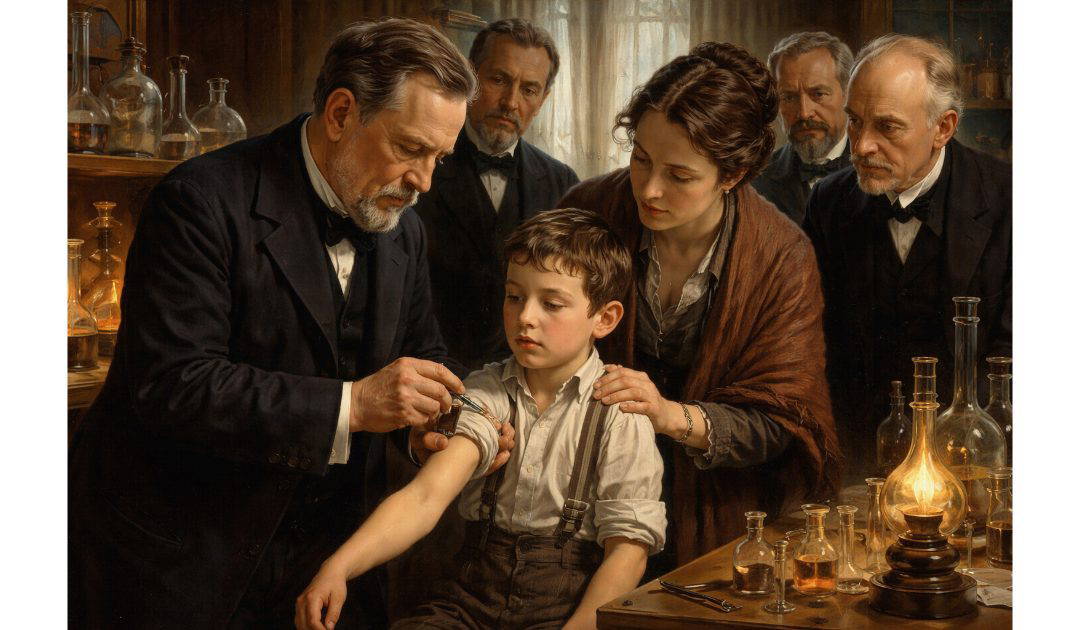
On the 6th of July, 1885, Louis Pasteur successfully tested his vaccine against rabies on Joseph Meister, a boy who had been bitten by a rabid dog. Pasteur got a mention in my post on antiseptics, but let us look into vaccination.
The origins of vaccination can be traced to practices in Asia and the Middle East long before modern science. In China and parts of the Ottoman Empire, a method known as variolation was used to protect against smallpox. This involved deliberately exposing a healthy person to material taken from a mild case of the disease, usually by scratching the skin or inhaling dried scabs. Although risky, variolation often resulted in a less severe infection and subsequent immunity. The practice was introduced to Britain in the early eighteenth century by Lady Mary Wortley Montagu, who had observed it in Constantinople and advocated for its use after having her own children inoculated.
The true breakthrough in vaccination came with the work of Edward Jenner in 1796. Jenner, a country doctor in Gloucestershire, noticed that milkmaids who had contracted the relatively mild disease cowpox seemed immune to smallpox. To test his theory, he inoculated a young boy with material from a cowpox sore and later exposed him to smallpox. The boy did not become ill, demonstrating that exposure to cowpox conferred protection. Jenner called his method “vaccination,” from the Latin vacca, meaning cow. His work laid the foundation for immunology and marked the beginning of scientific vaccine development.
Throughout the nineteenth century, vaccination gradually spread, although it was sometimes met with resistance due to fear, religious objections, and concerns about safety. Nevertheless, governments began to recognise its value, and compulsory vaccination laws were introduced in several countries, including Britain. These measures significantly reduced the incidence of smallpox, which had been a major cause of death for centuries.
The next major advances came with the work of Louis Pasteur in the late nineteenth century. Pasteur expanded Jenner’s principles by developing vaccines for diseases such as rabies and anthrax. He demonstrated that pathogens could be weakened, or attenuated, in the laboratory and then used to stimulate immunity without causing severe illness. Pasteur’s work also helped establish the germ theory of disease, providing a scientific explanation for how vaccines function.
The twentieth century saw rapid progress in vaccine development, driven by advances in microbiology, chemistry, and medicine. Vaccines were created for diseases such as diphtheria, tetanus, and whooping cough, often combined into a single immunisation. The development of the polio vaccine in the 1950s was particularly significant. Jonas Salk created an inactivated polio vaccine, while Albert Sabin later developed an oral version using a weakened live virus. These vaccines dramatically reduced the incidence of polio, a disease that had caused widespread paralysis and fear.
One of the greatest triumphs of vaccination came in 1980, when the World Health Organization declared smallpox eradicated following a global vaccination campaign. This marked the first—and so far only—complete eradication of a human infectious disease, highlighting the power of coordinated public health efforts.
In recent decades, vaccine technology has continued to evolve. New methods, including recombinant DNA technology and mRNA vaccines, have revolutionised the field. The rapid development of vaccines against COVID-19 in 2020 demonstrated the potential of these innovations. I have mentioned the role of Oxford University in the development of a Covid-19 vaccine. Scientists were able to design, test, and distribute vaccines in record time, helping to control a global pandemic.
Despite their success, vaccines have also been the subject of controversy. Misinformation and scepticism have led to declining vaccination rates in some areas, resulting in the resurgence of diseases once thought under control. Public health organisations continue to emphasise the safety and importance of vaccines in preventing outbreaks and protecting vulnerable populations.
Today, vaccines remain a cornerstone of modern medicine. They not only protect individuals but also contribute to herd immunity, reducing the spread of disease within communities. Research continues into vaccines for conditions such as malaria, HIV, and even certain cancers, offering hope for further breakthroughs.