
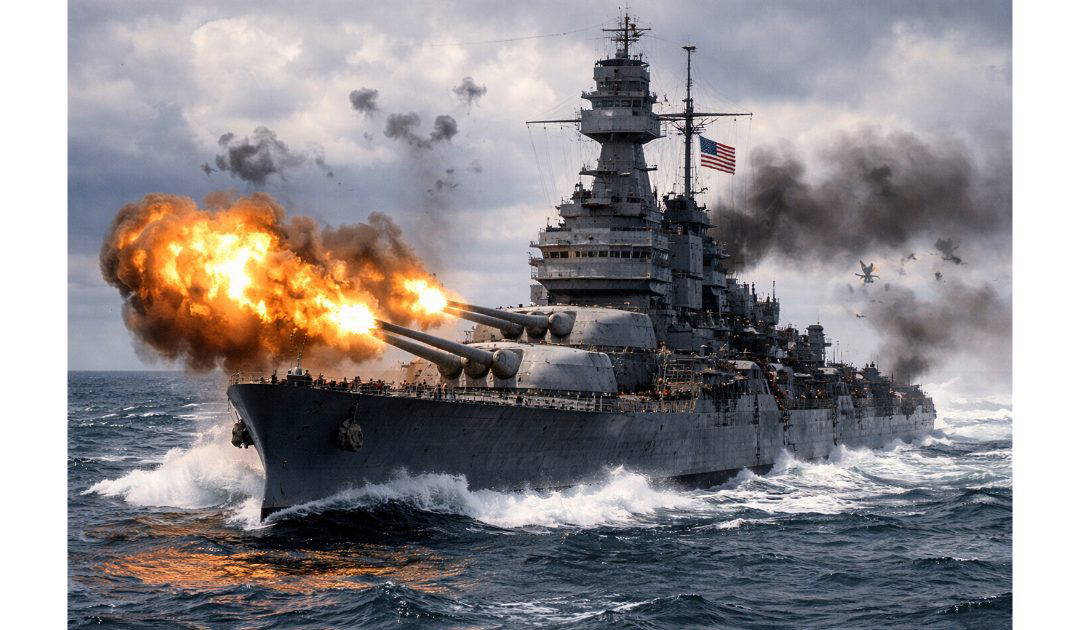
The event that catches my attention for the 31st of July is the sinking of the USS Nevada. The phrase that caught my attention is: “USS Nevada is sunk by an aerial torpedo after surviving hits from two atomic bombs (as part of post-war tests) and being used for target practice by three other ships.” That was one resilient ship.
USS Nevada (BB-36) was one of the most important and innovative battleships in the history of the United States Navy, serving with distinction across both world wars and symbolising a turning point in naval design.
Commissioned in 1916, the USS Nevada represented a new generation of “standard-type” battleships. She was built with several revolutionary features that would influence warship construction for decades. Among these were the adoption of oil-fired boilers instead of coal, which increased efficiency and range, and the introduction of the “all-or-nothing” armour scheme. This concept concentrated heavy armour around the most vital parts of the ship—such as magazines and engine spaces—while leaving less critical areas unprotected. The result was a more survivable vessel without excessive weight.
Armed with ten 14-inch guns mounted in four turrets, the Nevada was a formidable opponent. Her firepower, combined with improved armour and propulsion, made her one of the most advanced battleships in the world at the time of her commissioning. During the First World War, however, she saw limited combat, primarily serving in a defensive role protecting shipping lanes in the Atlantic.
It was during the Second World War that the Nevada earned her place in history. On the 7th of December, 1941, she was moored at Pearl Harbor when Japanese forces launched their surprise attack. Of all the battleships present, the Nevada was the only one able to get underway during the assault. This dramatic attempt to escape the harbour made her a conspicuous target for Japanese bombers and torpedo planes. Despite being struck by at least one torpedo and multiple bombs, the ship continued moving for a time before being deliberately beached to prevent her from sinking and blocking the harbour entrance.
Images of the Nevada, battered but still afloat and flying the American flag, became an early symbol of resistance in the Pacific War. Though heavily damaged, she was eventually salvaged and underwent extensive repairs and modernisation. This refit significantly improved her anti-aircraft armament and updated her systems, preparing her for further combat.
Returning to service in 1942, the Nevada participated in several key operations. In the European theatre, she provided naval gunfire support during the D-Day landings in Normandy in June 1944, bombarding German positions to aid Allied troops coming ashore. Later, she took part in the invasion of southern France, continuing her role as a powerful artillery platform.
The Nevada was then transferred back to the Pacific, where she supported amphibious assaults on Japanese-held islands, including Iwo Jima and Okinawa. In these operations, her heavy guns were used to destroy fortifications, artillery positions, and defensive structures, demonstrating the continued importance of battleships in shore bombardment even as aircraft carriers became dominant at sea.
Despite her age—by this point nearly three decades old—the Nevada proved remarkably durable and adaptable. She survived not only the attack on Pearl Harbor but also the intense demands of modern naval warfare, including air attacks and kamikaze threats.
After the war, the Nevada’s long service came to a dramatic and unusual end. In 1946, she was selected as a target ship for atomic bomb tests at Bikini Atoll, part of Operation Crossroads. Subjected to two nuclear explosions—one airburst and one underwater detonation—the Nevada absorbed tremendous damage but remained afloat. This endurance underscored both the strength of her design and the destructive power of nuclear weapons, which rendered traditional battleships increasingly obsolete.
Too damaged and radioactive to return to service, the Nevada was eventually sunk in 1948 during naval gunfire exercises. Even in her final moments, she proved difficult to destroy, requiring sustained bombardment before finally going down.
The legacy of the USS Nevada is multifaceted. As a pioneer of modern battleship design, she influenced the construction of subsequent warships not only in the United States but around the world. Her service record—spanning two world wars, surviving Pearl Harbor, and participating in major amphibious operations—demonstrates both resilience and adaptability.
More broadly, the Nevada represents the transition from the era of heavily armoured battleships to the age of air power and nuclear weapons. She began her career as a symbol of naval might in the early twentieth century and ended it as a witness to the dawn of the atomic age.
Few ships have experienced such a wide range of historic moments. From the calm before the storm at Pearl Harbor to the beaches of Normandy and the nuclear tests in the Pacific, the USS Nevada stands as a remarkable testament to the evolution of naval warfare and the endurance of those who served aboard her.