
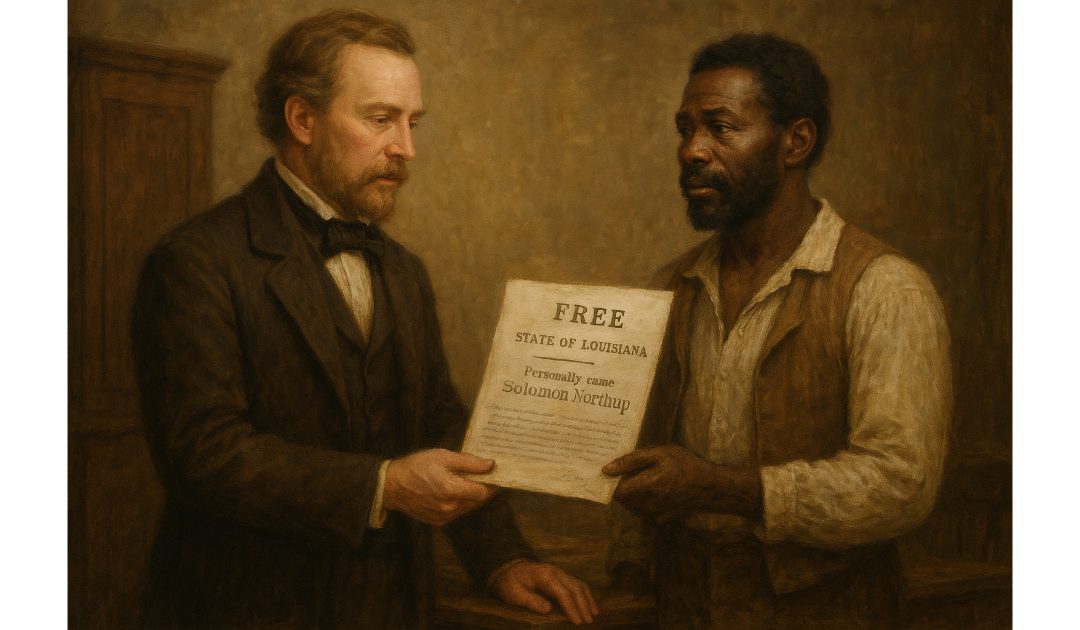
On the 4th of January, 1853, after having been kidnapped and sold into slavery, Solomon Northup regained his freedom. His memoir, Twelve Years a Slave, became a bestseller.
Northup was born in July 1808 in Minerva, New York, into a free Black family. His father, Mintus Northup, had once been enslaved but was freed by his owner, and he worked hard to give his children a stable upbringing. Solomon grew up on the family farm and received a modest education, which was unusual for many free Black individuals at the time. He learned to read and write, and he developed a passion for music, becoming a talented violinist, a skill that would play a significant role in his life.
In 1829, Solomon married Anne Hampton, a woman of mixed African American and Native American heritage, and the couple had three children. The Northups lived in Saratoga Springs, New York, where Solomon earned a living through a combination of farming, labouring, and performing music at social events. His musical talent made him well-known in his community and ultimately led to the fateful encounter that changed his life.
In 1841, Solomon was approached by two men who offered him a job as a musician with a travelling circus. Believing it to be a legitimate opportunity, he travelled with them to Washington, D.C., where slavery was still legal. There, he was drugged, kidnapped, and sold into slavery under the false name “Platt.” He was transported to New Orleans, one of the largest slave markets in the country, and sold to a series of owners in Louisiana.
Northup spent the next twelve years enduring the harsh conditions of plantation life in the Deep South. His narrative vividly describes the physical and emotional suffering he experienced, the cruelty of some of his masters, and the exploitation of enslaved people. He worked on cotton and sugar plantations, facing relentless labour and violence. Despite this, he retained hope of regaining his freedom, and his literacy and intelligence helped him navigate the treacherous environment. He carefully avoided revealing his status as a free man to most people, knowing that discovery could result in death.
A turning point came when Northup encountered a Canadian carpenter named Samuel Bass, who was sympathetic to the plight of enslaved people. Bass agreed to send letters to Northup’s family and friends in New York, describing his situation and location. These letters eventually reached Henry B. Northup, a white lawyer and longtime family friend who was distantly related to the family that had once enslaved Solomon’s father. Henry journeyed to Louisiana with the legal paperwork proving Solomon’s free status. In January 1853, after twelve long years, Solomon Northup was legally freed and returned home to his family.
Soon after his rescue, Northup collaborated with a white abolitionist writer, David Wilson, to publish his memoir Twelve Years a Slave. The book became an immediate bestseller in the United States and the United Kingdom, selling thousands of copies within its first year. It provided a detailed, first-hand account of enslavement from the perspective of a free Black man and served as a powerful tool for the abolitionist movement. Northup’s descriptive storytelling and his unflinching portrayal of the cruelty of slavery helped sway public opinion in the years leading up to the American Civil War.
After the publication of his book, Northup dedicated himself to the abolitionist cause, giving lectures and supporting efforts to end slavery. However, the details of his later life are uncertain. He is believed to have continued his activism, possibly assisting in the Underground Railroad, but historical records of his final years are scarce. His exact date and circumstances of death remain unknown.
Solomon Northup’s legacy lives on through his narrative, which remains a crucial historical document. Twelve Years a Slave not only exposes the inhumanity of the slave system but also demonstrates the resilience of the human spirit in the face of profound injustice. The book has been studied for generations and gained renewed attention with the 2013 Academy Award-winning film adaptation, ensuring that Northup’s voice continues to be heard more than 150 years after his ordeal.