
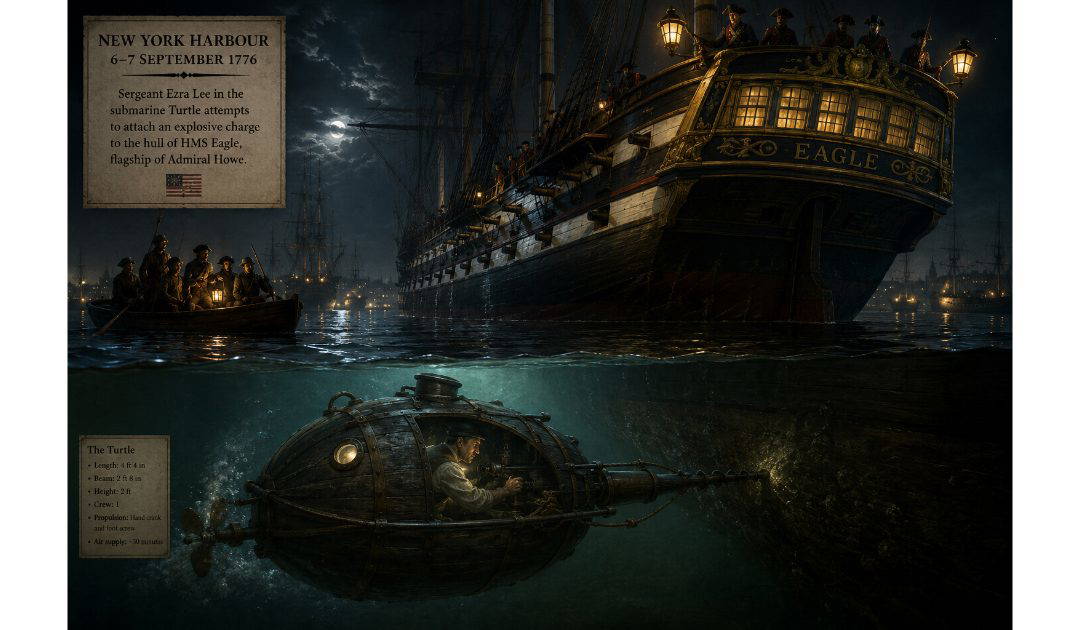
The problem with daily historical posts is that you risk repeating yourself. For the 7th of September I was drawn to the arrest of Thomas Howard for his part in the Ridolfi Plot, to assassinate Queen Elizabeth I and put Mary Queen of Scots on the throne. But I’ve done it. Then I found the first submarine attack in the Turtle. I thought I’d already done it, but I hadn’t. It was in 1776, on the 7th of September Ezra Lee made the first submarine attack on HMS Eagle in New York harbour. He attempted to attach a time bomb to the hull, but failed. No British record of the event exists, possibly because since it failed, they didn’t know about it.
Ezra Lee (1749–1821) occupies a unique place in military history as the first person to carry out a combat mission in a submarine. Although his daring attempt failed to sink its target, his voyage in the experimental Turtle submarine during the American Revolutionary War marked the beginning of undersea warfare and demonstrated extraordinary courage and determination.
Lee was born in Lyme, Connecticut, in August 1749. Little is known about his early life, but when the American colonies rebelled against British rule he enlisted in the Continental Army. On the 1st of January, 1776, he joined the 10th Continental Regiment as a sergeant. His reputation as a capable and dependable soldier eventually brought him to the attention of Brigadier General Samuel Holden Parsons, who recommended him for one of the war’s most secret and unusual assignments.
The assignment centred upon an invention by the Connecticut engineer David Bushnell. Bushnell had designed what is generally regarded as the world’s first practical military submarine. Known as the Turtle because its shape resembled two turtle shells joined together, the vessel was a remarkable feat of engineering. Constructed mainly of oak, it was just large enough for one man to sit inside. The operator propelled it using hand-cranked and foot-operated propellers, controlled its depth by admitting or pumping out water ballast, and navigated using simple instruments illuminated by naturally glowing foxfire. It carried only about thirty minutes of breathable air before the pilot needed to surface.
Bushnell had intended that his own brother should operate the submarine, but illness prevented him from doing so. Several volunteers were trained, and after weeks of practice Ezra Lee proved the most competent. His mission was extraordinarily dangerous. The British fleet had occupied New York Harbour following their victory on Long Island, and Admiral Richard Howe’s flagship, HMS Eagle, lay at anchor as a symbol of British naval power. If Eagle could be destroyed, it might damage British morale and perhaps disrupt the blockade of New York.
On the night of 6th–7th of September, 1776, Lee was towed close to the British fleet before entering the Turtle alone. He then began the slow, exhausting task of propelling the submarine towards HMS Eagle. Every movement required physical effort. Steering, maintaining depth and direction, watching the instruments and conserving his limited air supply all had to be performed simultaneously. Darkness, tidal currents and unfamiliar conditions made the mission even more difficult.
After nearly two hours Lee succeeded in manoeuvring beneath the stern of the British warship. His plan was to drill a hole into the hull using a hand-operated auger and attach a timed explosive charge. Once fixed, he would withdraw to a safe distance before the explosive detonated.
This was the crucial moment, and it did not go according to plan. Lee repeatedly attempted to bore into the ship’s underside but met an unexpected obstruction. Bushnell later believed the drill had struck an iron fitting associated with the rudder, while other historians have suggested Lee encountered metal sheathing protecting the hull. Whatever the exact cause, the drill simply would not penetrate. Having constructed a new frame for Claire’s garden swing, from inch thick oak, in ideal conditions with an electric drill, I can offer an expert opinion. It isn’t as easy as it might sound. I think I got through four drill bits. Anyway, back to Ezra Lee. As precious minutes passed, Lee’s air supply dwindled and dawn approached. Realising that remaining beneath the ship would almost certainly lead to capture or death, he abandoned the attempt.
During his escape, British soldiers apparently noticed the strange object moving through the water and gave chase in rowing boats. Lee released the explosive charge into the harbour, believing his pursuers might investigate it. Instead they prudently withdrew. Some time later the timed device exploded spectacularly, throwing water and debris high into the air but causing no damage to British shipping. Lee escaped safely back to the American lines.
Although the attack failed, George Washington is said to have congratulated Lee personally for his bravery. Lee was subsequently employed on further secret service missions, and another attempt was made against a British vessel, though it too proved unsuccessful. Not long afterwards, the Turtle itself was lost when the vessel transporting it was sunk by British forces. Bushnell later recovered parts of the submarine, but its ultimate fate remains uncertain.
Ezra Lee lived until 1821, long enough to see the United States firmly established as an independent nation. His remarkable exploit remained largely forgotten for many years, overshadowed by larger battles and more famous commanders. Today, however, historians recognise that his lonely voyage beneath New York Harbour represented the world’s first submarine attack in warfare. Modern submarines, with their nuclear reactors, sonar and guided missiles, are vastly more sophisticated than Bushnell’s tiny wooden craft, yet they all trace part of their heritage to that hazardous night in September 1776 when Sergeant Ezra Lee became the pioneer of underwater combat.