
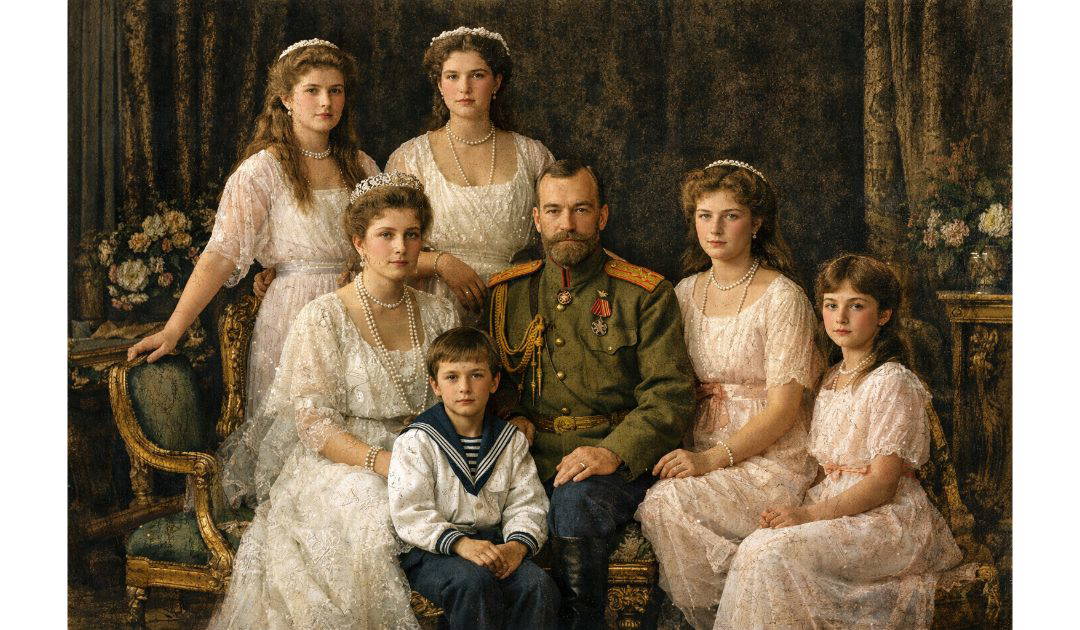
On the 17th of July, 1918, Tsar Nicholas II was executed along with his immediate family and retainers by Bolshevik Chekists at the Ipatiev House in Yekaterinburg, Russia. I wrote a little about the Russian Revolution in my post on Leon Trotsky.
Nicholas II of Russia was the last Tsar of Russia, ruling from 1894 until his abdication in 1917. His reign marked the end of more than three centuries of Romanov rule and was defined by a mixture of personal devotion to his family, deep religious conviction, and political misjudgement that contributed to the collapse of imperial Russia.
Born in 1868, Nicholas Alexandrovich Romanov was the eldest son of Alexander III of Russia and Empress Maria Feodorovna. He received a traditional education suitable for a future autocrat but was not particularly well prepared for the demands of ruling a vast and complex empire. When his father died suddenly in 1894, Nicholas ascended the throne at the age of twenty-six. By temperament, he was reserved, courteous, and devoted to his family, but he lacked the decisiveness and political skill that the role required.
Soon after becoming Tsar, Nicholas married Alexandra Feodorovna, a German princess and granddaughter of Queen Victoria. Nicholas was also a cousin to King George V, so he was closely related to the British Royal Family by both blood and marriage. The marriage was deeply affectionate, and together they had five children: four daughters—Olga, Tatiana, Maria, and Anastasia—and a son, Alexei. The birth of Alexei in 1904 was particularly significant, as he was the long-awaited male heir. However, he suffered from haemophilia, a serious genetic disorder that caused excessive bleeding. This condition had profound consequences for the family, increasing their reliance on the mystic Grigori Rasputin, whose apparent ability to ease Alexei’s suffering granted him considerable influence at court.
Nicholas II believed firmly in the principle of autocracy—the idea that the Tsar ruled by divine right and should not share power. This belief put him increasingly at odds with the changing political climate of early twentieth-century Russia, where calls for reform and greater representation were growing. His refusal to embrace meaningful constitutional change contributed to widespread dissatisfaction among workers, peasants, and intellectuals.
The first major crisis of his reign came with the disastrous Russo-Japanese War of 1904–1905. Russia’s unexpected defeat by Japan, a rising Asian power, shocked the nation and exposed the weaknesses of the imperial government and military. This humiliation helped spark the Russian Revolution of 1905, during which strikes, protests, and uprisings spread across the empire. One of the most infamous incidents was “Bloody Sunday,” when peaceful demonstrators were fired upon by troops in St Petersburg.
Under pressure, Nicholas reluctantly agreed to the creation of a legislative assembly, the Duma, and issued the October Manifesto, which promised limited civil liberties. However, he remained unwilling to share real power and repeatedly undermined the Duma, dissolving it when it challenged his authority. This half-hearted reform satisfied neither conservatives nor reformers, leaving the political situation unstable.
The outbreak of World War I in 1914 proved to be the final test of Nicholas’s rule. Russia entered the war driven by alliances and a desire to support fellow Slavic nations. Initially greeted with patriotic enthusiasm, the war soon turned disastrous. The Russian army suffered enormous losses, and the country faced severe shortages of food, fuel, and basic goods.
In 1915, Nicholas made the fateful decision to take personal command of the army at the front. While intended to inspire confidence, this move left the government in the hands of Alexandra, whose reliance on Rasputin further damaged the monarchy’s reputation. As conditions worsened, public confidence in the Tsar collapsed.
In early 1917, unrest in Petrograd escalated into mass protests and strikes, leading to the February Revolution. Faced with the breakdown of order and the loss of support from the military and political elite, Nicholas abdicated the throne in March 1917. His abdication marked the end of the Romanov dynasty and centuries of autocratic rule in Russia.
After his abdication, Nicholas and his family were placed under house arrest, first at Tsarskoye Selo and later in Siberia. Following the Bolshevik seizure of power in the October Revolution, their situation became increasingly precarious. In July 1918, they were executed by Bolshevik forces in the city of Yekaterinburg, bringing a tragic end to the imperial family.
Nicholas II remains a deeply controversial figure. To some, he was a devoted husband and father who faced overwhelming challenges beyond his capacity. To others, he was an ineffective ruler whose rigid adherence to autocracy and poor decisions contributed directly to the suffering of his people and the collapse of his empire. His reign stands as a poignant example of the dangers of inflexibility in a time of rapid social and political change, and his life and death continue to symbolise the dramatic end of imperial Russia.