
It’s the season of Strictly Come Dancing and The Celebrity Traitors for TV viewing in our household. What on earth was Richard E Grant thinking?
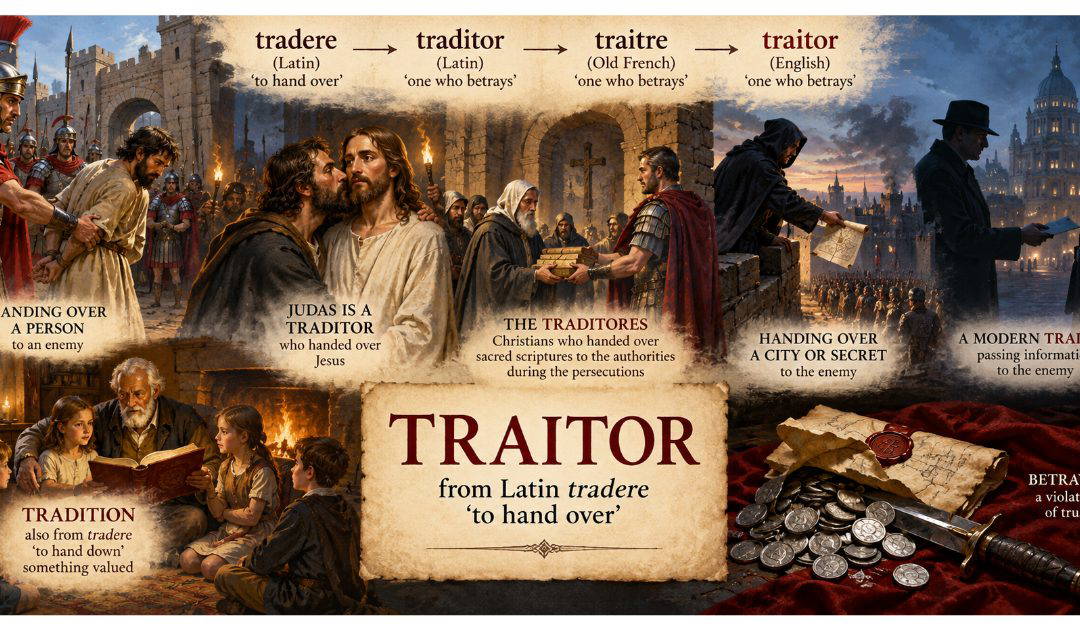
The word traitor has a history stretching back more than two thousand years, with its origins in Latin and a fascinating connection to the words tradition, trade and betrayal.
Its immediate ancestor is the Old French traitre, meaning someone who betrays another person, particularly one who violates an obligation of loyalty. The French inherited the word from the Latin traditor, meaning ‘one who hands over’ or ‘one who betrays’.
The Latin traditor derives from the verb tradere, composed of two elements: trans, meaning ‘across’ or ‘over’, and dare, meaning ‘to give’. Literally, therefore, tradere meant ‘to hand over’.
Originally, this was an entirely neutral expression. A Roman might “tradit” a document, property or responsibility to another person. However, handing something over could acquire a sinister meaning when the object being surrendered was a person, a city or a military secret. Thus, a traditor became someone who delivered another person into the hands of an enemy.
The word acquired particular significance in early Christianity. During the persecutions ordered by the Roman emperor Diocletian, beginning in AD 303, certain Christians surrendered sacred scriptures to the authorities rather than face punishment. These people became known as traditores, and the controversy surrounding their actions contributed to the Donatist schism in North Africa.
There is also a fascinating connection with Judas Iscariot. In the Latin Vulgate Bible, Judas is described as the traditor of Jesus Christ, the man who handed him over to his enemies. This association helped establish the word’s enduring connection with treachery.
The English word traitor appeared in Middle English during the thirteenth century, following the Norman Conquest’s profound influence on English vocabulary.
Interestingly, tradition comes from the same Latin verb, tradere. A tradition is something handed down from one generation to another. The difference between handing down cherished customs and handing over a friend to his enemies is enormous, yet both ideas share the same linguistic ancestry.
The related English word betray has a different history, deriving from the Old English betrēdan, meaning to deceive or lead astray.
Today, traitor retains its ancient association with violated trust. Whether applied to a political conspirator, a wartime collaborator or a disloyal friend, its underlying meaning remains remarkably consistent: someone who hands over what ought to have been protected.