
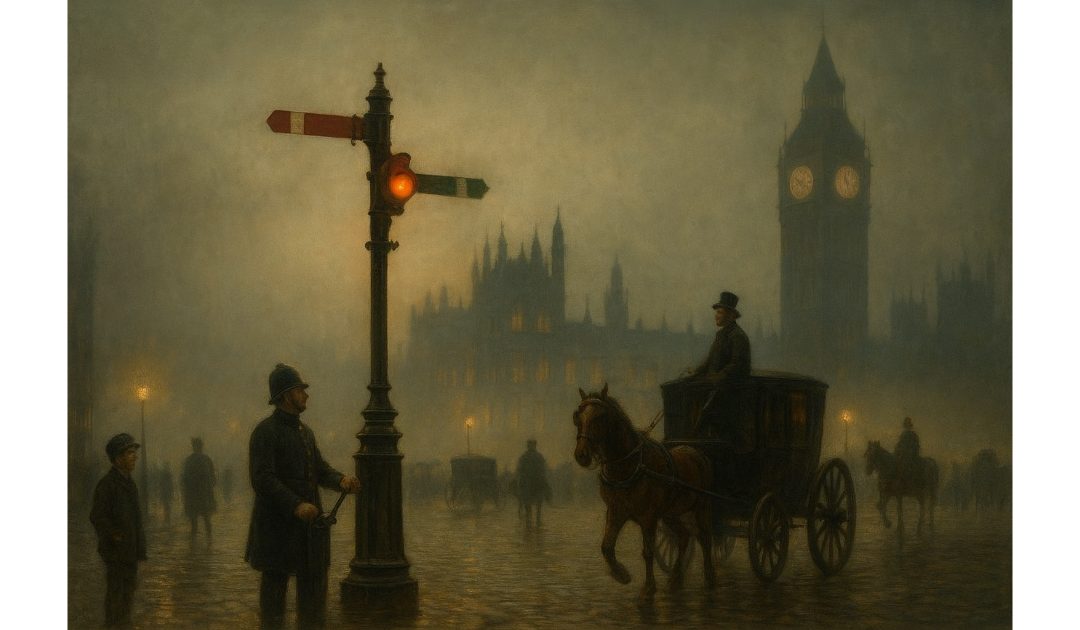
I have posted about a number of inventors and scientists, such as Edison and Einstein. Now it’s time to give policemen their due. On the 9th of December, 1868, the first traffic lights were installed outside the Palace of Westminster in London. They were modelled on railway signals with semaphore arms, and illuminated at night with red and green gas lamps. They were designed by railway engineer J. P. Knight. Policemen manually operated the signals to control horse-drawn carriages and pedestrians. Unfortunately, the gas-powered lights were prone to leaks, and an explosion in 1869 injured a police operator, discouraging further use of such devices at the time.
As cities grew and motor vehicles emerged at the turn of the twentieth century, the need for better traffic control became pressing. Early efforts still relied heavily on human intervention, with police officers using hand signals or mechanical signs. In the United States, a significant breakthrough came in 1912 when Lester Wire, a police officer in Salt Lake City, created one of the first electric traffic lights. His device used red and green lights mounted on a pole and was manually operated. This marked the shift from gas to electric illumination, increasing reliability and visibility.
In 1914, Cleveland, Ohio, introduced what is often cited as the first modern traffic light system. Installed at the intersection of East 105th Street and Euclid Avenue, it consisted of electric red and green lights and was controlled from a nearby booth by a police officer. Just two years later, in 1916, the city of San Francisco experimented with an automatic system that included an audible signal to warn when lights were about to change.
One of the most significant innovations in traffic signal history was the introduction of the amber, or yellow, light. This idea is credited to William Potts, a Detroit police officer, in 1920. The addition of the amber phase provided a transitional warning between stop and go, improving safety by reducing sudden stops and collisions. By the 1930s, the three-light system of red, amber, and green had become standard in many countries.
The interwar period also saw the development of automatic signal controllers using timers and electromechanical switches, allowing lights to change without direct human oversight. These systems steadily replaced the need for police officers at busy junctions and laid the groundwork for traffic networks in growing cities.
After the Second World War, the rapid rise of car ownership demanded further improvements in traffic management. In the 1950s and 1960s, engineers began experimenting with interconnected traffic signals, where multiple lights were coordinated to create smoother flows along main roads. This period also saw the first attempts at using sensors, such as pressure plates embedded in the road, to detect vehicles and adjust timings automatically.
The late twentieth century marked the era of computerised traffic control. In the 1970s and 1980s, cities began implementing centralised systems that could adjust traffic signal timings in response to real-time conditions. Cameras, inductive loops, and increasingly sophisticated sensors allowed for adaptive traffic management, reducing congestion and improving safety. Systems such as SCOOT (Split Cycle Offset Optimisation Technique) in the UK and SCATS (Sydney Coordinated Adaptive Traffic System) in Australia became influential models adopted worldwide.
Today, traffic signals are an integral part of intelligent transportation systems. Many modern lights are equipped with LED technology, which is brighter, more energy-efficient, and longer-lasting than traditional incandescent bulbs. They are often integrated with pedestrian push buttons, countdown timers, and auditory signals to ensure accessibility for all road users, including those with visual or hearing impairments.
Looking ahead, the future of traffic signals may see even greater integration with smart city infrastructure and autonomous vehicles. Some cities are experimenting with vehicle-to-infrastructure communication, where traffic signals can interact with cars to optimise traffic flow and reduce accidents. In time, artificial intelligence could manage entire networks dynamically without the rigid cycles we see today.
From its humble beginnings with gas-lit semaphore arms to today’s advanced, sensor-driven systems, the history of traffic signals reflects society’s ongoing efforts to make roads safer and more efficient. As urban populations continue to grow, the innovation that has driven traffic signal development for over 150 years will remain essential for the movement of people and goods in modern life.