
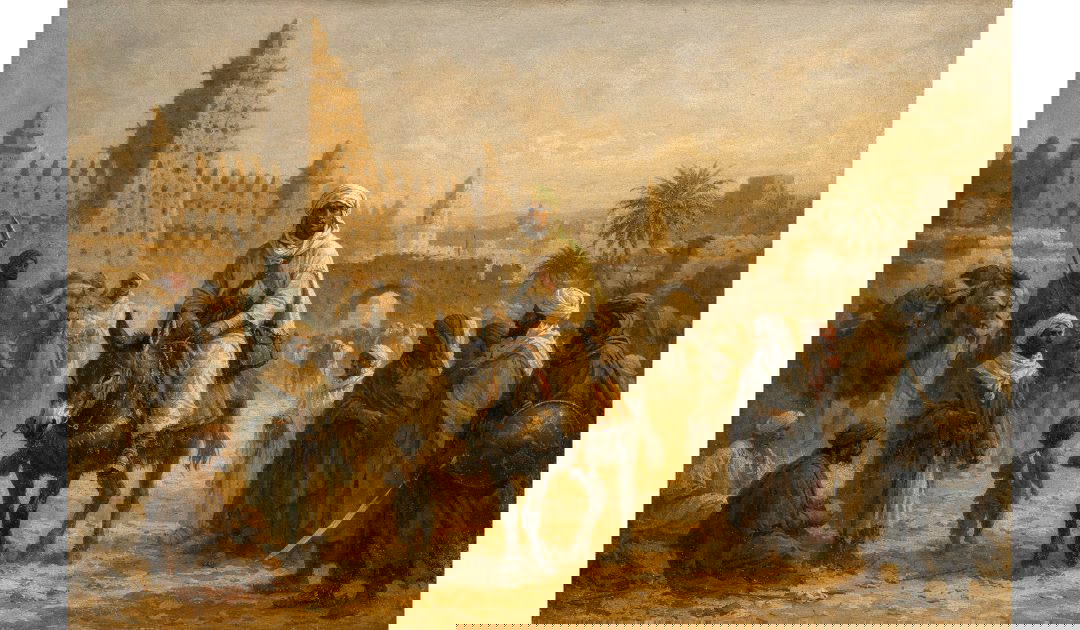
On the 20th of April, 1828, René Caillié became the second non-Muslim to enter Timbuktu, following Major Gordon Laing, and the first to leave alive. Chambers Dictionary defines Timbuktu as a noun meaning any distant place and cites the origin as a town in Mali on the River Niger.
Timbuktu, on the southern edge of the Sahara in present-day Mali, is one of the most storied cities in the history of Africa. For centuries it stood at the crossroads of desert and savannah, of trade and scholarship, of legend and reality. Its name has passed into many European languages as a byword for remoteness—“from here to Timbuktu”—yet in its great age it was anything but remote. It was a cosmopolitan centre of commerce and learning, linked by caravan routes to North Africa and the Mediterranean world and by river to the rich lands of West Africa.
The city’s origins lie in the eleventh or twelfth century. According to tradition, Tuareg nomads used the site as a seasonal camp, leaving their wells in the care of an old woman named Buktu. Travellers referred to the place as “Tin Buktu”—“the well of Buktu.” Whether or not the story is literal, it reflects the city’s roots as a desert way-station. Its position was ideal: just north of the Niger River’s great bend, where goods from the forested regions to the south could be transferred to camel caravans bound for the Sahara and beyond.
Timbuktu’s rise was inseparable from the trans-Saharan trade. Gold from the Akan fields, ivory, kola nuts, and enslaved people moved northwards; in return came salt from the Saharan mines of Taghaza, textiles, horses, and luxury goods from the Mediterranean and Islamic world. By the fourteenth century, Timbuktu had become one of the principal nodes of this trade network. When Mansa Musa, the emperor of Mali, passed through the city in the early 1300s and later made his famous pilgrimage to Mecca, he brought scholars and architects back with him. Under his patronage and that of his successors, Timbuktu flourished.
Three great mosques came to dominate the skyline: Djinguereber, Sankoré, and Sidi Yahya. These were not merely places of worship but centres of scholarship. Sankoré in particular developed into what is often described as a university, though in a looser medieval sense. Scholars taught theology, law, astronomy, mathematics, grammar, and literature. Thousands of manuscripts were copied and studied, many of which survive today in private family libraries. Timbuktu became renowned across the Islamic world as a seat of learning, drawing students from as far as Morocco and Egypt.
The city reached its zenith under the Songhai Empire in the fifteenth and early sixteenth centuries, especially during the reign of Askia Muhammad. At this time Timbuktu was reputed to have tens of thousands of inhabitants, including a large scholarly class. Leo Africanus, a traveller writing in the early sixteenth century, described a city wealthy in books and learning, where manuscripts were among the most valuable commodities.
Yet Timbuktu’s prosperity was fragile. In 1591 a Moroccan army equipped with firearms defeated the Songhai forces and occupied the city. This invasion disrupted trade routes and led to political instability. Scholars were deported, and Timbuktu’s intellectual life waned. Over the following centuries, as Atlantic trade routes supplanted the trans-Saharan caravans, the city declined into relative obscurity. By the eighteenth century it was still a regional town but no longer a great centre of power or learning.
Ironically, it was during this period of decline that Timbuktu’s legend grew in Europe. For centuries, European geographers and explorers had only second-hand accounts of the city. It appeared on maps as a mysterious, golden place in the heart of Africa. Stories of its wealth, drawn from Arabic sources and travellers’ tales, were repeated and embellished. Timbuktu became, in the European imagination, a kind of African El Dorado—a city of gold hidden beyond the desert.
This mystery was heightened by the difficulty of reaching it. The Sahara posed a formidable barrier, and few Europeans had the linguistic skills, local knowledge, or political connections to survive the journey. Several expeditions ended in death. The Scottish explorer Mungo Park perished in West Africa in 1806 without reaching Timbuktu. The Frenchman René Caillié finally arrived in 1828, disguised as a Muslim pilgrim, becoming the first European to return alive with a first-hand account. What he found was not a city of gold but a modest desert town, dusty and diminished, though still dignified by its great mosques and learned traditions.
Caillié’s realistic description did little to dispel the myth in popular imagination. Instead, Timbuktu’s very inaccessibility reinforced its symbolic power. It came to represent the ultimate far-off place, somewhere almost impossibly distant. By the nineteenth century, English speakers were using “Timbuktu” humorously or hyperbolically to mean “the back of beyond.” The word’s unusual, rhythmic sound also contributed to its appeal; it seemed exotic and evocative, easily detached from its geographic reality.
Thus, Timbuktu entered folklore as much as geography. Children’s stories, adventure novels, and travel writing used it as shorthand for remoteness. The phrase “from here to Timbuktu” implied an immeasurable distance. Few who used the term had any clear idea where the city actually lay.
In modern times, historians and scholars have worked to restore Timbuktu’s true significance. The rediscovery and preservation of its manuscripts have highlighted its role as a centre of African intellectual life. UNESCO has recognised its mosques and cultural heritage as world treasures. Despite challenges from desertification, conflict, and neglect, Timbuktu remains a potent symbol—not of remoteness alone, but of a rich, interconnected past.
The irony is striking. Timbuktu was once a hub linking continents, a meeting place of cultures and ideas. Only after it declined and became genuinely remote from global trade routes did it acquire its reputation as the world’s most distant place. The name that once signified wealth, learning, and connection came to mean the very opposite: isolation and obscurity.