
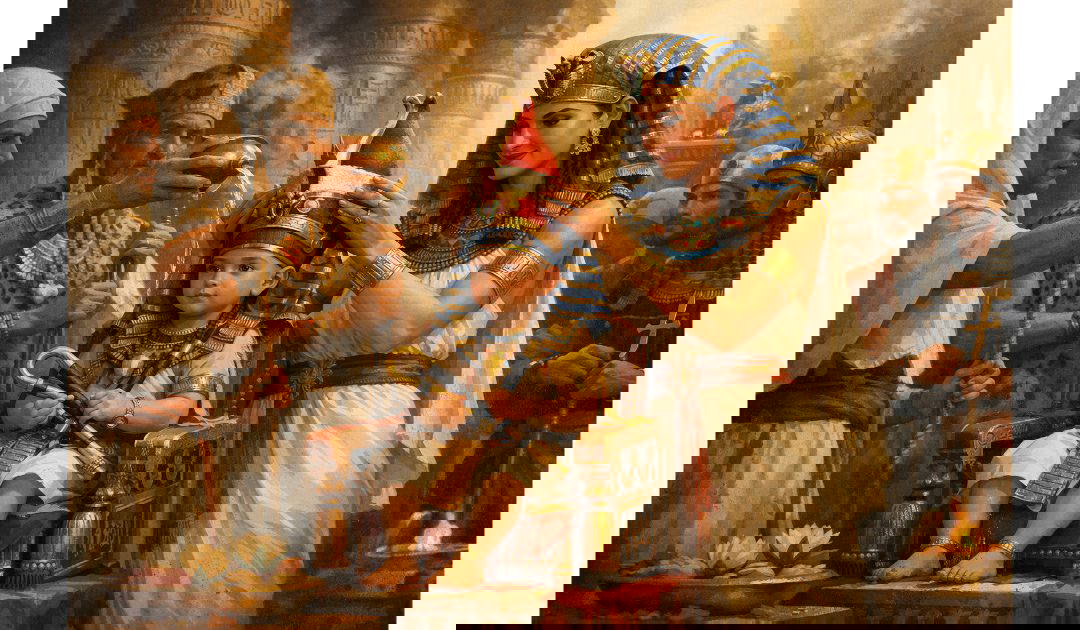
Wikipaedia tells me that on the 24th of April, 1479 BC, Thutmose III ascended to the throne of Egypt. I mentioned him in my post on pharaohs, but I think he warrants closer examination.
Thutmose III was one of the greatest pharaohs of ancient Egypt and is often described as the empire’s greatest military commander. Ruling during the Eighteenth Dynasty of the New Kingdom, he transformed Egypt into a vast imperial power stretching from the borders of Nubia in the south to the Euphrates River in the north. His long reign of more than fifty years combined military brilliance, administrative skill, religious devotion, and prolific building activity.
Thutmose III was the son of Thutmose II and a secondary wife, Iset (or Isis). When his father died, Thutmose III was still only two years old. Because of his youth, his stepmother and aunt, Hatshepsut, the Great Royal Wife of Thutmose II, acted as regent. Within a few years she assumed full pharaonic titles and ruled as king in her own right. During this period, Thutmose III was nominally co-ruler but played a secondary role while Hatshepsut governed Egypt.
Hatshepsut’s reign was marked by internal stability, extensive trade expeditions—most famously to Punt—and significant building works, including her magnificent mortuary temple at Deir el-Bahri. Thutmose III grew up in this environment, probably receiving training as a priest and military leader. He held the title of commander of the army during Hatshepsut’s reign, suggesting he was being prepared for active rule.
After Hatshepsut’s death, around 1458 BC, Thutmose III assumed sole power. It was at this point that his true character and ambition became evident. Almost immediately, he faced a rebellion among Egypt’s northern vassal states in Canaan and Syria. The rulers of these territories, led by the king of Kadesh, had hoped that the transition of power would weaken Egyptian authority. Instead, they encountered one of history’s most dynamic campaigners.
In his 22nd regnal year, Thutmose III led his army into the Levant in what became the famous Battle of Megiddo. Demonstrating boldness, he chose a narrow and risky mountain pass to approach the city, catching his enemies by surprise. The Egyptian victory at Megiddo reasserted control over Canaan and marked the beginning of a series of annual campaigns. Over the next two decades, Thutmose III conducted at least 17 military expeditions into Syria-Palestine, subduing rebellious cities, defeating Mitanni-backed coalitions, and extending Egyptian influence as far as the Euphrates.
These campaigns were meticulously recorded in inscriptions at the Temple of Amun at Karnak, providing one of the earliest detailed military annals in history. The records list conquered cities, spoils of war, tribute, and even botanical specimens brought back to Egypt. Thutmose III’s empire became a network of vassal states required to pay tribute, send hostages, and provide military support. Rather than direct occupation everywhere, Egypt maintained control through diplomacy backed by overwhelming force.
To the south, he also campaigned in Nubia, reinforcing Egyptian dominance over the gold-rich territories that were vital to the state’s wealth. By the height of his reign, Egypt stood at the center of an international system of great powers.
Despite his reputation as a warrior king, Thutmose III was also a devoted builder and patron of religion. He undertook extensive construction projects at Karnak, expanding the Temple of Amun with new pylons, obelisks, and halls. He erected numerous statues and monuments across Egypt and Nubia, many celebrating Amun, the chief god of Thebes. His building works helped solidify Thebes as the religious heart of the empire.
One of his notable architectural contributions was the Festival Hall (Akh-menu) at Karnak, built to commemorate his jubilee (Sed festival). The hall contains unique artistic representations, including detailed carvings of foreign plants and animals encountered during his campaigns—evidence of both Egypt’s expanding horizons and the king’s interest in cataloguing the natural world.
Later in his reign, Thutmose III undertook a systematic erasure of Hatshepsut’s monuments and images. Her statues were smashed or buried, and her cartouches were replaced with those of other rulers. Scholars debate his motives: whether it was personal resentment, political necessity to reinforce male succession, or the actions of officials after his death. Whatever the reason, it reshaped how history remembered Hatshepsut for centuries.
Thutmose III died around 1425 BC after a reign of approximately 54 years. He was buried in the Valley of the Kings (KV34), in a tomb decorated with unusual and innovative wall paintings depicting the Amduat, a funerary text describing the sun god’s journey through the underworld. His mummy was later discovered in the Deir el-Bahri cache in the 19th century.
Often called the “Napoleon of Egypt,” Thutmose III earned his place among the most formidable rulers of the ancient world. Yet his legacy is broader than conquest alone. He consolidated Egypt’s first true empire, strengthened its economy through tribute and trade, enriched its religious institutions, and left an enduring architectural mark on Thebes. Under his rule, Egypt reached a peak of power, prestige, and prosperity that defined the New Kingdom’s golden age.