
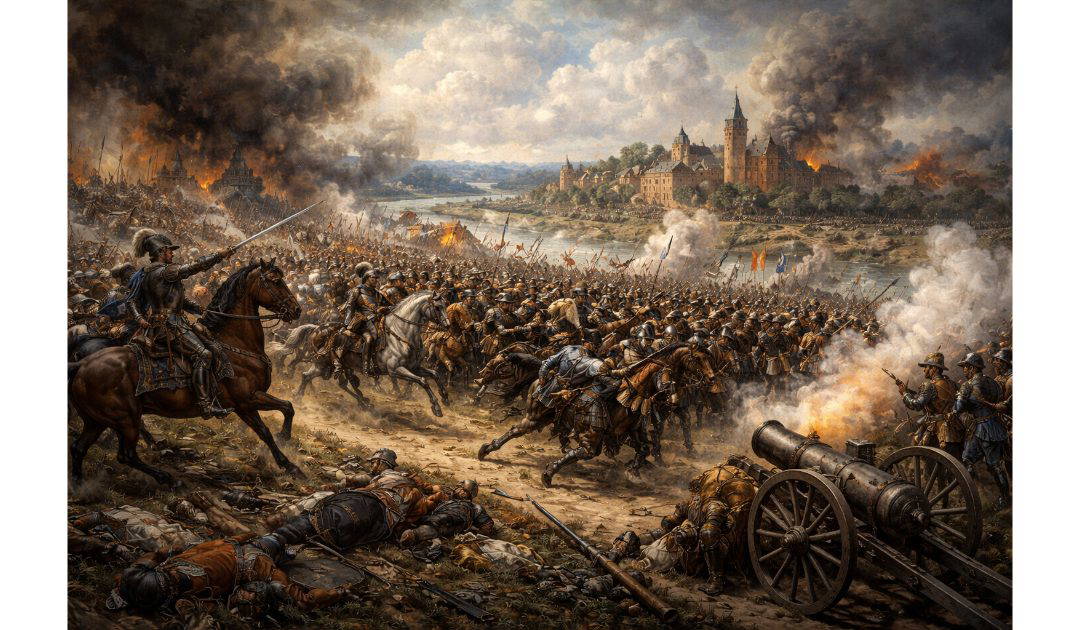
The Battle of Höchst was fought on the 20th of June 1622 during the Thirty Years’ War. I just checked and I haven’t written explicitely about the Thirty Years’ War before. I have written about the Eighty Years’ War many times because my ancestor, Sir Anthony Standen played his part. I have also written about events within it, but not the entire war.
The roots of the conflict lay in the religious tensions created by the Protestant Reformation of the sixteenth century. When Martin Luther challenged the authority of the Catholic Church in 1517, Protestant movements spread rapidly across German-speaking lands. In 1555 the Peace of Augsburg attempted to settle these disputes by allowing each ruler within the Holy Roman Empire to determine whether his territory would be Catholic or Lutheran. However, the settlement left many issues unresolved, particularly the rights of other Protestant groups such as Calvinists.
By the early seventeenth century tensions were rising again. The Habsburg emperors, strong supporters of Catholicism, attempted to restore Catholic authority in regions that had become Protestant. This alarmed Protestant princes within the empire, who feared losing both religious freedom and political autonomy.
The immediate spark for the war came in 1618 in the kingdom of Bohemia, then part of the Habsburg domains. Protestant nobles rebelled against the Catholic king, Ferdinand II. In a famous incident known as the Defenestration of Prague, rebel leaders threw two imperial officials out of a window in Prague Castle. Although the men survived, the act symbolized open rebellion and triggered war.
The Bohemian rebels offered their crown to the Protestant ruler Frederick V, Elector Palatine, drawing wider European powers into the conflict. However, the imperial army crushed the Bohemian revolt at the Battle of White Mountain in 1620, restoring Habsburg control over Bohemia and forcing many Protestants into exile.
What might have remained a regional revolt soon expanded. Protestant states feared Habsburg dominance, while Catholic rulers sought to strengthen their influence. Denmark entered the war in 1625 under King Christian IV, hoping to support Protestant interests in northern Germany. However, Danish forces were defeated by imperial commanders such as Albrecht von Wallenstein.
The conflict intensified further when Gustavus Adolphus, the powerful king of Sweden, invaded the empire in 1630. Gustavus Adolphus was both a committed Protestant and an ambitious military reformer. His well-trained army won several important victories, including the Battle of Breitenfeld in 1631, which broke the aura of invincibility surrounding imperial forces. Although Gustavus Adolphus was killed at the Battle of Lützen in 1632, Sweden remained a major force in the war.
In its final phase the war became less about religion and more about political power. The Catholic kingdom of France, under the leadership of Cardinal Richelieu, joined the conflict in 1635 on the Protestant side. Richelieu’s goal was to weaken the Habsburgs, who ruled both Spain and the Holy Roman Empire and thus surrounded France.
French involvement transformed the struggle into a broader European war. Battles were fought across Germany, the Low Countries, Italy, and beyond. Armies often lived off the land, plundering villages and towns, which caused immense suffering for civilians.
The war had catastrophic effects on the population of central Europe. Large areas of Germany were repeatedly ravaged by marching armies, famine, and disease. Towns were destroyed, agriculture collapsed, and trade declined sharply.
Mercenary soldiers formed a large part of the armies, and discipline was often poor. As a result, civilians frequently suffered looting, violence, and forced contributions. The war became infamous for its brutality and chaos.
After decades of fighting, exhaustion finally pushed the combatants toward negotiation. In 1648 the conflict ended with the Peace of Westphalia, a series of treaties signed in the cities of Münster and Osnabrück.
These treaties reshaped the political structure of Europe. They confirmed the independence of the Dutch Republic and recognized Switzerland as separate from the Holy Roman Empire. Within the empire, princes gained greater autonomy, weakening imperial authority. The settlement also expanded religious tolerance by recognizing Calvinism alongside Catholicism and Lutheranism.
The war had catastrophic effects on the population of central Europe. Large areas of Germany were repeatedly ravaged by marching armies, famine, and disease. Historians estimate that some German regions lost between a quarter and a half of their population. Towns were destroyed, agriculture collapsed, and trade declined sharply.
The Thirty Years’ War is often seen as a turning point in European history. It marked the decline of the Holy Roman Empire as a central power and the rise of France as a dominant force in continental politics. The conflict also demonstrated how religious disputes could become entangled with dynastic and territorial ambitions.
Perhaps most importantly, the Peace of Westphalia helped establish principles that influenced the modern international system. The idea that states should respect each other’s sovereignty and avoid interfering in internal affairs became a foundation of European diplomacy.
After thirty years of destruction, the war left deep scars across central Europe. Yet it also reshaped the political and religious landscape of the continent, helping to define the structure of Europe for centuries to come.