
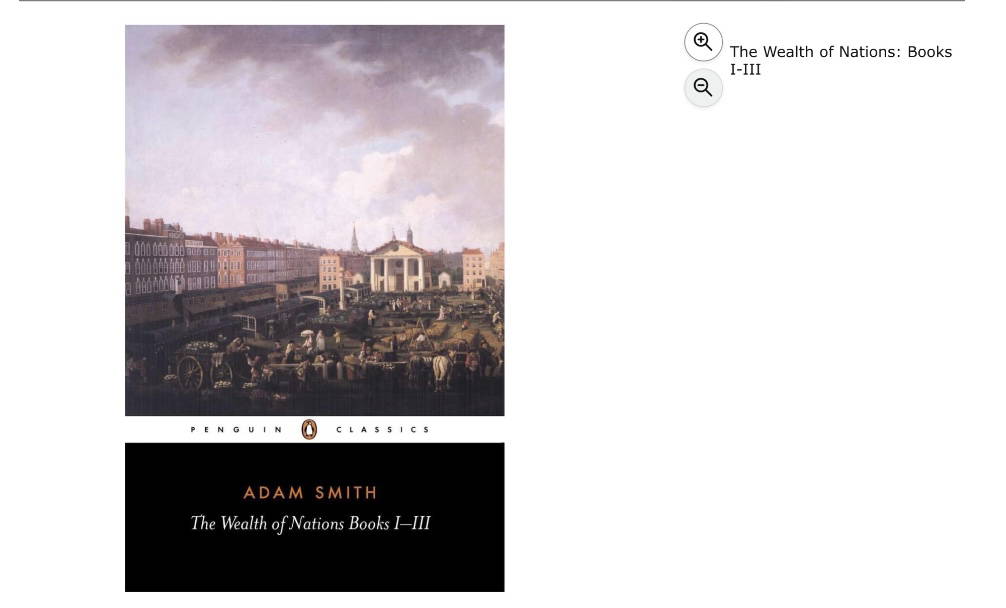
On the 9th of March, 1776, Adam Smith published The Wealth of Nations. Adam Smith’s An Inquiry into the Nature and Causes of the Wealth of Nations, published in 1776, is one of the most influential works in the history of economics and political thought. Often shortened simply to The Wealth of Nations, it laid the intellectual foundations for classical economics and remains a cornerstone of modern discussions about markets, trade, labour, and government.
Smith, a Scottish moral philosopher and professor at the University of Glasgow, did not set out to write a narrow technical manual. Instead, he aimed to understand a large question: what makes some nations prosperous while others remain poor? His answer was radical for its time. Wealth, he argued, does not consist primarily in gold and silver, as the dominant economic doctrine of mercantilism claimed, but in the productive capacity of a nation’s people and the goods and services they can create.
The Division of Labour
One of the most famous parts of the book appears near the beginning: Smith’s description of a pin factory. He observed that when a single worker tried to make a pin from start to finish, output was extremely low. But when the process was divided into specialised tasks — drawing the wire, cutting it, sharpening the point, attaching the head — productivity soared. This division of labour became a central concept in economics.
Smith argued that specialisation increases skill, saves time, and encourages the invention of machines and methods that further improve efficiency. This principle, he believed, was one of the chief reasons for the rapid economic growth seen in parts of Britain during the Industrial Revolution.
Self-Interest and the “Invisible Hand”
Another of Smith’s enduring ideas is that individuals, acting in their own self-interest, can unintentionally benefit society as a whole. He famously wrote that it is not from the benevolence of the butcher, brewer, or baker that we expect our dinner, but from their regard to their own interest.
This process is often summarised by the metaphor of the “invisible hand.” Though Smith used the phrase only sparingly, it came to symbolise his belief that when markets are left relatively free, the pursuit of profit leads to the efficient allocation of resources. Producers supply what consumers demand because it is in their interest to do so.
Smith did not mean that people are purely selfish or that markets are perfect, but rather that self-interest, within a framework of laws and justice, can be socially productive.
Critique of Mercantilism
At the time Smith was writing, European governments widely believed that national wealth depended on accumulating precious metals and maintaining a favourable balance of trade. This led to heavy regulation, tariffs, colonial monopolies, and restrictions on imports.
Smith strongly criticised this system. He argued that trade is not a zero-sum game: both sides can benefit. Restrictions on imports harm consumers by raising prices and limiting choice (take note Trump). Colonies and monopolies distort natural market forces and benefit only a few privileged merchants.
He advocated instead for free trade, believing that nations should specialise in what they produce best and exchange freely with others.
Role of Government
Contrary to the common caricature of Smith as advocating complete laissez-faire, he recognised important roles for government. He outlined three primary duties:
- Defence – protecting the nation from foreign aggression.
- Justice – maintaining laws and courts to protect property and enforce contracts.
- Public works and institutions – building infrastructure (like roads, bridges, canals) and supporting education where private investment would not be sufficient.
Smith understood that markets require a stable legal and institutional framework to function properly. He also warned about the dangers of powerful business interests manipulating government for their own benefit.
Labour, Value, and Wages
Smith explored how prices are determined, distinguishing between a product’s “use value” and its “exchange value.” He developed an early labour theory of value, suggesting that in primitive societies, the value of goods was related to the labour required to produce them.
He also examined wages, profits, and rents as the three main components of income in society, analysing how these were distributed among workers, capital owners, and landowners Smith worried about the impact of extreme division of labour on workers, suggesting that monotonous factory work could make them “as stupid and ignorant as it is possible for a human creature to become,” and he supported public education as a remedy.
Structure of the Book
The Wealth of Nations is divided into five books:
- Book I: Causes of improvement in labour productivity and distribution of output.
- Book II: Nature and accumulation of capital.
- Book III: Economic development in different nations.
- Book IV: Critique of mercantilism and other economic systems.
- Book V: Revenue of the sovereign and the role of government.
Impact and Legacy
The book had an enormous influence. It helped shift economic thinking away from state-controlled trade and towards market-based systems. Its ideas shaped British economic policy in the 19th century and influenced thinkers such as David Ricardo, John Stuart Mill, and later economists.
Even today, debates about free markets, trade, inequality, and the role of government often return to ideas first clearly expressed by Smith.
However, modern readers sometimes misinterpret Smith as a champion of unrestrained capitalism. In fact, he was deeply concerned with morality, fairness, and the dangers of concentrated economic power. His earlier work, The Theory of Moral Sentiments, emphasised sympathy and ethical behaviour as essential to social life.
Conclusion
The Wealth of Nations is not merely an economics textbook but a sweeping analysis of how societies organise work, exchange, and governance to create prosperity. Its central message — that human productivity, guided by freedom within a framework of justice, is the true source of national wealth — remains one of the most powerful ideas in economic history.