
I have been on holiday to Dublin, and have also been busy publicising my latest book, Serpent’s Teeth. But now it’s time to get back to word of the day.
The word rout is a particularly interesting example of how a word can develop several apparently unrelated meanings while retaining traces of its original sense. Today, we most commonly associate a rout with a crushing military defeat, but its history reveals connections with crowds, disorder, violence and even social gatherings.
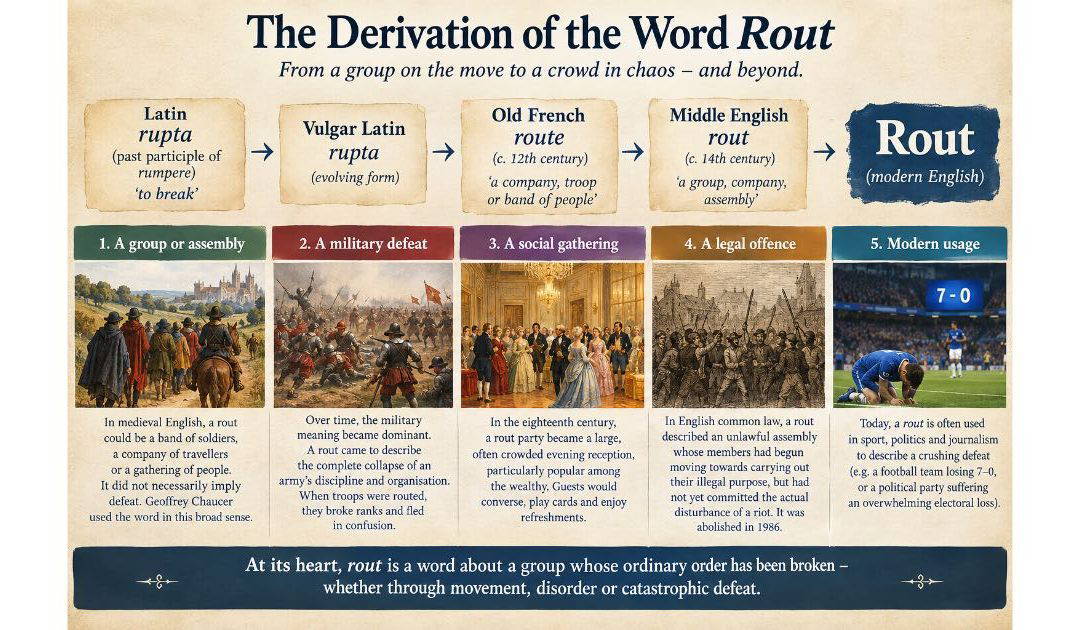
The word entered Middle English through Old French, particularly route, meaning a company, troop or band of people. This developed from Vulgar Latin rupta, associated with the Latin verb rumpere, meaning ‘to break’. The underlying idea was of a group breaking away or moving together, sometimes in a disorderly fashion.
In medieval English, a rout was originally an assembly or company of people. It did not necessarily imply defeat. A rout might be a band of soldiers, a gathering of travellers or a disorderly crowd. Geoffrey Chaucer used the word in this broad sense, referring to groups of people.
Over time, the military associations became increasingly important. A rout came to describe not merely a body of soldiers but the complete collapse of an army’s discipline and organisation. When troops were routed, they broke ranks and fled in confusion. This was more than an ordinary defeat: it suggested panic, disintegration and an inability to maintain resistance.
The distinction survives today. An army might lose a battle while withdrawing in good order, but a routed army abandons its formations and escapes as best it can.
Interestingly, rout also acquired a fashionable social meaning during the eighteenth century. A rout party was a large, often crowded evening reception, particularly popular among wealthy British society. Such gatherings could involve considerable numbers of guests, conversation, card-playing and refreshments. The connection with the older meaning of a crowd or assembly is unmistakable.
There is also a legal meaning. In English common law, a rout historically described an unlawful assembly whose members had begun moving towards carrying out their common illegal purpose, but had not yet committed the actual disturbance constituting a riot. It therefore occupied a position between unlawful assembly and riot. This historical offence was abolished in England and Wales by the Public Order Act 1986.
The word should not be confused with route, meaning a road or course of travel, although their histories overlap.
Today, rout remains a vivid word in military, sporting and political journalism. A football team losing 7–0, or a political party suffering an overwhelming electoral defeat, may be described as having been routed. Hmmm, now I see why I chose this word.
The central idea running through its history is that of a group whose ordinary order has been broken, whether through movement, disorder or catastrophic defeat.