
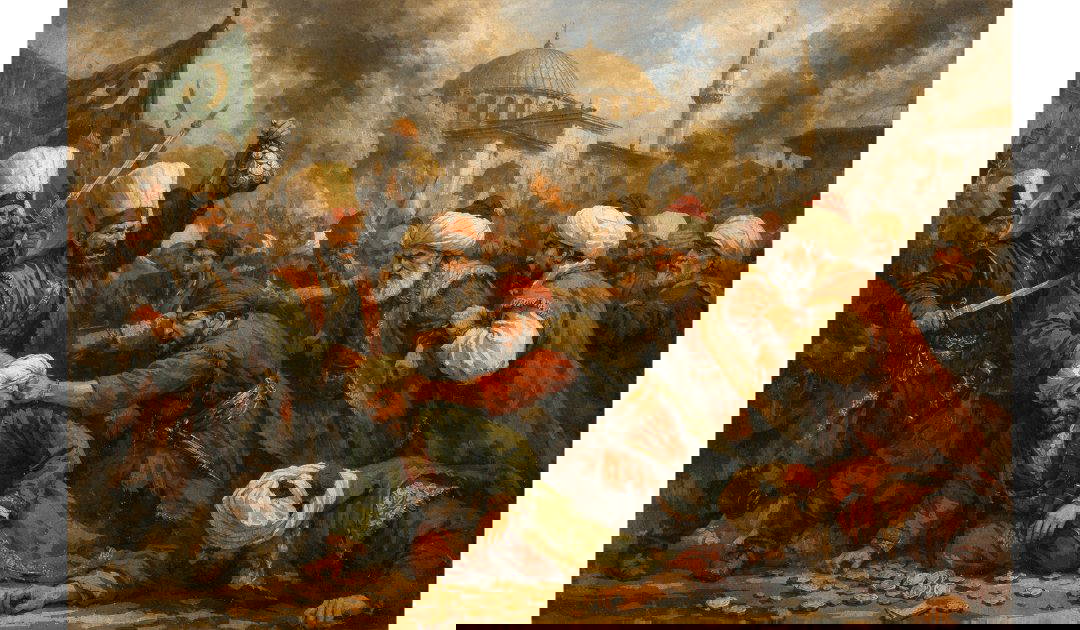
On the 3rd of April, 1589, Sultan Murad III, leader of the Ottoman Emprire, faced a revolt by his janissaries, the elite infantry who formed his bodyguard. Murad is a minor character in The Spy who Sank the Armada, the first book in the Sir Anthony Standen Adventures.
The Janissaries’ revolt of 1589 was one of the earliest and most significant signs that the Ottoman Empire’s elite military corps had begun to transform from a disciplined instrument of state power into a political force capable of intimidating and coercing the government itself. The uprising was triggered by Sultan Murad III’s debasement of the currency, but its roots lay in deeper economic strain, administrative corruption, and the changing character of the Janissary corps during the later sixteenth century.
By the 1580s, the Ottoman Empire was still vast and formidable, stretching from Hungary to Yemen and from Algeria to the Caucasus. Yet beneath this appearance of strength, the state was under intense financial pressure. Long wars against the Habsburgs in Europe and the Safavids in Persia had drained the treasury. At the same time, the influx of New World silver into European markets had caused widespread inflation across the Mediterranean world. Prices rose sharply, but the Ottoman system of pay and taxation did not adjust smoothly to these changes. Soldiers, bureaucrats, and urban workers alike found that their wages bought less and less.
The Janissaries, the empire’s elite infantry corps originally formed from the devshirme levy of Christian youths, were particularly affected. For centuries they had been the Sultan’s most loyal troops, bound directly to him, forbidden to marry or engage in trade, and renowned for their discipline. By Murad III’s reign (1574–1595), however, this system had eroded. Janissaries were increasingly allowed to marry, live in Istanbul, and engage in business. Many no longer saw themselves purely as soldiers but as urban citizens with economic interests. They had become deeply embedded in the commercial and social life of the capital.
Their pay, issued in silver akçes, had not kept pace with inflation. The government’s response to financial crisis was to debase the coinage: reducing the silver content of the akçe while keeping its nominal value the same. In 1589, this debasement became especially severe. When the Janissaries received their wages, they immediately realised that the coins were of inferior quality and worth far less in real terms. Merchants and moneychangers in Istanbul refused to accept the debased currency at face value, exposing the deception.
The reaction among the Janissaries was swift and furious. Feeling cheated by the very state they served, they marched in protest through Istanbul. This was not merely a spontaneous riot but a collective, organised demonstration by a body that knew its political leverage. The Janissaries understood that they were indispensable to the regime. Without them, the Sultan had no reliable force in the capital.
The soldiers gathered in the Hippodrome (At Meydanı), the traditional space for public demonstrations near the heart of imperial authority. They demanded redress and the punishment of those responsible for the debasement. Their anger focused not directly on Sultan Murad III but on his ministers and financial officials, whom they accused of corruption and mismanagement. This pattern—blaming viziers rather than the Sultan—would become typical in later Janissary uprisings.
Unable or unwilling to confront the Janissaries militarily, the government yielded. Several high-ranking officials, including the defterdar (treasurer) and other financial administrators, were handed over to the mob. The Janissaries executed them brutally in public. Their deaths were intended both as punishment and as a warning to the rest of the administration. The debased coinage was withdrawn, and new payments were arranged in better-quality silver.
This episode marked an important turning point. For perhaps the first time, the Janissaries had successfully used collective violence to dictate policy and remove senior officials. The precedent was dangerous. It demonstrated that the corps could act as a political pressure group within the capital, capable of forcing the Sultan’s hand. The fear of provoking Janissary unrest would haunt Ottoman rulers for centuries afterward.
The revolt also revealed how far the Janissaries had drifted from their original function. No longer isolated military slaves devoted solely to the Sultan, they had become a semi-corporate urban class defending their economic interests. Their grievances were not purely military but financial and social. They were reacting as much as Istanbul residents and wage earners as soldiers.
Murad III’s government learned a harsh lesson. The state’s financial weakness, once exposed, had emboldened the troops. Yet the underlying problems were not solved. Inflation continued, wars continued, and the Janissaries’ political confidence grew. Over the next decades, they would repeatedly intervene in politics, deposing and killing sultans, blocking reforms, and resisting attempts to modernise the army.
Historians often view the 1589 revolt as an early symptom of the so-called “Ottoman decline,” though modern scholarship prefers to see it as part of a broader transformation. The empire was not collapsing, but its institutions were adapting—sometimes maladaptively—to new economic and social realities. The Janissaries were at the centre of this transformation.
In the long run, the political power the Janissaries acquired in episodes like the 1589 revolt would become a major obstacle to reform. By the nineteenth century, they were widely seen as reactionary and corrupt. In 1826, Sultan Mahmud II finally destroyed the corps in the “Auspicious Incident,” ending nearly five centuries of Janissary history.