
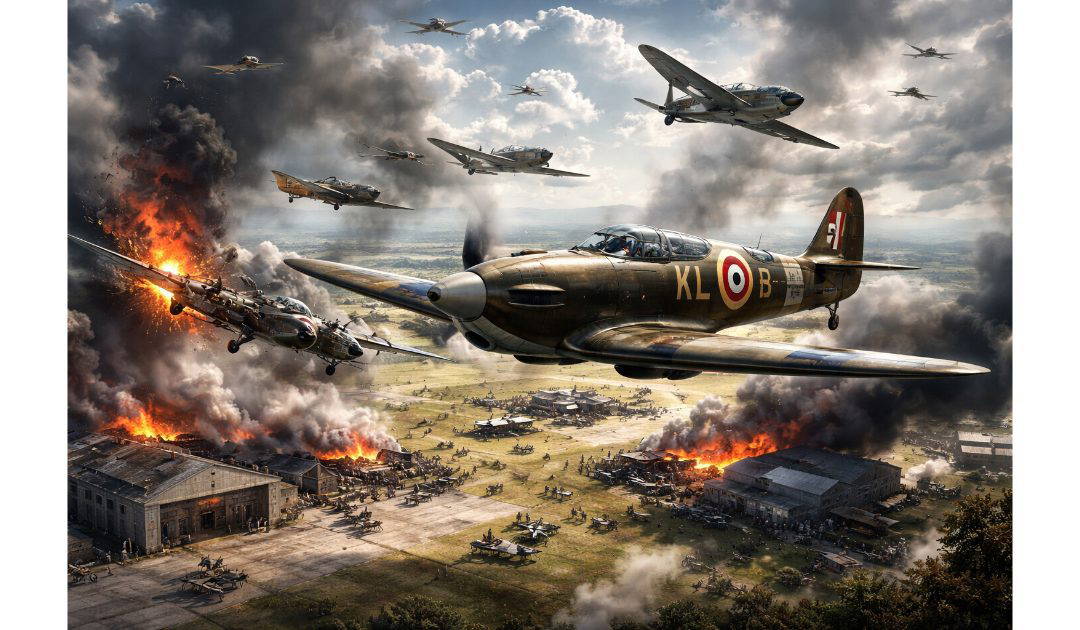
Sunday the 18th of August, 1940, is known as The Hardest Day of the Battle of Britain. Although Sunday the 15th of September is celebrated as Battle of Britain day, and the climax of the battle, the combined losses of allied and German aircraft on the 18th of August exceeded losses on any other day of the battle.
The Battle of Britain had begun in earnest in July, but the fighting intensified dramatically in August. German commanders targeted airfields, radar stations and aircraft factories in an attempt to wear down Britain’s air defences. The attacks of the 18th of August were among the largest and most determined of the entire battle.
The first raids began in the morning. Waves of German bombers, escorted by Messerschmitt Bf 109 fighters, crossed the Channel and headed for RAF airfields in Kent, Surrey and Sussex. Their main objective was to cripple the air bases of No. 11 Group, the formation responsible for defending London and south-east England.
One of the most heavily attacked stations was RAF Kenley in Surrey. Low-flying Dornier Do 17 bombers swept over the airfield and dropped bombs with great accuracy. Hangars, workshops and buildings were shattered. The runways were cratered and several aircraft on the ground were destroyed. Despite the devastation, ground crews worked quickly to repair the damage and keep the station operational.
RAF Biggin Hill, another crucial fighter station, also came under attack. Bombs damaged communications equipment and operations rooms, but the station continued to function. The ability of British personnel to restore damaged airfields within hours was one of the key reasons Fighter Command survived.
The most tragic attack of the day took place at RAF Ford in West Sussex. German fighters strafed the airfield, killing service personnel and civilians. Thirty-seven people died in the raid. The attack was particularly shocking because many victims were machine-gunned while attempting to flee.
Throughout the day, RAF squadrons flying Spitfires and Hurricanes intercepted incoming raids. Pilots climbed repeatedly into combat, often with little time to rest between sorties. Dogfights raged across the skies above southern England and the English Channel. Aircraft twisted and dived through clouds and smoke, while anti-aircraft guns fired from below.
The losses were severe on both sides. The RAF lost around 31 fighters, while the Luftwaffe lost approximately 69 aircraft, including bombers and fighters. German aircrew casualties were especially damaging because many highly trained crews could not be replaced quickly.
For the RAF, the day was exhausting and costly, but it also demonstrated the resilience of Britain’s air defence system. Radar stations gave early warning, the Observer Corps tracked enemy formations, and Fighter Command’s control rooms directed squadrons to the right place at the right time. Even when airfields were damaged, they were seldom put out of action for long.
For the Germans, the 18th of August revealed a difficult truth. The RAF was battered but far from defeated. British fighters continued to rise to meet every attack, and the losses sustained by German bomber crews were unsustainable.
The Hardest Day did not decide the Battle of Britain on its own, but it marked a turning point. It showed that the Luftwaffe could inflict heavy damage but could not destroy Fighter Command. In the weeks that followed, Germany shifted its attacks from RAF airfields to London and other cities during the Blitz. This eased pressure on Fighter Command and allowed it to recover.
By September it was clear that the Luftwaffe had failed to gain air superiority. Operation Sea Lion was postponed indefinitely, and Britain remained in the war.
The Hardest Day remains one of the most dramatic episodes of the Second World War. It was a day of destruction, courage and endurance, when the outcome of the battle hung in the balance. The determination of the RAF and its supporting personnel helped ensure that Britain would not be conquered and would continue the fight against Nazi Germany.