
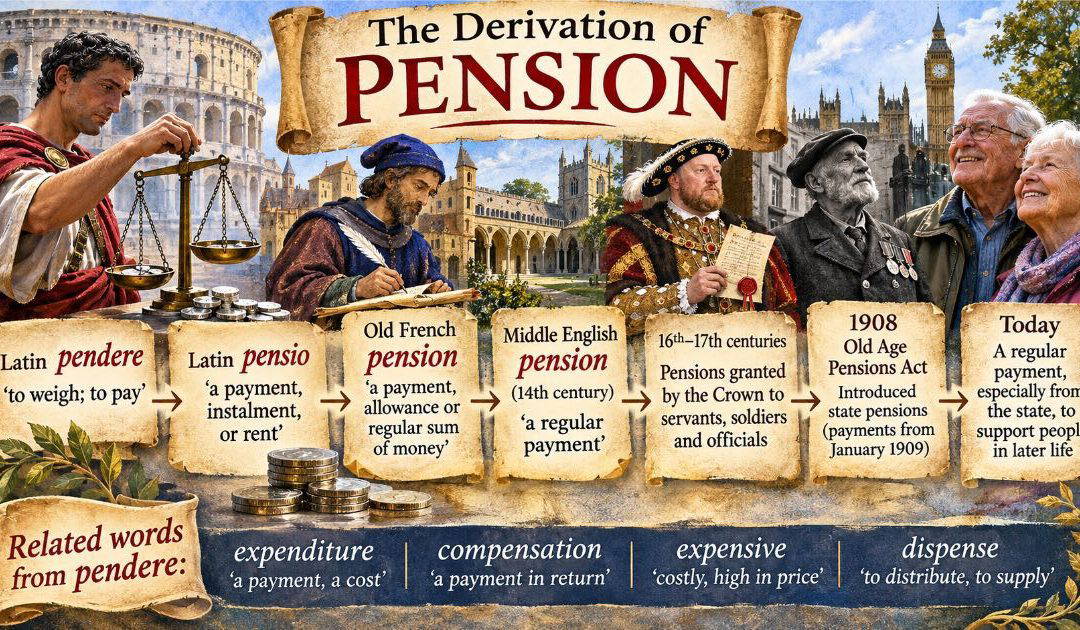
The word pension has a history stretching back more than two thousand years to ancient Rome. Its origins lie not in retirement or old age, but in the simple physical act of weighing something.
The word derives from the Latin pensio, meaning a payment, instalment or rent. This came from the verb pendere, meaning ‘to weigh’ or ‘to pay’. In ancient Rome, money was originally associated with weighed quantities of precious metal, so the connection between weighing and paying was entirely natural.
The Latin verb pendere has given English several other familiar words, including expenditure, compensation, expensive and dispense. All retain, in different ways, the underlying idea of weighing, balancing or making payments.
The word passed into Old French as pension, meaning a payment, allowance or regular sum of money. It entered Middle English during the fourteenth century, initially referring to regular payments made to individuals, institutions or religious establishments.
In medieval England, a pension was not necessarily associated with retirement. Monasteries, churches and universities received pensions, while monarchs granted regular allowances to favoured courtiers, servants and political allies. Such payments could represent rewards for services, financial obligations or instruments of patronage.
By the sixteenth and seventeenth centuries, pensions were increasingly associated with payments made by the Crown to former servants, soldiers and officials. However, they could also be politically controversial. A politician receiving a pension from a foreign monarch might be suspected of having divided loyalties.
The modern association between pensions and retirement developed gradually. Military pensions, particularly those awarded to wounded or elderly soldiers and sailors, helped establish the principle that long service could justify continuing financial support.
Britain’s Old Age Pensions Act of 1908 marked a significant milestone, introducing state-funded pensions for qualifying people aged seventy and over. The first payments were made in January 1909. Later legislation expanded pension provision, eventually establishing the modern state pension system.
Interestingly, the word also survives in French as pension, meaning a pension, boarding house or payment for accommodation. The English expression full pension, once used in hotels, similarly referred to accommodation with meals included.
Thus, a word that began with the physical weighing of metal has evolved into one of the central concepts of modern social and economic policy.
The next time someone discusses the cost of pensions, they are unknowingly invoking an ancient Roman practice of weighing out money.