
Yesterday I posted about the derivation of the word bond. OK I was influenced by the announcement that Robert Pattinson would be the new James Bond. Then the Cambridge Dictionary went and upstaged me by announcing that human was their word of the year. They explain that the growth of AI means it is now necessary to explicitly say ‘human’ for things that once could only be done by humans. Well the Oxford English Dictionary haven’t announced their word of the year yet but slopaganda is on the shortlist. It means low-quality propaganda produced using generative artificial intelligence and widely distributed online, esp. via social media. So they’re on the same page.
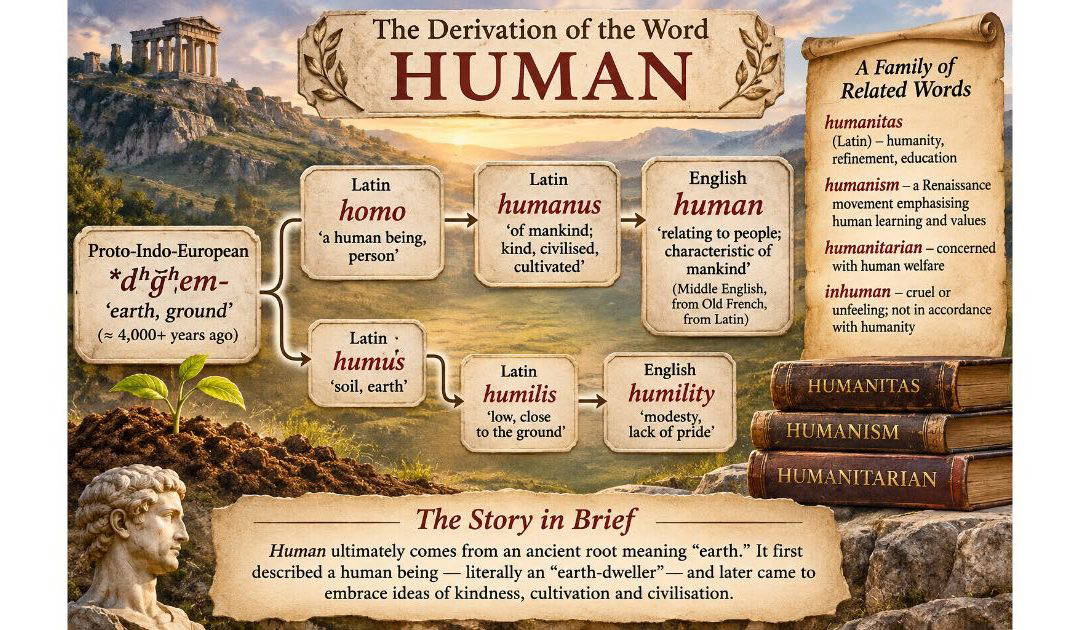
The English word human derives from the Latin humanus, meaning ‘of mankind’, ‘belonging to people’, or ‘cultivated and refined’. This, in turn, comes from the Latin homo, meaning ‘a human being’ or ‘person’. Unlike vir, which specifically meant ‘man’ in the masculine sense, homo embraced both sexes.
The deeper origins of homo are intriguing. Many etymologists connect it with the Proto-Indo-European root dʰǵʰem-, meaning ‘earth’ or ‘ground’. This suggests that the earliest conception of a human being was literally an ‘earth-dweller’, distinguishing mortals who inhabited the ground from the gods who occupied the heavens.
There is a striking parallel with the Latin word humus, meaning ‘soil’ or ‘earth’, from which English derives humus, the organic material found in fertile soil. Although human and humus are not derived directly from one another, they are generally understood to share an ancient linguistic ancestry.
Another interesting relative is humility, derived from Latin humilitas, itself from humilis, meaning ‘low’ or ‘close to the ground’. The connection is metaphorical: a humble person does not elevate himself above others. Thus, human, humus and humility preserve different echoes of an ancient association with the earth.
The Romans developed humanus beyond its biological meaning. It could describe someone who was courteous, educated, compassionate or civilised. From this emerged humanitas, a concept embracing refinement, learning, benevolence and the qualities considered appropriate to a cultivated person.
The word entered Middle English through Old French humain, ultimately from Latin humanus. By the late medieval period, it described both membership of mankind and the characteristics associated with human nature.
During the Renaissance, humanitas helped inspire humanism, the intellectual movement that emphasised classical learning, literature, moral philosophy and the capacities of human beings.
Later, humanitarian developed to describe concern for human welfare, while inhuman came to signify cruelty or behaviour unworthy of humanity.
There is therefore a remarkable progression in the word’s history: from an ancient association with the earth, through the simple identification of our species, to an ideal of compassion and civilisation.
Perhaps its greatest irony is that ‘human’ describes both what we inevitably are and what we continually aspire to become.