
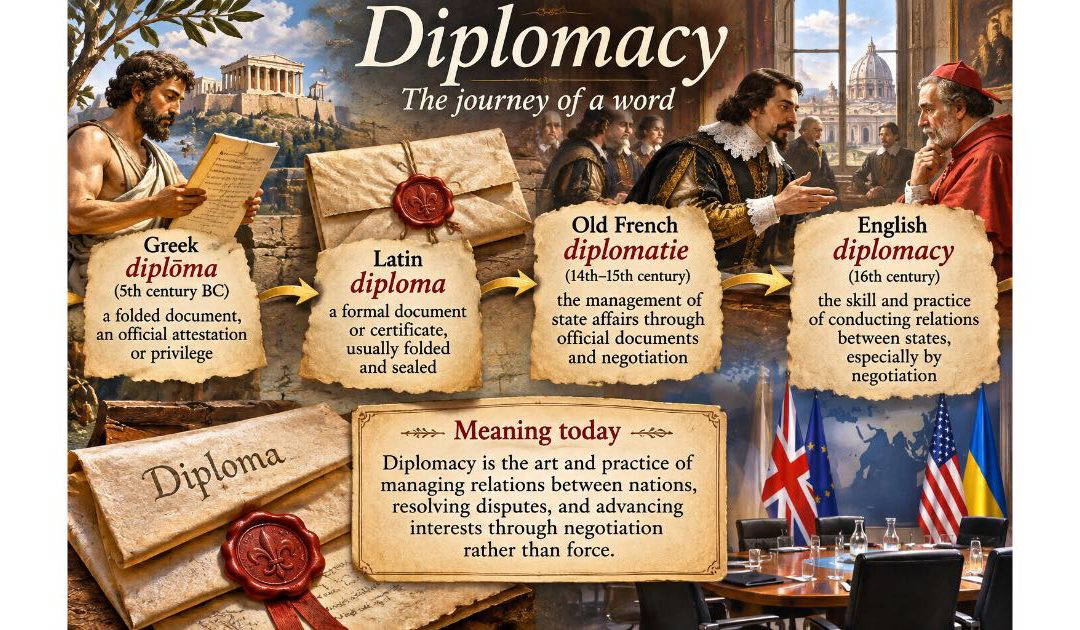
The word diplomacy conjures images of ambassadors negotiating treaties, statesmen exchanging carefully chosen words, and governments attempting to resolve disputes without resorting to war. Yet its origins lie not in international politics but in something far more mundane: a folded piece of paper.
The story begins with the ancient Greek word díplōma, meaning something folded double. It derives from diploos, meaning double, itself formed from di-, meaning two, and a root associated with folding. In classical Greece, a diplōma could refer to a folded document, particularly one conferring official privileges or authority.
The Romans adopted the Greek word as the Latin diploma. Roman authorities issued official documents granting particular rights, including permits allowing travellers to use the imperial transport system. Such documents could consist of two hinged bronze tablets, their inscriptions providing evidence of the holder’s privileges. The connection between folding and official authority was thus firmly established.
During the Renaissance, European scholars became increasingly interested in ancient documents, charters and treaties. The study of these records developed into a specialised discipline known as diplomatics. This was not the art of international negotiation but the science of examining historical documents to establish their authenticity.
A significant milestone came in 1681, when the French Benedictine scholar Jean Mabillon published De re diplomatica, a pioneering work establishing methods for distinguishing genuine medieval documents from forgeries. His scholarship helped give diplomatics its modern academic meaning.
Meanwhile, European governments were developing increasingly sophisticated systems of permanent ambassadors, diplomatic correspondence and international negotiation. Because official relations between states depended heavily upon treaties, credentials and other formal documents, the vocabulary of diplomatics gradually became associated with the people responsible for handling them.
The French word diplomatie emerged in the eighteenth century, and English adopted diplomacy towards its end. The term came to describe the conduct of international relations through negotiation rather than force.
By the nineteenth century, its meaning had broadened beyond foreign affairs. Someone displaying diplomacy in everyday conversation demonstrated tact, discretion and the ability to manage delicate situations without causing offence.
There is a pleasing irony in this linguistic journey. A word originally describing something physically folded came to represent the intellectual skill of navigating complicated relationships.
Today, whether exercised in an international summit or a family disagreement, diplomacy remains the art of achieving agreement through carefully chosen words.
From folded bronze tablets to peace treaties, the word’s history reminds us that the written word has long been an instrument of power.