
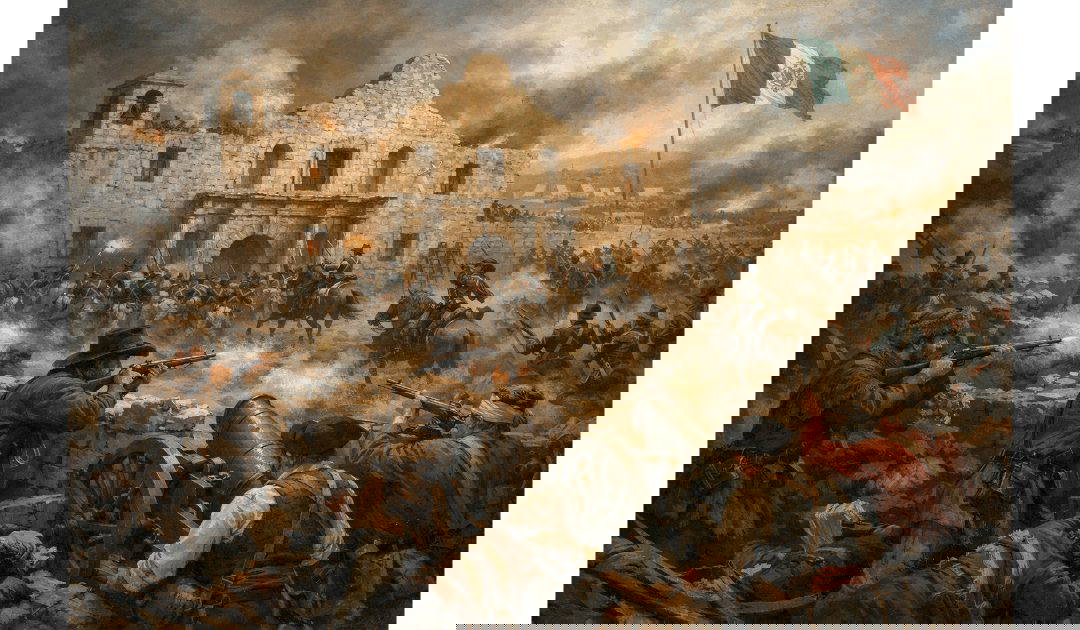
The Alamo is a film that I watched so many times as a child. My parents were both great fans of John Wayne.
The Siege of the Alamo, fought from the 23rd of February to the 6th of March, 1836, is one of the most famous and symbolically powerful episodes in American and Texan history. It took place during the Texas Revolution, a conflict in which Anglo-American settlers and Tejanos in the Mexican province of Texas rebelled against the centralising government of Mexico under President Antonio López de Santa Anna. Although the siege ended in a decisive Mexican victory, the Alamo became a potent symbol of resistance, sacrifice, and defiance.
The Alamo itself was originally Mission San Antonio de Valero, an 18th-century Spanish mission located in San Antonio de Béxar. By 1836 it had been converted into a crude fortress. Its thick stone walls and existing buildings provided some defensive strength, but it was poorly designed to withstand a sustained siege, particularly against heavy artillery. Nevertheless, a small Texian garrison occupied the mission as Mexican forces advanced north.
The defenders numbered between 180 and 250 men, though exact figures remain debated. They were a mix of Anglo settlers, recent volunteers from the United States, and Tejanos who opposed Santa Anna’s regime. Among the most famous defenders were Lieutenant Colonel William B. Travis, who commanded the regular army troops; James “Jim” Bowie, a frontier fighter weakened by illness during the siege; and Davy Crockett, a former US congressman and celebrated frontiersman. Their presence later contributed greatly to the Alamo’s legendary status.
Santa Anna arrived at San Antonio with an army of around 1,500–1,800 men, though reinforcements increased this number during the siege. On the 23rd of February, 1836, Mexican troops entered the town, forcing the Texians to withdraw into the Alamo compound. Travis sent urgent messages asking for reinforcements, including his famous letter declaring his intention to “never surrender or retreat.” Despite these appeals, only a handful of men managed to reach the Alamo before the final assault.
For nearly two weeks, Mexican artillery bombarded the mission. The cannon fire caused damage and exhaustion but failed to breach the walls decisively. Inside the Alamo, conditions deteriorated. Food and ammunition were limited, and morale fluctuated as the defenders realised relief was unlikely. According to later tradition, Travis gathered his men shortly before the final assault and drew a line in the sand, asking those willing to die for the cause to cross it. While historians debate the literal truth of this story, it reflects the defenders’ awareness of their desperate situation.
Before dawn on the 6th of March, 1836, Santa Anna launched a full-scale assault. Mexican troops attacked in multiple columns, advancing under heavy fire from the walls. After fierce fighting, they succeeded in scaling the defences and overwhelming the defenders. Combat continued inside the compound, room by room, until organised resistance ceased. Nearly all the Texian defenders were killed. The exact circumstances of Davy Crockett’s death are disputed, with some accounts suggesting he died fighting and others claiming he was captured and executed.
Mexican casualties were significant, with estimates ranging from 400 to 600 killed or wounded, though Santa Anna reported lower figures. Despite his victory, the losses were heavy and affected the morale and effectiveness of his army. Santa Anna ordered the bodies of the Texian dead burned or buried in mass graves, a decision that further inflamed Texian outrage.
In military terms, the Alamo was a defeat for the Texian rebels, but politically and psychologically it became a rallying cry. “Remember the Alamo!” was shouted by Texian forces under Sam Houston just weeks later at the Battle of San Jacinto on the 21st of April, 1836. In a surprise attack, Houston’s army decisively defeated Santa Anna and captured him, effectively securing Texas’s independence from Mexico.
The legacy of the Siege of the Alamo remains complex. In Texas and the United States, it is often remembered as a heroic last stand for liberty. In Mexico, it has traditionally been viewed as a lawful suppression of rebellion. Modern historians also emphasise the broader context, including tensions over federalism, immigration, and slavery, which played a significant role in the Texas Revolution. The Alamo endures not merely as a battlefield, but as a powerful symbol shaped by memory, myth, and national identity.