
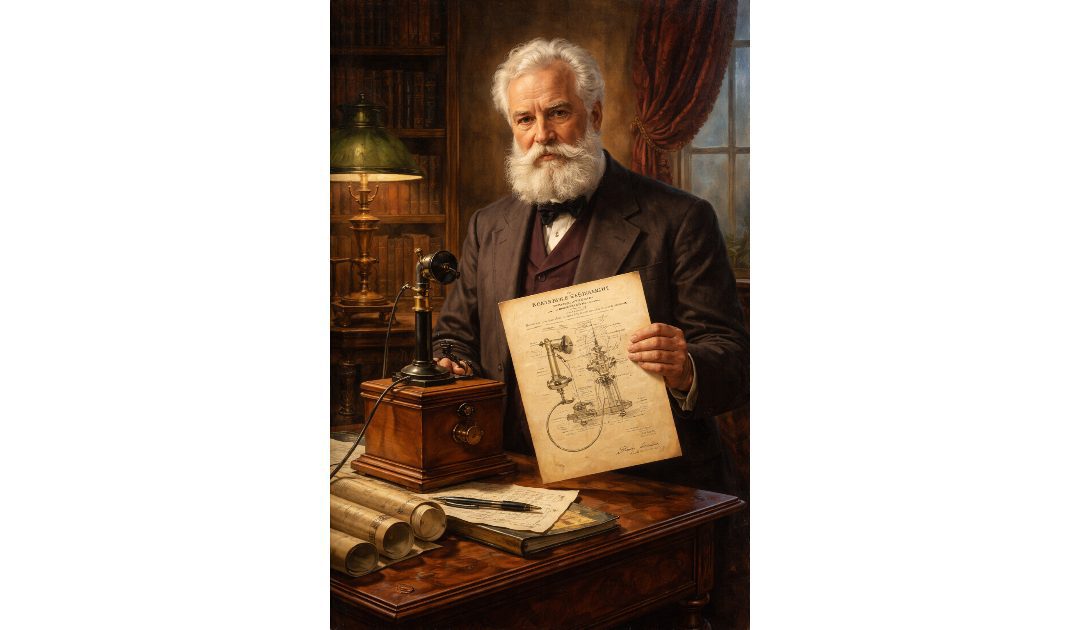
On the 7th of March, 1876, Alexander Graham Bell was granted a patent for his invention of the telephone. I haven’t always been a great fan of the telephone. I remember when I was a child, and my father was in hospital, answering the phone to be told that my father had suffered a cardiac arrest. So it’s unsuprising that I came to associate the telephone with bad news. I think I’m over it now.
Alexander Graham Bell (1847–1922) is best remembered as the inventor of the telephone, but his life and work ranged far beyond that single, transformative achievement. He was a scientist, teacher of the deaf, experimenter, and visionary whose interests spanned sound, speech, aviation, and even early hydrofoils. Bell’s life was shaped by a deep fascination with communication—how it works, how it can fail, and how it might be improved.
He was born on the 3rd of March, 1847, in Edinburgh, Scotland, into a family already immersed in the study of speech and elocution. His father, Alexander Melville Bell, was a leading authority on phonetics and developed a system called “Visible Speech,” designed to help deaf people learn to speak by representing sounds with written symbols. Bell’s mother, Eliza Grace Symonds Bell, was hard of hearing, a fact that profoundly influenced his interests and sympathies. From an early age, Bell became sensitive to the challenges of communication for those with hearing impairments.
Bell showed an early talent for invention and experimentation. As a boy, he built a device that could remove husks from wheat and displayed a keen interest in mechanics and sound. He was educated in Edinburgh and later in London, but much of his learning came informally from his father’s work and his own curiosity. Tragedy struck the family when Bell’s two brothers died of tuberculosis. Fearing for his health, the family emigrated to Canada in 1870, settling near Brantford, Ontario. This move would be pivotal, placing Bell in North America just as technological and scientific innovation was accelerating.
In 1871 Bell moved to Boston, where he began teaching at schools for the deaf. His work as a teacher was central to his identity. He developed techniques to help deaf students learn to speak and lip-read, and his reputation grew rapidly. Among his pupils was Mabel Hubbard, a young deaf woman who later became his wife. Teaching the deaf sharpened Bell’s focus on the mechanics of sound and speech and directly influenced his scientific experiments.
Bell became obsessed with the idea of transmitting sound electrically. At the time, the telegraph was widely used, but it could only send coded signals. Bell envisioned a “harmonic telegraph” capable of sending multiple tones simultaneously along a wire. While working on this concept, he began to realize that the human voice itself might be transmitted. Working with a skilled electrician, Thomas Watson, Bell conducted numerous experiments.
On the 10th of March, 1876, Bell famously spoke the first intelligible words transmitted by telephone: “Mr. Watson, come here, I want to see you.” Just three days earlier he had been granted U.S. Patent No. 174,465 for the telephone. This invention revolutionized global communication. Despite legal challenges and rival claimants such as Elisha Gray, Bell’s patent held, and the telephone rapidly moved from experimental device to practical tool.
The success of the telephone brought Bell wealth and fame, but he did not remain focused solely on this invention. He co-founded the Bell Telephone Company, which later evolved into the American Telephone and Telegraph Company (AT&T). However, Bell preferred scientific exploration to corporate management. He sold most of his shares and turned his attention to new fields.
Bell continued to work extensively with the deaf community and advocated for oral education (teaching deaf people to speak rather than use sign language), a position that later became controversial. He believed speech was essential for integration into wider society, though modern perspectives recognize the cultural importance of sign language and Deaf identity in ways Bell did not.
His curiosity led him into many other areas. He experimented with the photophone, a device that transmitted sound on a beam of light—an early precursor to fibre-optic communication. He worked on early aviation experiments, forming the Aerial Experiment Association in 1907, which contributed to the development of powered flight in North America. He also designed and tested hydrofoil boats, achieving world speed records on water in 1919.
Bell was one of the founding members and later president of the National Geographic Society. Under his leadership, the society transformed its magazine into a widely read publication filled with photographs and accessible scientific writing, helping popularize geography and exploration.
He spent much of his later life in Nova Scotia, at his estate, Beinn Bhreagh, where he maintained laboratories and workshops. There he continued to invent, experiment, and reflect on communication and technology. Bell died on the 2nd of August, 1922, at the age of 75. In a remarkable tribute, telephone services across North America were briefly silenced during his funeral.
Alexander Graham Bell’s legacy is complex and far-reaching. He is rightly celebrated for the invention that shrank the world by allowing voices to travel across continents. Yet his deeper legacy lies in his lifelong quest to understand and improve human communication. Whether through teaching, invention, or exploration, Bell pursued the idea that barriers to communication could be overcome by ingenuity and persistence.