
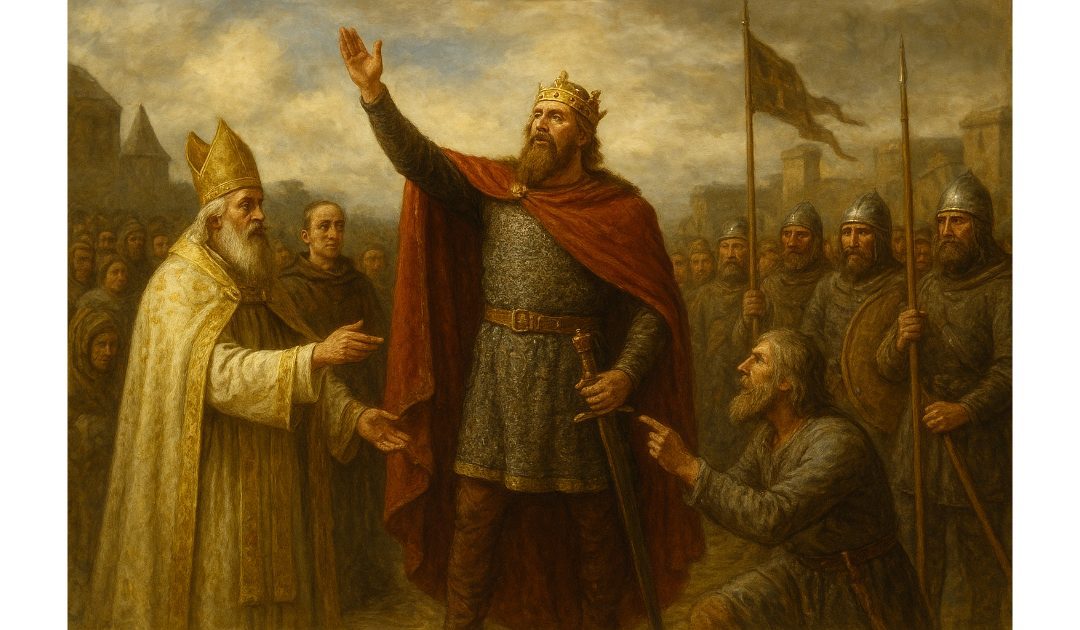
Happy Christmas dear readers. I have previously written about the origin of the 25th of December as the date on which we celebrate the birth of Jesus of Nazareth. So I have chosen to write about Sweyn Forkbeard today. He was King of Denmark from 986 CE, and according to Wikipedia he was proclaimed King of England on Christmas Day in 1013. The percentage of Dane in my DNA, according to Ancestry, seems to ebb and flow. It has been as high as 10%, but now languishes at 3%.
Sweyn Forkbeard was a significant figure in the history of Scandinavia and England during the late 10th and early 11th centuries. Born around 960 AD, he was the son of Harald Bluetooth, the king who famously Christianised Denmark, and he inherited a realm already rising in power. Sweyn’s nickname “Forkbeard” is thought to refer to the distinctive style of his beard. He would go on to become the first Danish king of England, leaving a legacy that reshaped northern European politics.
Sweyn’s early life was shaped by the turbulent politics of Denmark and Norway. His father, Harald Bluetooth, was a strong ruler, but internal dissent and external pressures weakened his reign towards its end. Sweyn rose to power in the 980s, possibly after rebelling against his father, and by 986 he was recognised as King of Denmark. His early reign was marked by consolidation of power at home and increasing involvement in Viking raids across northern Europe. Sweyn’s ambitions soon extended beyond Denmark, and he set his sights on England, which had been a favoured target for Viking raiders since the late 8th century.
England at this time was under the rule of Æthelred II, often remembered as Æthelred the Unready. His reign was plagued by Viking incursions which intensified throughout the 990s. Sweyn played a leading role in these raids, which were not merely small-scale plundering expeditions but large and coordinated attacks. One of the notable events in this period was the Battle of Maldon in 991, after which Æthelred agreed to pay a substantial tribute known as Danegeld to the Vikings, in an attempt to secure peace. Such payments only encouraged further attacks, and Sweyn’s wealth and influence grew as a result.
Sweyn’s relationship with England took a dramatic turn after the events of 1002, when Æthelred ordered the St Brice’s Day Massacre, a coordinated killing of Danes living in England. Among those killed may have been Sweyn’s sister, Gunhild, which gave him a personal as well as political motive for vengeance. Over the following decade, Sweyn launched a series of punitive and ambitious campaigns against England. By 1013, his efforts culminated in a full-scale invasion that forced Æthelred to flee to Normandy. Sweyn was then declared king of England, becoming the first Danish monarch to rule over the English kingdom.
Sweyn’s reign in England was brief, lasting only a few weeks to perhaps a few months, as he died suddenly in early 1014 in Gainsborough, Lincolnshire. The cause of his death remains uncertain, with some sources attributing it to illness and others to more legendary explanations. His death created a power vacuum that allowed Æthelred to return temporarily, but Sweyn’s ambitions did not die with him. His son, Cnut the Great, would return to conquer England in 1016 and establish a lasting North Sea Empire that included Denmark, England, and later Norway.
Sweyn’s legacy is multifaceted. As a ruler, he was part of a generation of Scandinavian kings who transitioned from the old Viking raiding culture towards building more centralised and enduring kingdoms. In Denmark, his reign strengthened the monarchy and set the stage for the rise of Cnut, who would become one of the most powerful rulers of his age. In England, Sweyn’s brief conquest was a prelude to a period of Scandinavian dominance that left lasting cultural and political impressions.
In medieval chronicles, Sweyn is often portrayed through the lens of the conflicts with Æthelred, which makes it tempting to see him solely as a fearsome invader. Yet his achievements also highlight his strategic acumen and his ability to exploit the weaknesses of his rivals. His story is part of the broader narrative of Viking expansion and integration into European politics, a process that saw raiding chieftains evolve into kings with transnational ambitions. Sweyn Forkbeard may not have reigned long in England, but his actions altered the course of English and Scandinavian history, paving the way for his son’s enduring empire and leaving his mark as one of the pivotal figures of the early medieval North Sea world.