
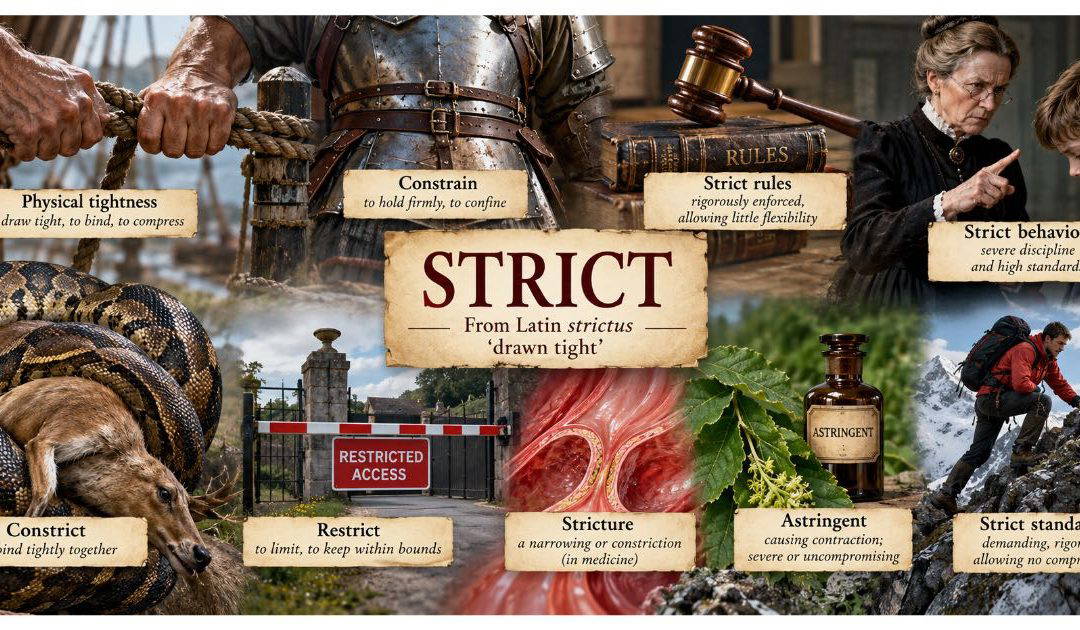
Since I mentioned Strictly Come Dancing yesterday, let’s make strict today’s word of the day. But before I do that, I have just realised that tracing the roots of words to Latin and other languages is exactly the teaching device that Sir Anthony Standen is using in Cade’s Point, the as yet unpublished sixth book in the Sir Anthony Standen Adventures. Anthony has been recruited as a teacher of languages in Joseph Calasanz’s free school in Frascati. The fifth book, Serpent’s Teeth will be published on the 1st of November. Hopefully Cade’s Point will be along a few months later.
The word strict has its origins in Latin and belongs to a fascinating family of words associated with pulling, binding, tightening and restricting. Its development illustrates how a physical action can acquire a moral or intellectual meaning.
The Latin verb stringere meant ‘to draw tight’, ‘to bind’, ‘to compress’ or ‘to grasp firmly’. Its past participle was strictus, meaning ‘drawn tight’ or ‘compressed’. From this came the Latin adjective strictus, which eventually gave English the word strict.
The underlying idea was originally physical. A rope might be pulled tight, a garment might constrict the body, or a binding might hold something firmly in place. Over time, the concept of tightness became metaphorical. Rules could be tightly enforced, behaviour closely controlled, and standards rigidly maintained.
English acquired strict in the late Middle English period, around the fifteenth century, influenced by Latin and French. Initially, it could describe something physically tight or confined, but its meaning increasingly shifted towards severity, precision and rigorous discipline.
Several familiar English words share the same Latin ancestry.
Constrict comes from Latin constringere, meaning ‘to bind tightly together’. A boa constrictor, for example, kills its prey by constriction.
Restrict derives from restringere, meaning ‘to bind back’ or ‘restrain’. Restrictions metaphorically tighten the boundaries of permitted behaviour.
Stricture originally referred to a tightening or constriction, particularly in medicine. It subsequently acquired the additional meaning of severe criticism, as though the critic were imposing tight constraints.
Astringent comes from astringere, meaning ‘to bind fast’. An astringent substance causes bodily tissues to contract. Figuratively, an astringent personality is severe or sharply critical.
Distress is a more distant relative, deriving through Old French from Latin distringere, meaning ‘to pull apart’ or ‘press hard’.
Interestingly, stringent and strict are particularly close relatives. Both convey an absence of looseness or flexibility, although stringent is especially associated with demanding requirements.
Today, a strict teacher, a strict interpretation of the law and a strict diet all preserve the original Latin metaphor.
The common thread is tightness: whether applied to a rope, a regulation or a person’s conduct, something strict allows little room for movement.
Thus, a word that began with the physical act of pulling something tight has evolved into one of our principal expressions for discipline, precision and uncompromising authority.