
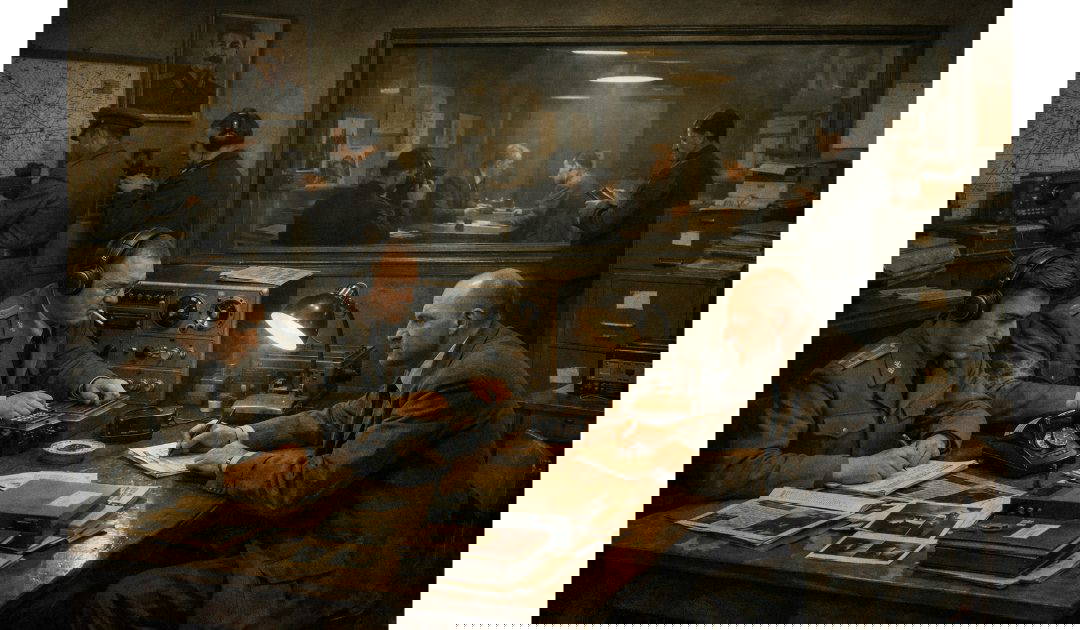
On the 8th of February, 1950, the secret police of East Germany were established. They were called the Stasi. Having recently read the George Smiley series by John Le Carré, I feel I know a fair amount about the Stasi, but I’m sure there must be more to learn.
The Stasi, short for Ministerium für Staatssicherheit (Ministry for State Security), was the secret police and intelligence service of the German Democratic Republic (GDR), or East Germany. Founded in 1950 and dissolved in 1990, it became one of the most pervasive and feared surveillance organisations in modern history. More than a police force, the Stasi functioned as the ruling Communist Party’s principal instrument for maintaining political control.
The Stasi was created in the early Cold War, when East Germany’s leaders, guided by Soviet influence, were determined to prevent dissent and Western infiltration. From the outset it was modelled on Soviet security agencies, adopting both their structure and their worldview. The Socialist Unity Party (SED) regarded opposition not as legitimate disagreement but as treachery. As a result, the Stasi’s mission was defined broadly as the defence of socialism against “enemies of the state,” a term elastic enough to include critics, reformers, church members, artists, students, and even loyal party members who showed insufficient conformity.
For most of its existence the Stasi was led by Erich Mielke, who served as Minister for State Security from 1957 until the regime’s collapse. Under Mielke, the organisation expanded relentlessly. By the late 1980s it employed approximately 91,000 full-time officers, supported by an estimated 170,000 unofficial informants, known as Inoffizielle Mitarbeiter (IMs). These informants were drawn from all walks of life—factory workers, teachers, doctors, students, and clergy—creating a dense web of surveillance that penetrated every corner of East German society.
The Stasi’s power lay less in overt brutality than in its ability to monitor, intimidate, and manipulate. While arrests, interrogations, and imprisonment were common—especially in the organisation’s early years—the Stasi increasingly favoured indirect repression. This approach was known as Zersetzung, meaning “decomposition” or “corrosion.” Rather than openly jailing a dissident, the Stasi might quietly destroy their career prospects, interfere with personal relationships, spread damaging rumours, or subject them to relentless but deniable harassment. The aim was psychological breakdown: to make resistance exhausting, isolating, and seemingly futile.
Surveillance was systematic and obsessive. The Stasi intercepted mail, tapped telephones, planted listening devices, and conducted secret searches of homes and offices. Officers were trained to enter apartments without leaving visible traces, sometimes rearranging objects subtly to unsettle the occupants. The organisation maintained immense archives, compiling millions of files filled with reports, photographs, recordings, and personal details. One of its more unsettling practices was the collection of body-odour samples from suspects, stored in sealed containers so that tracking dogs could later identify individuals.
The Stasi also extended its reach beyond East Germany’s borders. Its foreign intelligence arm, the Hauptverwaltung Aufklärung (Main Directorate for Reconnaissance), was highly effective, particularly in West Germany. East German agents infiltrated political parties, government ministries, and military-related institutions. One of the most damaging espionage scandals involved Günter Guillaume, a Stasi agent who became a trusted aide to West German Chancellor Willy Brandt. When Guillaume was exposed in 1974, the political fallout contributed to Brandt’s resignation, marking one of the Stasi’s greatest intelligence successes.
Despite official propaganda depicting the Stasi as guardians of peace and socialism, most East Germans feared and despised it. The sheer scale of informing fostered an atmosphere of suspicion that corroded social trust. People learned to speak cautiously, even among friends or family, aware that anyone might be reporting to the authorities. This climate of self-censorship was one of the most profound and lasting effects of Stasi rule.
The collapse of the Stasi came rapidly in 1989 as mass protests swept the GDR and the Berlin Wall fell. Citizens occupied Stasi buildings to prevent the destruction of records, although many files were shredded before they could be secured. In 1990 the organisation was formally dissolved. After German reunification, a special agency was created to manage the surviving archives and allow individuals to view their files. For many, this was a painful process, revealing betrayals by friends, colleagues, and loved ones.
Today, the Stasi stands as a stark example of how a modern state can employ surveillance, bureaucracy, and psychological pressure to exert near-total control over its population—often without constant visible violence. Its legacy remains a powerful warning about the fragility of privacy, trust, and freedom under authoritarian rule.