
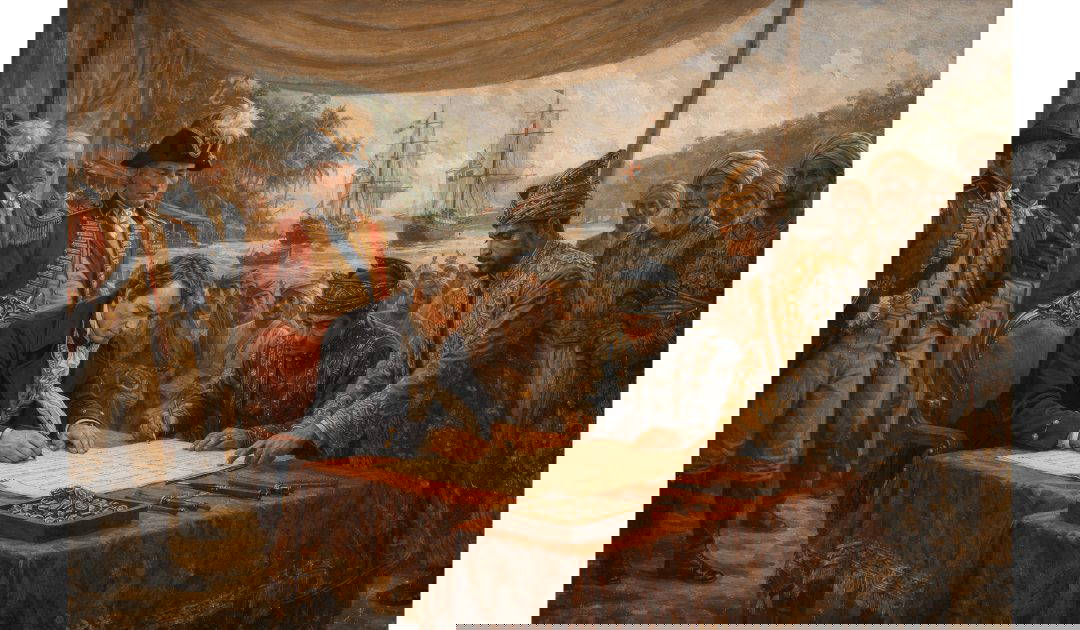
On the 6th of February, 1819, the Treaty of Singapore was signed. I have nothing against Singapore, I’ve never been there, it isn’t on our bucket list, but I would like to visit. If I’m sounding at all negative it’s simply that it has been quite a while since I’ve found the opportunity to mention Sir Anthony Standen, and plug my Sir Anthony Standen Adventures series. The history has all been to recent of late.
The history of Singapore has been shaped by geography, trade, colonial ambition, war, and determined state-building. Situated at the southern tip of the Malay Peninsula, controlling access between the Indian Ocean and the South China Sea, Singapore’s strategic location has made it a hub of commerce for over a millennium.
Long before European arrival, Singapore was part of the Malay maritime world. Archaeological and textual evidence suggests that as early as the 13th and 14th centuries, a settlement known as Temasek existed on the island. Chinese records describe it as a trading port frequented by merchants from China, India, and Southeast Asia. According to Malay tradition, the island later became Singapura—the “Lion City”—after a Sumatran prince, Sang Nila Utama, supposedly sighted a lion there. Although the historical accuracy of this legend is uncertain, it reflects the island’s early integration into regional networks dominated by the Srivijaya and later the Malacca Sultanate.
By the 16th century, Singapore’s prominence declined as regional trade concentrated elsewhere, particularly at Malacca and Johor. When the Portuguese captured Malacca in 1511 and the Dutch later supplanted them, Singapore remained a sparsely populated outpost, inhabited mainly by fishermen and pirates, and loosely controlled by the Johor-Riau Sultanate.
Singapore’s modern history began decisively in 1819, when Sir Thomas Stamford Raffles, an official of the British East India Company, recognised the island’s strategic potential as a free port. On the 6th of February, 1819, Raffles concluded a treaty with Sultan Hussein Shah of Johor and the Temenggong, allowing the British to establish a trading post. This move was aimed at breaking Dutch dominance in regional trade and securing British commercial interests in Southeast Asia. Singapore was formally incorporated into the British Empire in 1824 and became part of the Straits Settlements alongside Penang and Malacca.
Under British rule, Singapore grew rapidly. Its status as a free port, open to traders of all nations, attracted migrants from China, India, the Malay Archipelago, and beyond. By the late 19th century, Singapore had become one of the busiest ports in the world, exporting rubber, tin, and other commodities from Malaya. This rapid growth also created deep social divisions, overcrowding, and ethnic segregation, which colonial authorities managed through a combination of regulation and indirect control.
The Second World War marked a traumatic rupture. In February 1942, Japanese forces captured Singapore after a swift campaign, shattering Britain’s reputation for imperial invincibility. The Japanese occupation (1942–1945) was harsh, marked by food shortages, forced labour, and widespread atrocities, particularly against the Chinese population. The experience profoundly altered political attitudes, discrediting colonial rule and accelerating demands for self-government.
After the war, Singapore returned briefly to British control, but independence movements gathered pace. In 1959, Singapore achieved internal self-government, with Lee Kuan Yew becoming its first Prime Minister. Facing economic vulnerability and concerns about security, Singapore joined the newly formed Federation of Malaysia in 1963. However, ideological and ethnic tensions soon emerged, particularly between Singapore’s multiracial leadership and Malaysia’s Malay-dominant political structure.
In August 1965, Singapore was unexpectedly expelled from Malaysia, becoming an independent republic. Independence presented daunting challenges: the island lacked natural resources, faced unemployment, and was surrounded by larger neighbours. Under Lee Kuan Yew and the People’s Action Party, the government pursued a strategy of rapid industrialisation, strict governance, and long-term planning. Foreign investment was encouraged, corruption was aggressively tackled, and education and housing were prioritised.
Over the following decades, Singapore transformed itself into a major manufacturing, financial, and logistics hub. Its port became one of the busiest globally, while its airline, airport, and financial institutions gained international prestige. The state adopted a distinctive political model combining electoral democracy with strong central authority, prioritising stability, economic growth, and social harmony over liberal pluralism.
By the late 20th and early 21st centuries, Singapore had achieved one of the highest standards of living in the world. It positioned itself as a global city, known for efficient administration, multicultural coexistence, and strategic diplomacy. At the same time, debates over political freedoms, inequality, and national identity have continued to shape its evolving society.
Today, Singapore’s history is often cited as an extraordinary example of successful state-building against the odds. From an ancient trading port to a colonial outpost and finally a sovereign city-state, Singapore’s story reflects the enduring power of geography, adaptability, and human ambition in shaping historical destiny.