
On the 20th of February, 1472, Orkney and Shetland were pawned by Norway to Scotland. My first job after Oxford was with Foster Wheeler, who had the contract for building the Sullem Voe Oil Terminal in Shetland. It wasn’t a project I worked on, but I had many friends who did. Claire and I enjoy the detective show Shetland, so we really must visit one day. Let’s do some research.
The Shetland Isles, a windswept archipelago lying far to the north of mainland Scotland, possess a history shaped by isolation, seafaring, and cultural exchange. Positioned closer to Norway than to Edinburgh, Shetland has long stood at a crossroads of the North Atlantic world, where prehistoric settlers, Norse raiders, medieval earls, and Scottish lairds all left their mark. Its story is one of continuity and adaptation, forged by harsh landscapes and the surrounding sea.
Human presence in Shetland stretches back over 5,000 years. The earliest settlers arrived during the Neolithic period, leaving behind impressive stone monuments that still dominate the landscape. Sites such as Scord of Brouster and Staneydale Temple reveal farming communities skilled in stone construction, animal husbandry, and ritual practice. Later Bronze Age inhabitants built burial cairns and field systems, while the Iron Age saw the emergence of the islands’ most distinctive ancient structures: brochs. These tall, circular stone towers—such as Mousa Broch, the finest preserved in Britain—suggest a society concerned with defence, status, and communal living.
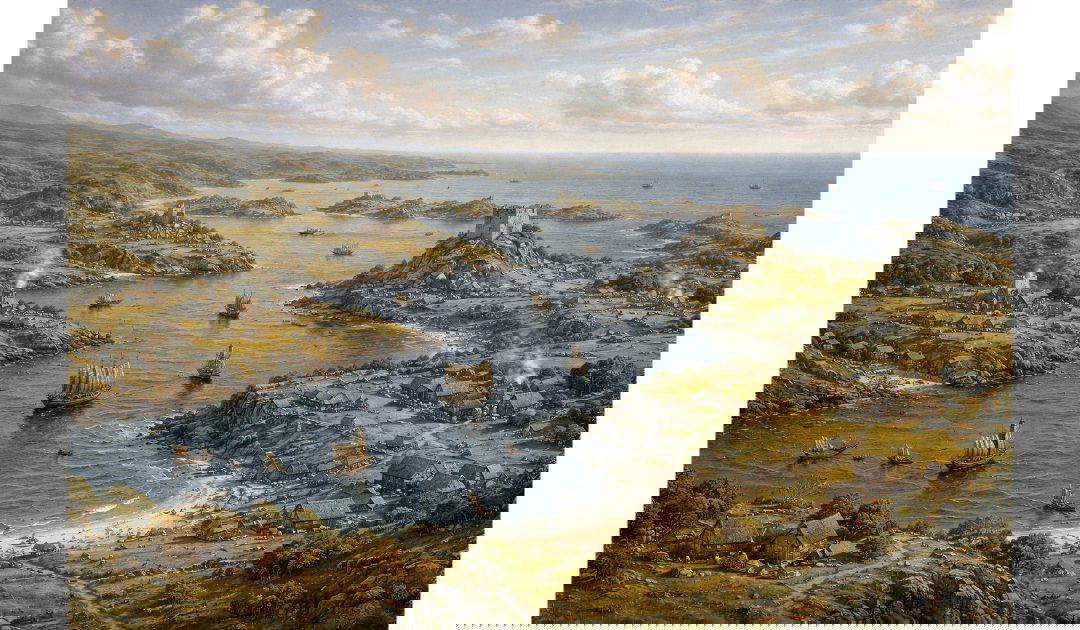
From around the late eighth century, Shetland entered a new and transformative phase with the arrival of Norse settlers. Vikings from Norway did not merely raid the islands but settled them extensively, displacing or absorbing the existing population. Shetland became firmly integrated into the Scandinavian world, a process evident in the complete replacement of the earlier language by Old Norse, from which the modern Shetland dialect partly descends. Place names across the islands—ending in -wick, -ness, and -firth—remain overwhelmingly Norse in origin.
By the ninth century, Shetland formed part of the Norwegian earldom of Orkney, ruled by Norse jarls who governed both island groups. Society revolved around farming, fishing, and seaborne trade, while Norse law and customs prevailed. Assemblies known as things were held to settle disputes, and Norse mythology shaped belief systems until the gradual spread of Christianity from the tenth century onward. Medieval Shetland was thus culturally Scandinavian rather than Scottish, with strong ties to Bergen and the Norwegian crown.
This Scandinavian identity persisted until the late Middle Ages. A decisive turning point came in 1469, when Christian I of Norway and Denmark pledged Shetland (along with Orkney) as security for the dowry of his daughter Margaret, who married James III of Scotland. The dowry was never paid in full, and in 1472 the Scottish Crown formally annexed the islands. Although sovereignty changed, daily life did so only slowly. Norse law lingered for decades, and many islanders continued to think of themselves as culturally distinct from Scotland.
Under Scottish rule, Shetland increasingly fell under the control of powerful landowners, often absentee lairds, who imposed rents and legal systems unfamiliar to the local population. By the seventeenth and eighteenth centuries, many Shetlanders were bound into systems of truck payment, paid in goods rather than cash, particularly through the fishing industry. Despite these pressures, the islands developed a resilient economy based on fishing, crofting, and maritime trade, with Dutch, German, and Scandinavian vessels regularly visiting Shetland waters.
The nineteenth century brought profound change. Population growth strained limited resources, leading to poverty and emigration, particularly to Canada, Australia, and New Zealand. At the same time, Shetland became deeply involved in the herring boom, when vast seasonal fisheries brought wealth and outside influence to the islands. Women played a vital role, gutting and packing fish in coastal stations, while improved transport gradually reduced Shetland’s isolation.
In the twentieth century, Shetland’s strategic location once again shaped its fate. During both World Wars, the islands served as naval and air bases, most notably through the “Shetland Bus” of the Second World War, which carried Norwegian resistance fighters and supplies across the North Sea under perilous conditions. In the late twentieth century, the discovery of North Sea oil transformed Shetland’s economy. The development of the Sullom Voe oil terminal brought jobs, infrastructure, and unprecedented local revenue, while careful political negotiation ensured that much of the benefit remained within the islands.
Today, Shetland balances modern life with a strong sense of heritage. Norse traditions are celebrated annually in Up Helly Aa, a dramatic winter fire festival featuring Viking costumes and a burning longship. Music, dialect, and storytelling reflect centuries of cultural blending. The history of the Shetland Isles is thus not merely a sequence of rulers and events, but a living narrative—one shaped by the sea, sustained by community, and defined by a proud identity forged at the edge of Europe.