
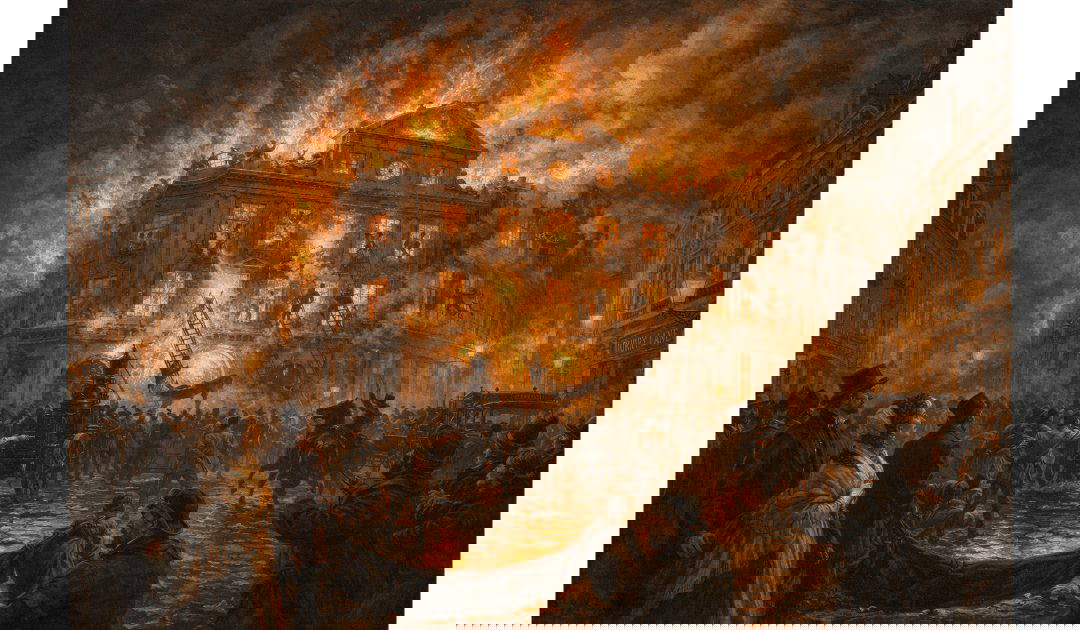
On the 24th of February, 1809, London’s Drury Lane Theatre burnt to the ground leaving its owner, Richard Brinsley Sheridan destitute. Sheridan was an immensely talented man, and it’s him rather than the theatre that I want to write about.
Sheridan was born in Dublin on the 30th of October, 1751, into a family deeply immersed in the arts. His father, Thomas Sheridan, was an actor, theatre manager, and elocutionist, while his mother, Frances Sheridan, was a successful novelist and playwright. The family moved to England when Richard was young, and he was educated at Harrow School, where he showed literary talent but little academic discipline. Unlike many of his contemporaries, he did not attend university, instead drifting toward literary London, sustained partly by family connections and his own formidable charm.
Sheridan’s early adulthood was shaped by romance and scandal. In 1772 he eloped twice with the celebrated singer Elizabeth Linley, daughter of the Bath composer Thomas Linley. Their marriage, though genuine and affectionate, was shadowed by Elizabeth’s ill health and by Sheridan’s increasingly reckless financial habits. Nevertheless, this period coincided with his meteoric rise as a dramatist.
Sheridan’s theatrical debut was sensational. The Rivals (1775), though initially a failure, was quickly revised and became a triumph. The play satirises the manners, pretensions, and romantic absurdities of fashionable society, introducing one of English comedy’s most enduring characters, Mrs Malaprop, whose misuse of language gave rise to the term “malapropism.” The wit of the dialogue, the deft plotting, and the affectionate mockery of social conventions immediately marked Sheridan as the heir to the Restoration comedy tradition, adapted to the more moral sensibilities of Georgian audiences.
His next major success, The School for Scandal (1777), secured his reputation as the greatest comic dramatist of his age. The play is a dazzling exposure of gossip, hypocrisy, and moral posturing, centred on the contrast between outward respectability and private vice. Characters such as Lady Sneerwell and Joseph Surface embody social corruption, while the famous “screen scene” remains one of the most perfectly constructed moments in English comedy. The play’s enduring popularity lies in its balance of brilliance and humanity: Sheridan condemns malice without abandoning sympathy for human weakness.
Sheridan’s third major theatrical achievement, The Critic (1779), turned satire inward, lampooning the pretensions of playwrights, critics, and audiences themselves. A meta-theatrical farce, it revealed Sheridan’s acute awareness of theatrical conventions and his confidence in mocking his own profession. Though he wrote other plays, including the operatic The Duenna (1775), it is these three comedies that form the core of his dramatic legacy.
Parallel to his literary career, Sheridan embarked on politics. In 1780 he entered Parliament as a Whig MP and soon became renowned as one of the finest orators of his generation. His speeches, particularly during the impeachment of Warren Hastings, Governor-General of India, were widely admired for their moral force and rhetorical splendour. Edmund Burke famously praised Sheridan’s eloquence, claiming it surpassed anything heard in Parliament before. Yet unlike his dramatic works, Sheridan’s political speeches were rarely preserved in full, contributing to the imbalance between his contemporary fame and his later reputation. He was Treasurer of the Navy from 1806 to 1807, just after the Battle of Trafalgar that must have been a prestigious post indeed.
Sheridan was also deeply involved in theatre management. He became part-owner of the Drury Lane Theatre, one of London’s most important stages. However, mismanagement, fires, and chronic debt plagued the venture. His finances deteriorated steadily, worsened by gambling, generosity to friends, and political expenses. The death of Elizabeth in 1792 further darkened his life, though he later remarried.
The final years of Sheridan’s life were marked by poverty and declining health. After losing his parliamentary seat and political influence, he retreated from public life. He died in London on 7 July 1816, heavily in debt. Despite this ignominious end, his funeral was attended by leading figures of British society, and he was buried in Westminster Abbey, a testament to the esteem in which his genius was still held.
Richard Brinsley Sheridan’s enduring significance lies in his comedies, which remain among the finest in the English language. Their wit, moral intelligence, and theatrical vitality continue to resonate, capturing the follies of human behaviour with elegance and compassion. Though his life was turbulent and his career uneven, Sheridan’s dramatic voice remains clear, incisive, and delightfully alive.