
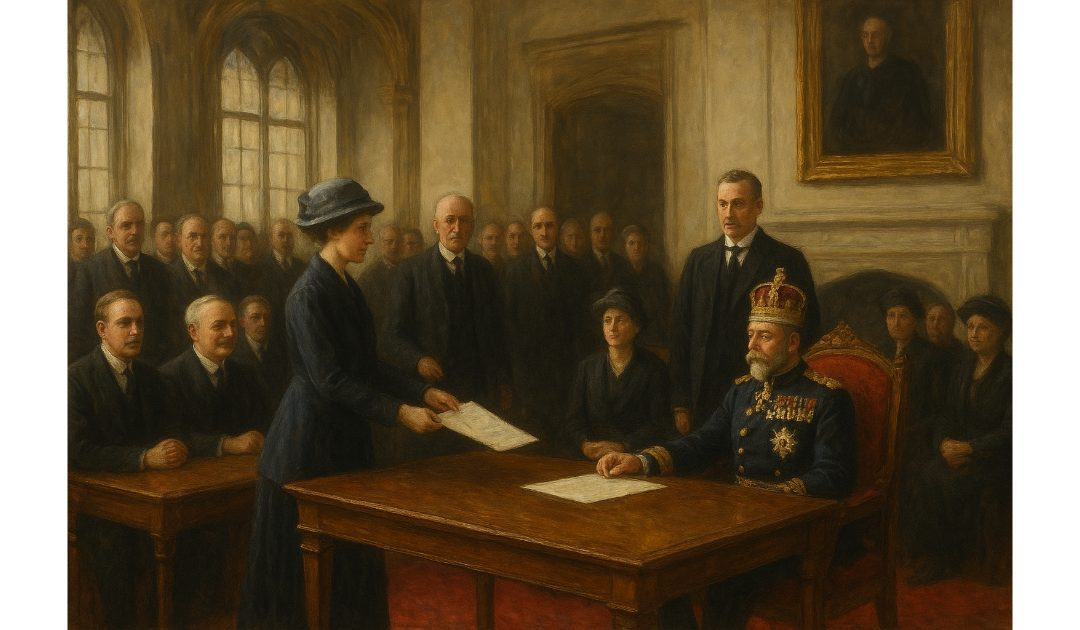
The Sex Disqualification (Removal) Act 1919 received royal assent on the 23rd of December, 1919. The Sex Disqualification (Removal) Act 1919 was landmark legislation in the United Kingdom that marked a profound shift in the legal recognition of women’s rights and their access to civic, professional, and public life. Passed in the wake of the First World War and the success of the suffrage movement, the Act sought to remove certain legal barriers that had previously excluded women from professions, public offices, and educational opportunities. While it represented a pivotal moment in the history of gender equality, it was far from a comprehensive solution, and many limitations and social barriers persisted in its wake.
Before the passage of the Act, women in Britain faced a wide array of legal and social restrictions. They were barred from practising in many professions, including law and the civil service, and from holding public office. While the Representation of the People Act 1918 had enfranchised many women over the age of 30, granting them a voice in the political system, there remained a sharp disparity between the rights given in principle and the realities of women’s social and professional exclusion. The Sex Disqualification (Removal) Act 1919 was intended to close some of these gaps.
The Act itself was relatively concise but had significant implications. Its primary achievement was to make it unlawful to disqualify a person from holding public office, exercising any civil or judicial function, or entering any profession or vocation on the grounds of sex or marriage. This meant that, for the first time, women could become magistrates, jurors, civil servants, and members of the legal profession. Previously, the common law, supported by judicial decisions, had often assumed that women were unfit for such roles; for instance, women had been barred from juries and were prevented from being appointed as magistrates or to other judicial posts.
One of the earliest and most symbolic impacts of the Act was the admission of women into the legal profession. The 1919 legislation cleared the way for women to be admitted to the Inns of Court and to practise as barristers and solicitors. In 1922, Ivy Williams became the first woman to be called to the English Bar, followed closely by Helena Normanton, the first female practising barrister. The Act also allowed women to serve as jurors, a crucial step in recognising their civic equality, although in practice the selection process often limited the number of women actually called to jury duty.
Politically, the Act facilitated the appointment of women to public office. In 1919, just months after the law passed, Ada Summers became the first woman magistrate, and in 1920, the first female mayors and councillors began to serve. This shift reflected broader societal recognition of women’s contributions, particularly in the context of the First World War, where women had taken on roles previously reserved for men, proving their competence and commitment to public service.
However, despite these achievements, the Sex Disqualification (Removal) Act 1919 was not an all-encompassing guarantee of equality. Crucially, it did not automatically dismantle the deep-seated social, institutional, and cultural obstacles that continued to limit women’s opportunities. Many professions technically opened by the Act remained dominated by men for decades to come, and informal discrimination persisted. For example, women in the civil service were still subject to the marriage bar for many years, meaning that married women were often required to resign from their posts. In the legal field, although the Act permitted entry, career progression was slow and marked by significant prejudice.
The Act also left untouched the issue of equal pay and economic parity. While women could now enter professions, they frequently did so on unequal terms, encountering wage gaps and fewer opportunities for advancement. Moreover, political representation for women remained limited even after the law’s passage, as the pool of women eligible for election was initially small due to existing voting restrictions. The Representation of the People (Equal Franchise) Act 1928, which equalised the voting age for men and women at 21, was necessary to build on the foundations laid by the 1919 legislation.
In terms of social change, the Act was both a legal milestone and a symbolic statement, but it relied on broader societal acceptance to fulfil its potential. The opening of doors to professions and public offices did not immediately lead to parity in numbers or influence. Cultural attitudes about women’s roles in the home, workplace, and politics continued to shape the pace of progress. The legislation was, therefore, a first step in a much longer journey toward gender equality.
Before you protest, I know that the sovereign doesn’t physically sign acts of parliament at royal assent. I use Chat GBT to produce images because I’m not a great painter, and Chat GBT is still far from perfect.